HSE, SCR and 3 Pickup Phases for UK Container Pin Release

A container pin release is the removal of twistlocks or stacking pins that lock a container to a chassis, trailer bed, or the unit beneath it, freeing it for lifting or road transport. UK terminals authorise that release two ways: the long-standing PIN code system, and the newer Secure Container Release (SCR) digital platform now spreading across ports. Both sit under HSE oversight and the Freight Containers (Safety Convention) Regulations 2017, which make plating, maintenance, and safe handling a legal duty, not a courtesy.
TL;DR:
- PIN codes are still the primary method of container release in the UK, but SCR digital transfer is increasingly being adopted, reducing fraud risks.
- Most delays occur at the initial authorization stage due to unresolved PIN or SCR onboarding issues, making early registration crucial.
- Handling jammed twistlocks requires a controlled sequence: make the area safe, attempt mechanical release, and escalate to specialist help if needed, avoiding improvised fixes.
- Containers must have a valid CSC plate and pass routine inspections for corrosion, deformation, or damage to ensure smooth pin releases.
- Hauliers should verify release authorization before dispatch, photograph any defects on arrival, and use GPS tracking to manage delays and coordinate quick escalation.
Table of Contents
- What container pin release means in UK terminal practice
- Safety, PPE and your regulatory duties for release operations
- Terminal authorisation: PIN codes and Secure Container Release explained
- Freeing jammed or stuck pins: the approved escalation route
- Inspection and maintenance that keeps pins releasing cleanly
- A haulier’s pickup checklist for UK container collections
- Digitisation is shifting risk, not removing it
- How Jagelo Haulage handles secure container collections
- Sources
- FAQ
What container pin release means in UK terminal practice
Twistlocks and stacking pins engage the ISO corner castings at each corner of a container, the standardised steel fittings that let boxes stack safely on vessels, chassis, and in yards. A twistlock rotates a quarter turn to lock into the casting; a stacking pin simply drops into the aperture and relies on gravity and container weight to hold position. Manual (non-locking) twistlocks are released by hand or bar; semi-automatic and fully automatic types release via a lever or remote trigger from ground level, which matters for reach-stacker and straddle-carrier operators working at height.
The practical release sequence at most UK ports runs in a fixed order:
- Authorised arrival — the haulier’s vehicle booking and container release entitlement (PIN or SCR transfer) are validated at the gate or via the terminal’s system before the vehicle proceeds.
- Gate and yard check — the driver or yard operative confirms container number, seal integrity, and visible condition against the booking reference.
- Crane or handler interaction — a straddle carrier, reach stacker, or quay crane lifts or positions the box; twistlocks disengage as the lifting frame takes the load off the corner castings.
- Final pin removal — remaining stacking pins or chassis twistlocks are released by hand once the container is seated and stable, clearing it for road movement.
Tools rarely go beyond a lever bar, a mallet for corroded pins, and the crane’s own locking mechanism, though certified clamps come into play when something jams (more on that below). Delays cluster at step one, where an unresolved PIN or an SCR onboarding gap stops the vehicle before it even reaches the stack. Getting authorisation sorted before the truck arrives at the gate, rather than at it, remains the single biggest time saver in the whole sequence.
Safety, PPE and your regulatory duties for release operations
Every freight container used in Great Britain with top corner fittings and a floor area of at least 7 square metres must carry a valid CSC safety approval plate and stay in efficient working order, inspected under an approved continuous examination scheme (ACEP or PES). That duty sits with the owner or lessee, not the haulier collecting the box, though anyone releasing pins on a defective unit shares the risk if they proceed regardless.
The Freight Containers (Safety Convention) Regulations 2017 set out the legal framework behind that plate: approval arrangements, maintenance obligations, and the examination schemes that keep a container legally fit to move. HSE also maintains a list of bodies authorised to approve container designs and run examination schemes, including names such as Lloyd’s Register Verification Limited, DNV, and Bureau Veritas UK.
Port Skills & Safety guidance (SiP003) translates that legal floor into gate-level practice:
- High-visibility clothing, safety footwear, and hand protection when handling twistlocks or stacking pins.
- Correct positioning away from suspended loads and crane swing radius during release.
- Never standing beneath a container while its locking mechanism is engaged or being freed.
- Reporting any twistlock that will not disengage cleanly rather than forcing it.
Statistic to note: HSE’s plating requirement applies specifically to containers with top corner fittings and a minimum 7 square metre base, a threshold worth checking before assuming a smaller or non-standard unit is exempt from CSC plating rules.
Responsibility splits three ways in practice. The owner or lessee keeps the container plated and maintained; the terminal controls safe access and lifting; the haulier checks visible condition at the gate and flags anything that looks wrong before pins are touched. Any container with a bent corner casting, missing plate, or visibly deformed twistlock housing should come out of service for inspection, not get forced through a release.
Terminal authorisation: PIN codes and Secure Container Release explained
PIN codes remain the default authorisation method at most UK terminals today. A shipping line or freight forwarder issues a numeric code tied to a specific container and booking; the haulier presents that code at the gate or portal, and the terminal releases the unit once it matches. It works, but the code travels between multiple parties by email, text, or phone, which creates room for PIN sharing and fraud that carriers have spent years trying to close down.
Hapag-Lloyd’s Secure Container Release (SCR) replaces that visible code with a digital entitlement transfer. Hauliers onboard through an invitation, set up an ID-wallet, and manage release rights through a dashboard at app.securecontainerrelease.com. The carrier confirms it has announced UK implementation after large-scale prior rollout in Rotterdam and Antwerp, and states that PIN codes stop working for a given shipment once onboarding is complete.
What this means for your operation:
- Register for SCR onboarding now if you move Hapag-Lloyd boxes regularly. Delaying it just pushes friction to a busier week later.
- Expect a mixed environment for some time. Not every carrier or vendor runs SCR yet, so drivers and planners need to handle both PINs and digital transfers side by side.
- Build the ID-wallet step into your compliance workflow alongside existing checks covered in a container transport compliance checklist.
- Treat SCR’s audit trail as an asset, not admin. A logged, timestamped transfer of release rights protects you if a dispute arises over who authorised a collection.
Pro Tip: Onboard your admin team to SCR before your drivers need it at the gate. A dashboard nobody can log into on a Friday afternoon causes more delay than the PIN system it replaces.
Freeing jammed or stuck pins: the approved escalation route
A jammed twistlock is not a problem to solve with a bigger hammer. The correct sequence, drawn from Port Skills & Safety guidance, runs as follows:
- Make the area safe — stop the lift, remove hoist tension from the fitting, and clear anyone from beneath or beside the container.
- Try controlled mechanical release — limited crane movement, a hand lever, or a certified twistlock clamp can often free a stuck fitting without further force. Any clamp used must show a valid safe working load rating and current certification before it touches the fitting.
- Escalate to hot work only when necessary — burning out a fitting requires a formal permit-to-work, sign-off from the vessel master where relevant, and fire prevention measures including a fire watch and extinguishing equipment on standby.
- Call specialist assistance if the above steps fail, and log the incident, including photographs, time, location, and who authorised each step taken.
Resist any ad-hoc workaround. Guidance is explicit that jam incidents are prevented through formal permit-to-work and vessel approvals, not improvised fixes at the quay.
Inspection and maintenance that keeps pins releasing cleanly
Most release failures trace back to a fitting nobody checked properly beforehand. During PES or ACEP inspections, and at routine gate checks, examiners look at corner castings for deformation, corrosion around the aperture, and cracking at weld points. Twistlocks get checked for worn threads, seized rotation, and bent locking cams that stop a clean quarter-turn release.
Typical maintenance triggers include:
- Visible corrosion reducing metal thickness at the casting aperture.
- Any deformation that stops a twistlock seating or rotating fully.
- Worn or stripped threads on manual twistlock housings.
- A missing, damaged, or illegible CSC plate.
Every one of those defects ties back to the container’s legal approval status. A unit failing inspection loses its right to move under the CSC scheme until repaired and re-plated, which is why hauliers should record condition at every gate acceptance, not just rely on the terminal’s own checks.
A haulier’s pickup checklist for UK container collections
Getting release right starts before the truck leaves the yard. Jagelo Haulage builds every collection around three phases.
- Pre-arrival — confirm release authorisation (SCR transfer or PIN), booking reference, and container plating status before dispatch. A driver arriving without a valid authorisation just queues and burns fuel.
- On arrival — verify identity at the gate, visually check corner castings and twistlock accessibility, and photograph any defect immediately rather than after the fact.
- If release fails — secure the scene, notify terminal operations and the carrier without delay, and follow your company’s escalation and tracking procedure rather than waiting it out.
Steps like these sit alongside routine container seal checks most drivers already run at collection, and pairing the two habits catches most problems in one pass.
Pro Tip: Keep a live contingency contact list for every terminal and carrier you deal with regularly. When a pin won’t release at 6am, a named contact beats a generic switchboard number every time.
Jagelo Haulage’s fleet runs GPS tracking across its vehicles, which means a stalled release shows up on the dispatch board in minutes rather than being discovered when a driver finally calls in. Combined with 24/7 support from a haulier who already knows the terminal’s quirks, that visibility turns a stuck pin from a lost afternoon into a managed delay.
Digitisation is shifting risk, not removing it
SCR fixes a real problem. PIN sharing has always been the soft underbelly of container release, and a system that logs exactly who transferred what to whom closes that gap properly. Hauliers who onboard early will see fewer disputes over who authorised a collection and cleaner audit trails when something goes wrong.
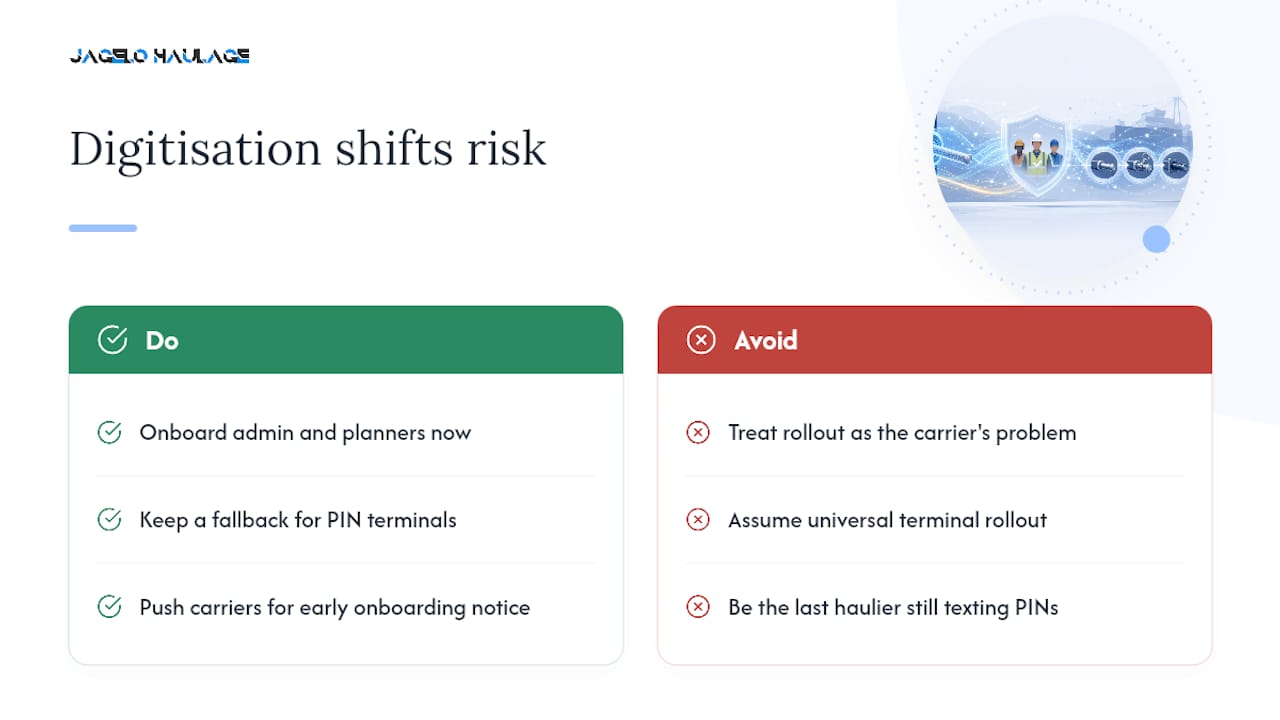
The friction nobody talks about enough is the mixed-fleet reality. For the next few years, drivers will carry both a PIN habit and an SCR login, and the businesses that get caught out are the ones that treat this as the carrier’s problem rather than their own operational one. Three things matter for fleet readiness: onboard your admin and planning staff to SCR now, not when a carrier forces the issue; keep a fallback process for legacy PIN terminals rather than assuming universal rollout; and push your regular carriers for early notice of onboarding deadlines so you are not the last haulier still texting for a code.
Terminal and carrier collaboration is the piece most likely to determine whether SCR reduces gate delays or briefly makes them worse. A digital system only speeds things up if the terminal’s own gate software talks to it cleanly, and that integration work is still catching up in places.
— Vytautas
How Jagelo Haulage handles secure container collections
Jagelo Haulage runs container haulage across major UK ports, with a fleet equipped to handle common release issues. Vehicles may be monitored to help identify delays promptly.
Where PINs and SCR sit side by side at a terminal, both methods are managed during the booking and release process. If a fitting jams or a release fails, escalation procedures involve informing relevant parties while prioritizing safety and compliance. For hauliers wanting a partner who already understands terminal-specific quirks across major UK ports, our guide to container haulage across major UK ports covers coverage and capacity in more detail, and businesses running road freight software alongside haulage may find value comparing notes with a transport management system built for road freight.
Get in touch through the Jagelo Haulage site for a quote on your next port collection, with 24/7 support ready when a release does not go to plan.
Sources
- Freight container safety - HSE
- The Freight Containers (Safety Convention) Regulations 2017
- Secure Container Release implementation in the United Kingdom - Hapag-Lloyd
- Safety in ports guidance (SiP003) - Port Skills & Safety
FAQ
What is a container pin release?
It is the act of removing twistlocks or stacking pins from a container’s corner castings, freeing it from a chassis, trailer, or stack for lifting or transport.
Is SCR replacing PIN codes at all UK terminals?
Not yet universally. Hapag-Lloyd has confirmed UK implementation of SCR, but PINs remain in use elsewhere, so hauliers should expect a mixed environment for now.
What should I do if a twistlock jams on collection?
Make the area safe, remove hoist tension, and attempt controlled mechanical release with certified equipment before considering hot work, which requires a formal permit-to-work.
Who is legally responsible for container maintenance and plating?
The owner or lessee holds that duty under the Freight Containers (Safety Convention) Regulations 2017, though hauliers should still flag visible defects at the gate.
How does Jagelo Haulage handle release delays?
Jagelo Haulage tracks every vehicle by GPS, so a stalled release or authorisation issue is visible on the dispatch board immediately, allowing the operations team to escalate with the terminal or carrier without waiting for a driver call.