Part of our guide to container haulage from Southampton
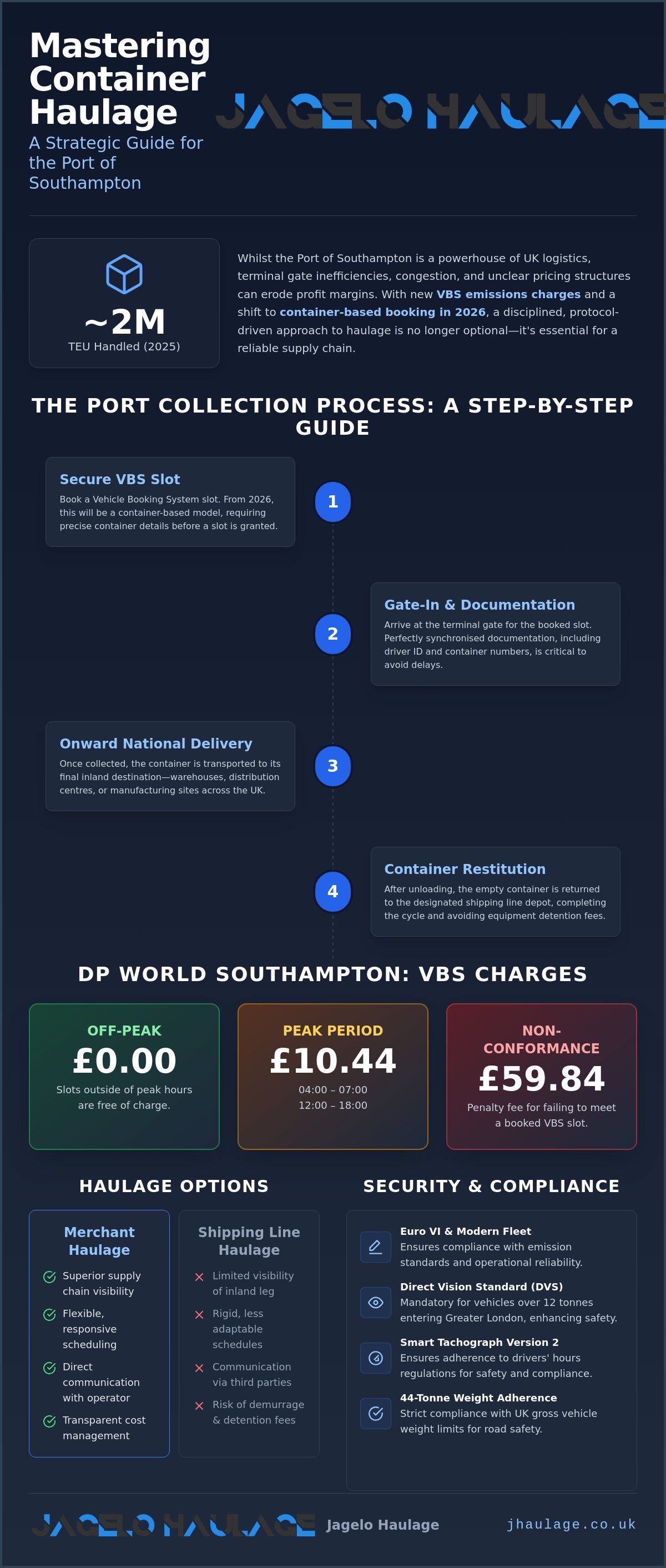
In 2025, the Port of Southampton handled approximately 2 million TEU, yet the efficiency of these movements often breaks down at the terminal gate. With DP World Southampton introducing new VBS emissions charges and a shift to container-based booking in 2026, the logistical landscape demands a higher level of operational discipline. You likely recognise that port congestion and unclear pricing structures can quickly erode your profit margins. It's difficult to maintain a reliable supply chain when operators fail to communicate or lack the fleet capacity to handle peak period demands.
This guide offers a comprehensive strategy for managing container haulage Southampton, ensuring your cargo reaches its inland destination on time and within a transparent cost framework. We'll explore how a partnership with a protocol-driven haulage contractor helps you navigate updated port fees and mandatory Smart Tachograph Version 2 regulations whilst maintaining seamless port collections. By focusing on functional reliability and masterfully executed fundamentals, you can transform your port transport from a source of stress into a secure, strategic asset.
Key Takeaways
- Navigate the 2026 VBS updates at DP World Southampton to prevent terminal delays and manage rising operational costs effectively.
- Compare the benefits of merchant container haulage Southampton against shipping line options to gain superior visibility over your inland supply chain.
- Ensure cargo security by partnering with operators who maintain a modern fleet compliant with Euro VI and Direct Vision Standard requirements.
- Overcome peak period capacity constraints by establishing a relationship with a disciplined contractor that prioritises functional reliability.
- Implement a solution-oriented approach to logistics that focuses on on-time national delivery and transparent cost management.
Container Haulage from Southampton: A Strategic UK Gateway
Container haulage involves the professional movement of shipping containers via road from maritime terminals to their final inland delivery points. For many businesses across the United Kingdom, the Port of Southampton serves as the primary entry point for global trade. Its status as a deep-sea hub allows it to accommodate the world's largest container vessels, making it a cornerstone of national logistics. Efficient container haulage Southampton is essential for maintaining the flow of goods from these massive vessels to warehouses, distribution centres, and retail hubs across the country. Without a disciplined road transport strategy, the advantages of maritime speed are quickly lost at the terminal gate.
The Role of the Port of Southampton in National Logistics
The terminal at DP World Southampton handled approximately 2 million TEU in 2025. This volume highlights the port's immense capacity and its strategic value to the UK economy. Located on the south coast, the port provides a direct route to the Midlands and the North via the A34 and M3 corridors. National businesses prioritise this gateway because it facilitates rapid transit to major industrial centres, often bypassing the congestion found at other eastern ports. Professional haulage contractors act as the vital link in this process. They ensure that once a container is discharged from a vessel, it doesn't sit idle on the quayside. Their role is to maintain the fluidity of the supply chain through disciplined scheduling and the precise execution of port collections, which prevents the accumulation of costly storage fees.
Key Container Types and Transport Requirements
Most operations involve standard 20ft and 40ft ISO containers. These units carry everything from raw materials to high-value consumer electronics, requiring a versatile approach to transport. Moving these containers safely requires specialised equipment, specifically skeleton trailers designed to secure the weight and dimensions of the load. In the UK, the standard maximum gross vehicle weight for a 6-axle articulated lorry is 44 tonnes. Adhering to these weight limits whilst maintaining delivery schedules requires a high level of operational expertise. A professional partner like Jagelo Haulage utilises a modern fleet of over 40 trucks to ensure these units are moved according to strict road safety protocols. Container haulage is the disciplined road transport of shipping containers from port terminals to inland destinations, serving as the critical link in a reliable port-to-door supply chain.
Navigating Port Logistics and Vehicle Booking Systems
Managing container haulage Southampton requires more than just vehicle availability; it demands a deep understanding of terminal operational protocols. Efficient logistics management prevents the accumulation of demurrage and detention charges. These costs accrue when containers remain at the port beyond their agreed free-time allowance. Professional hauliers mitigate these risks through disciplined scheduling and real-time communication. By monitoring vessel arrival data and terminal status via the Southampton Port Authority, operators can anticipate potential delays and adjust booking slots accordingly. This proactive approach ensures that your cargo moves as soon as it's cleared for release.
The Step-by-Step Port Collection Process
Securing a Vehicle Booking System (VBS) slot is the first critical step in the collection process. In 2026, DP World Southampton transitioned to a container-based booking model, meaning hauliers must have precise container details before a slot is granted. Peak booking periods, specifically between 04:00–07:00 and 12:00–18:00, carry a £10.44 fee, whilst off-peak slots remain free of charge. Failing to meet a booked slot results in a £59.84 non-conformance charge, which can quickly impact the profitability of a shipment. Once at the gate, documentation must be perfectly synchronised. Any mismatch in driver ID or container numbers leads to immediate gate-out delays. Finally, restitution involves returning the empty unit to the designated shipping line depot, a task that requires careful coordination to avoid equipment detention fees.
Optimising Delivery Schedules for National Distribution
Balancing terminal congestion with inland delivery windows is a masterclass in timing. Modern fleet management software allows dispatchers to track vehicles in real time, ensuring that drivers arrive at the terminal exactly when their slot opens. Precise VBS slot management directly impacts on-time delivery rates by eliminating avoidable waiting times at the port. This level of coordination is essential for national distribution, where a thirty-minute delay at the port can result in a missed delivery window in the Midlands or the North. If you require a partner that understands these technical requirements and prioritises functional reliability, you can request a haulage quote for your next shipment. Our team focuses on the fundamentals of port transport to ensure your cargo remains on schedule.
Merchant Haulage vs Shipping Line Haulage at Southampton
Choosing the right model for container haulage Southampton is a critical decision for freight forwarders and cargo owners. The two primary methods are merchant haulage and shipping line haulage. Each approach offers distinct advantages depending on the complexity of your supply chain and the level of control required over the inland journey. Understanding these differences allows you to manage costs more effectively and ensure that your national logistics operate with the necessary discipline. Whilst both models result in the physical delivery of goods, the operational execution varies significantly.
The Strategic Benefits of Merchant Haulage
Merchant haulage occurs when the merchant or their freight forwarder arranges the inland transport independently of the ocean carrier. This model is frequently favoured by national operators who require high levels of performance and reliability. By selecting a dedicated contractor, you gain the flexibility to choose an operator based on their specific port expertise and fleet capacity. This choice provides enhanced visibility of the container’s journey from the quayside to the final destination. It allows you to vet the haulier directly, ensuring they possess the 15+ years of industry experience required to handle complex port protocols.
A specialist partner like Jagelo Haulage provides the professional oversight needed to navigate terminal requirements. This level of control is often missing in shipping line models where your cargo is one of thousands in a carrier’s vast system. For a deeper analysis of these choices, you can read our Merchant Haulage vs Shipping Line Haulage: A Strategic Comparison.
When to Choose Shipping Line Haulage
Shipping line haulage, or carrier haulage, simplifies the logistics process by making the ocean carrier responsible for the "last mile" delivery. This model offers a single point of contact and can be easier to manage for businesses with less complex inland requirements. However, you often trade operational control for this simplicity. Carriers may prioritise their own equipment repositioning over your specific delivery windows, which can lead to unpredictable arrival times at your warehouse or distribution centre.
Transitioning from line haulage to merchant haulage is a common strategy for businesses looking to improve delivery performance. It allows for more precise scheduling and a more responsive relationship with the driver and dispatcher. Regardless of the chosen model, all equipment must adhere to strict UK container safety regulations regarding maintenance and structural integrity. Jagelo Haulage supports both frameworks by providing a modern fleet of over 40 trucks and trailers, ensuring that every container movement is executed with functional reliability and professional discipline.
Ensuring Security and Compliance in National Transport
Professional container haulage Southampton requires a disciplined approach to regulatory compliance and vehicle maintenance. Security is not a passive state; it's the direct result of strict operational protocols and a commitment to the fundamentals of road safety. National operators must ensure that every link in the supply chain adheres to the latest safety standards to prevent transit delays or financial penalties. This rigorous commitment to compliance protects the cargo and ensures the physical integrity of the goods during their journey across the UK road network. A haulage partner that prioritises these standards provides a level of security that smaller, less disciplined operators cannot match.
Fleet Standards and Environmental Compliance
Maintaining a modern fleet of over 40 trucks is essential for ensuring functional reliability and reducing the risk of mechanical breakdowns. Older vehicles often struggle to meet the stringent requirements of modern logistics hubs and urban clean air zones. For instance, as of July 2026, DP World Southampton utilises a VBS Emissions Charge to incentivise the use of lower-emission transport. Under this system, Euro VI E HGVs are exempt from these charges, whilst Euro VI A, B, and C models incur a £9.50 fee per visit. This cost management is a vital component of a transparent pricing structure.
Operating a compliant fleet is also a strategic necessity for national distribution. Vehicles entering Greater London must comply with the Direct Vision Standard (DVS) to ensure driver visibility and pedestrian safety. Failing to meet a minimum three-star rating or equipping a Progressive Safe System results in a £550 Penalty Charge Notice. You can learn more about how equipment choice affects your logistics in our guide to The Modern Container Transport Fleet: A Strategic Guide.
Cargo Security and Risk Management
Cargo security involves a comprehensive risk management strategy that includes driver training and robust insurance coverage. All professional drivers must hold a valid Driver Certificate of Professional Competence (CPC) and undergo regular training to handle the specific demands of containerised transport. This expertise ensures that high-value goods are managed with the necessary care and professionalism from the moment they leave the terminal. Disciplined drivers follow established routes and utilise secure parking facilities to mitigate the risk of theft or tampering during transit.
Comprehensive insurance is another pillar of a secure operation. Professional hauliers maintain substantial Goods in Transit and Public Liability insurance to protect against unforeseen events. This level of protection provides necessary security for freight forwarders and cargo owners alike. Before any vehicle departs from the terminal, drivers perform a comprehensive safety check to ensure the container is properly seated on the skeleton trailer and all twistlocks are correctly engaged. If you value this level of operational discipline, you can request a quote for secure container transport to safeguard your next shipment.
Selecting a Professional Partner for Southampton Haulage
Selecting a partner for container haulage Southampton is a strategic decision that determines the stability of your supply chain. It requires a move away from transactional service providers toward partners that offer functional reliability and professional discipline. A disciplined haulage contractor doesn't just perform a task; they provide a protected outcome for your cargo. You need a partner that understands the high stakes of the UK supply chain and possesses the fleet capacity to maintain consistency during peak operational periods. Reliability is built on the mastery of fundamentals, not on marketing promises.
Criteria for Evaluating Haulage Contractors
Evaluating a contractor for container haulage Southampton requires a focus on their operational fundamentals. You must assess whether a provider possesses the fleet capacity to absorb peak demand whilst maintaining the punctuality required for national distribution. A company with 15+ years of industry experience understands the nuances of terminal protocols and can anticipate delays before they impact your schedule. This local port knowledge is only valuable when paired with a national delivery infrastructure. You should look for a partner that views logistics as a strategic outcome rather than a series of physical tasks. For more detailed guidance, read our article on how to choose a reliable container haulage company.
Responsiveness is another critical metric. In the fast-moving environment of port transport, the ability to handle emergency transport needs without compromising on safety or compliance is vital. A professional partner maintains a clear line of communication between their dispatch team and your logistics managers, ensuring that you are always informed of your container's status. This transparency builds trust and allows for better planning at your inland distribution centres.
The Jagelo Haulage Commitment to Excellence
Jagelo Haulage operates with a clear focus on functional reliability and professional discipline. Our modern fleet of over 40 trucks and trailers ensures that your cargo is moved safely and in full compliance with UK road regulations. We specialise in both merchant and shipping line haulage, providing a seamless link between the quayside and your inland destination. Our reach extends across major UK maritime hubs, including Southampton, Felixstowe, and London Gateway. This broad operational footprint allows us to integrate into your existing supply chain as a dependable strategic partner.
Our no-nonsense approach prioritises the security and efficiency of your operations above all else. We don't attempt to be disruptive; instead, we position ourselves as masters of the fundamentals. Every movement we execute is governed by strict protocols to ensure your cargo arrives on time and in perfect condition. We take stoic pride in our ability to provide protected outcomes for our clients, ensuring that your logistics remain a strength rather than a liability. Contact Jagelo Haulage for a professional container haulage quote to secure your next national delivery.
Strategic Security for Your National Supply Chain
Managing the movement of goods from the quayside to an inland destination is a technical challenge that requires operational discipline. Effective container haulage Southampton depends on a contractor's ability to navigate terminal protocols, manage VBS slot timing, and maintain a compliant, modern fleet. By prioritising functional reliability over generic marketing claims, you ensure your cargo moves through the supply chain without avoidable delays or hidden costs. We don't just provide transport; we deliver a strategic outcome that strengthens your broader operational framework.
Jagelo Haulage provides the professional oversight necessary to secure your national logistics. We utilise over 15 years of port logistics experience and a modern fleet of more than 40 trucks to deliver consistent results from all major UK maritime hubs, including Southampton and Felixstowe. Our team focuses on the masterly execution of fundamentals to protect your cargo and your profit margins. You can request a professional container haulage quote from Jagelo Haulage to begin a strategic partnership rooted in competence and trust. We look forward to supporting your national distribution requirements with the precision your business deserves.
Frequently Asked Questions
How much does container haulage from Southampton cost?
The cost of container haulage depends on variables such as delivery distance, container weight, and current fuel surcharges. Operational fees at DP World Southampton, including VBS charges and the ISPS fee, also influence the final total. We provide bespoke quotes tailored to these specific requirements to ensure transparent cost management for our clients. Requesting a specific quote allows for accurate budgeting based on your unique inland destination.
What is the difference between merchant and shipping line haulage at Southampton?
Merchant haulage allows you to appoint an independent contractor for container haulage Southampton, giving you direct control over scheduling and communication. Shipping line haulage is a service where the ocean carrier manages the inland journey. Many freight forwarders prefer the merchant model because it offers enhanced visibility and the ability to secure dedicated fleet capacity during peak periods. This choice often leads to more reliable delivery windows.
Can Jagelo Haulage provide same-day container delivery from the port?
We focus on disciplined, pre-planned scheduling to maintain the highest levels of functional reliability for our clients. Whilst we don't offer a guaranteed same-day service, our dispatch team works to accommodate urgent requests where fleet capacity and VBS slot availability permit. Our priority is ensuring that every movement is executed safely and in full compliance with port protocols to prevent transit delays.
Does your fleet meet the Direct Vision Standard for London deliveries?
Yes, our modern fleet is fully compliant with the Direct Vision Standard (DVS) for operations within Greater London. We ensure our vehicles meet the required safety ratings or are fitted with Progressive Safe Systems to maintain lawful access to the capital. This commitment to compliance protects your cargo from avoidable Penalty Charge Notices and ensures that national distribution routes remain efficient and uninterrupted.
What ports do you serve in addition to Southampton?
In addition to Southampton, we provide professional haulage services from other major UK maritime hubs, including Felixstowe and London Gateway. Our operational reach allows us to support nationwide operators with a consistent level of discipline across the country's primary entry points. This multi-port capability enables our clients to consolidate their logistics requirements with a single, reliable partner that understands the nuances of each terminal.
How do you manage VBS slots at DP World Southampton?
We utilise the terminal's container-based booking system to secure VBS slots that align with your delivery requirements. Our team monitors live port data and vessel arrival times to anticipate potential congestion and adjust bookings accordingly. This proactive management helps us avoid non-conformance charges and ensures that our drivers enter the terminal during their allocated windows. This disciplined approach is vital for maintaining on-time national delivery.
Are all your container movements fully insured?
All container movements managed by our fleet are protected by comprehensive Goods in Transit and Public Liability insurance. We recognise that high-value cargo requires robust protection, and our insurance coverage is designed to provide financial security against unforeseen events. This level of protection is a fundamental part of our commitment to providing a secure, professionally managed transport service for every client we serve.
What container sizes can your fleet transport?
Our fleet of over 40 trucks and specialised skeleton trailers is equipped to transport standard 20ft and 40ft ISO containers. We handle these units with a focus on safety and structural integrity, ensuring every load is correctly secured for transit. Our equipment is maintained to support the 44-tonne maximum gross vehicle weight, allowing us to move a diverse range of cargo types across the UK road network.