Five actions that clear goods through UK customs efficiently

Clearing goods through UK customs efficiently comes down to five actions: pre‑lodge your Customs Declaration Service (CDS) entry, get commodity codes and commercial invoice details right first time, hold a valid EORI with correct VAT treatment sorted, align your haulage arrival status with GVMS before the vehicle reaches port, and use Postponed VAT Accounting or a deferment account to remove payment friction. Each one removes a specific point of failure — for more details on freight types and timelines, see our UK freight shipping guide. Pre‑lodgement means HMRC has already reviewed your paperwork before the container touches UK soil. Accurate codes and invoice values stop the query that stalls everything else. The right VAT and EORI setup avoids rejected declarations. Matching arrival status prevents a “cleared” declaration sitting uselessly against a container the terminal thinks hasn’t arrived.
- Pre‑lodge your CDS declaration ahead of arrival
- Get commodity codes and invoice data right first time
- Hold a valid GB EORI with VAT treatment confirmed
- Match haulage/GVMS arrival status to your CDS entry
- Use Postponed VAT Accounting or a deferment account
Pro Tip: Brief your haulier with the exact CDS Movement Reference Number and confirm they’ll trigger GVMS arrival status the moment the vehicle books in. A mismatch here holds more containers than any documentation error we see.
Key Takeaways
Efficient UK customs clearance depends on pre‑lodging accurate CDS declarations, matching haulage arrival status to that declaration, and using PVA or deferment accounts to remove payment delays.
| Point | Details |
|---|---|
| Pre‑lodge everything | Submit your CDS declaration before arrival to use HMRC’s review window productively. |
| Get documents right first time | Accurate commodity codes and invoice values prevent the queries that cause most holds. |
| Match GVMS to CDS | Brief your haulier on arrival status to avoid terminal holds despite a cleared declaration. |
| Use PVA and deferment | Postponed VAT Accounting and duty deferment remove cashflow friction at the border. |
| Coordinate haulage tightly | A tracked partner like Jhaulage turns a cleared declaration into a fast, verified delivery. |
Table of Contents
- Step‑by‑step checklist from booking to release
- How to set up your business to submit import declarations
- What documents do you need ready before goods arrive?
- How do you submit an import declaration through CDS?
- Which tactics genuinely speed up clearance?
- What causes most customs delays, and how do you avoid them?
- How long does customs clearance actually take?
- Should you use a customs agent or handle clearance yourself?
- What does a typical sea container clearance timeline look like?
- Frequently asked questions
- Sources
Step‑by‑step checklist from booking to release
Work through this sequence and you’ll rarely be caught out.
- Pre‑arrival (set up): confirm your GB EORI, VAT registration status and record‑keeping process.
- Pre‑arrival (data): gather the commercial invoice, packing list, transport document, commodity codes and any licences.
- Pre‑arrival (declaration): pre‑lodge your import declaration in CDS, ideally before the vessel or vehicle departs.
- Pre‑arrival (safety data): submit the Entry Summary Declaration (ENS) so HMRC has the safety and security data in advance.
- At‑port: coordinate haulage collection and confirm GVMS arrival status matches your declaration.
- At‑port: respond promptly to any HMRC query via CDS messaging.
- Post‑clearance: settle or defer duty and import VAT, then file the transaction against your records.
Decide early whether simplified procedures suit your volume, and whether a broker should handle steps three and six on your behalf.
How to set up your business to submit import declarations
You cannot declare anything without a GB EORI number, and if you’re VAT registered, that status must be correctly linked to your declarations. HMRC requires import records kept for at least six years, so build that filing habit from your first shipment rather than retrofitting it later.
For paying duty and VAT, you’ve three realistic routes: a Duty Deferment Account (monthly settlement, smoother cashflow), direct payment per declaration, or letting your agent manage payments through their own account. Businesses moving regular volumes usually find deferment pays for itself in reduced admin.
If you’re declaring yourself, you’ll need CDS access and compatible declaration software — CDS doesn’t offer a simple web form for full declarations.
- Register for a GB EORI before your first shipment
- Confirm VAT treatment and set up record retention
- Choose a Duty Deferment Account if you import regularly
- Secure CDS access and third‑party authorisations if using an agent
Pro Tip: Run a test declaration before your first live shipment, and formally authorise any agent to use your CDS accounts in advance. Doing this on the day of arrival is how first shipments get stuck.
What documents do you need ready before goods arrive?
Every query HMRC raises traces back to one of a handful of documents. Get these right and most holds simply never happen.
| Document | Purpose | Common error |
|---|---|---|
| Commercial invoice | States value, origin, full product description | Vague description or understated value |
| Packing list | Confirms contents match the invoice | Mismatch with invoice quantities |
| Transport document | Bill of lading or airway bill proves shipment | Missing consignee details |
| Certificate of origin | Supports preferential duty rates | Wrong or absent certificate |
| ENS/safety data | Meets safety and security requirements | Submitted too late for the mode of transport |

Vague descriptions and mismatched values are the single biggest trigger for a documentary query, according to Logistics UK’s customs checklist. Fix these at the supplier end, not at the port.
For controlled goods, keep these ready too:
- Import or export licences for restricted items
- CITES permits for protected species products
- Strategic goods or dual‑use export licences
How do you submit an import declaration through CDS?
The direct answer: CDS is now the mandatory route for every UK import declaration, and you submit it either yourself through compatible software or via an agent acting as your declarant.
Get these fields right and the rest tends to follow:
- Correct commodity code from the UK Trade Tariff
- Accurate customs value and country of origin
- Valid EORI for both consignor and consignee
- Incoterms recorded correctly, since they affect who declares what
Pre‑lodge before arrival wherever possible, and set your arrival status correctly once the goods land. If HMRC needs supporting documents, CDS’s secure messaging lets you respond without a phone call to the National Clearance Hub.
Pro Tip: Keep an audit trail of every declaration and HMRC response. When queries repeat, that trail usually reveals which supplier or product line is causing them.
Which tactics genuinely speed up clearance?
Postponed VAT Accounting lets you declare and recover import VAT on your regular VAT return instead of paying it at the border, which removes a major cashflow bottleneck and cuts a step from the release process. Simplified declaration procedures and Authorised Economic Operator (AEO) status both reduce routine friction, though AEO takes time to earn and shifts some checks into post‑clearance reporting.
- Adopt Postponed VAT Accounting for import VAT
- Investigate simplified procedures if you import at volume
- Seek an advance tariff ruling for hard‑to‑classify goods
- Keep supplier invoices reconciled against declared values
Pro Tip: Pair a duty deferment account with a monthly reconciliation routine. Unpaid or mismatched duty is a quiet but common reason declarations get flagged for review.
What causes most customs delays, and how do you avoid them?
Most holds trace back to a short list of repeat offenders:
- Wrong commodity codes — verify against the UK Trade Tariff before shipping, not after a query lands.
- Undervaluation — reconcile invoice values against actual payment terms every time.
- Missing licences — check controlled‑goods status before booking transport.
- Inconsistent paperwork — standardise invoice and packing list templates across suppliers.
- Mismatched GVMS/CDS arrival status — brief your haulier on the exact reference before departure.
Pro Tip: A single standardised supplier template, checked automatically before submission, eliminates most of these errors before they reach CDS.
How long does customs clearance actually take?
HMRC’s documented benchmark: air, road and short‑strait roll‑on/roll‑off shipments typically clear within 2 hours of document submission. Marine documents received between 08:00 and 15:00 usually clear within 3 hours; anything submitted after 15:00 clears by 08:00 the next business day.
Those windows assume complete, accurate paperwork submitted within business hours, not around them. Beyond the declaration itself, cost drivers include customs duty, import VAT, agent fees, terminal handling charges, and demurrage if a container overstays free time at the terminal.
- Get valuation right first time to avoid duty disputes
- Use PVA to remove upfront VAT payment friction
- Run a Duty Deferment Account to smooth variable costs
Should you use a customs agent or handle clearance yourself?
Run through this before deciding:
- Volume — occasional imports rarely justify building in‑house CDS expertise.
- Commodity complexity — hard‑to‑classify goods benefit from specialist knowledge.
- Licence controls — controlled goods usually warrant professional handling.
- Cashflow needs — an agent’s deferment account can simplify payment timing.
If you appoint an agent, ask about their CDS access, track record at your specific ports, insurance cover, fee structure, who’s named as declarant, and their service‑level commitment on query response times. Retain rights to audit copies of every declaration filed on your behalf. Share your commercial invoice templates, EORI details and licence documents with them before the first shipment moves, not after it’s stuck.
What does a typical sea container clearance timeline look like?
A realistic sequence for a marine shipment:
- 7 to 14 days before arrival: pre‑lodge your CDS declaration with finalised documents.
- On vessel arrival: terminal registers the container; GVMS status must match CDS.
- Within 3 hours (business hours submission): HMRC documentary review, per the national clearance benchmark.
- After 15:00 submission: clearance typically follows by 08:00 the next business day.
- Post‑release: haulage collection and onward delivery.
Delays cluster at the documentary review stage when invoices are incomplete, so have your supplier’s paperwork finalised well before the vessel docks.
Practitioner perspective: why accuracy saves time and money
Poor data is the quiet cost centre of customs clearance. A vague product description or an unreconciled invoice value rarely stops a shipment outright, but it triggers the query that costs a day, and a day at a container terminal often means demurrage charges nobody budgeted for.
Systemising supplier documents and reconciling declared values against actual shipments isn’t glamorous work. It’s also the single control that separates businesses with predictable clearance times from those firefighting every week.
Coordinating haulage with customs clearance
A clean CDS declaration only gets goods released. Someone still has to move the container off the terminal before demurrage charges start eating into your margin, and that’s where haulage coordination decides whether your clean paperwork actually translates into a fast delivery.
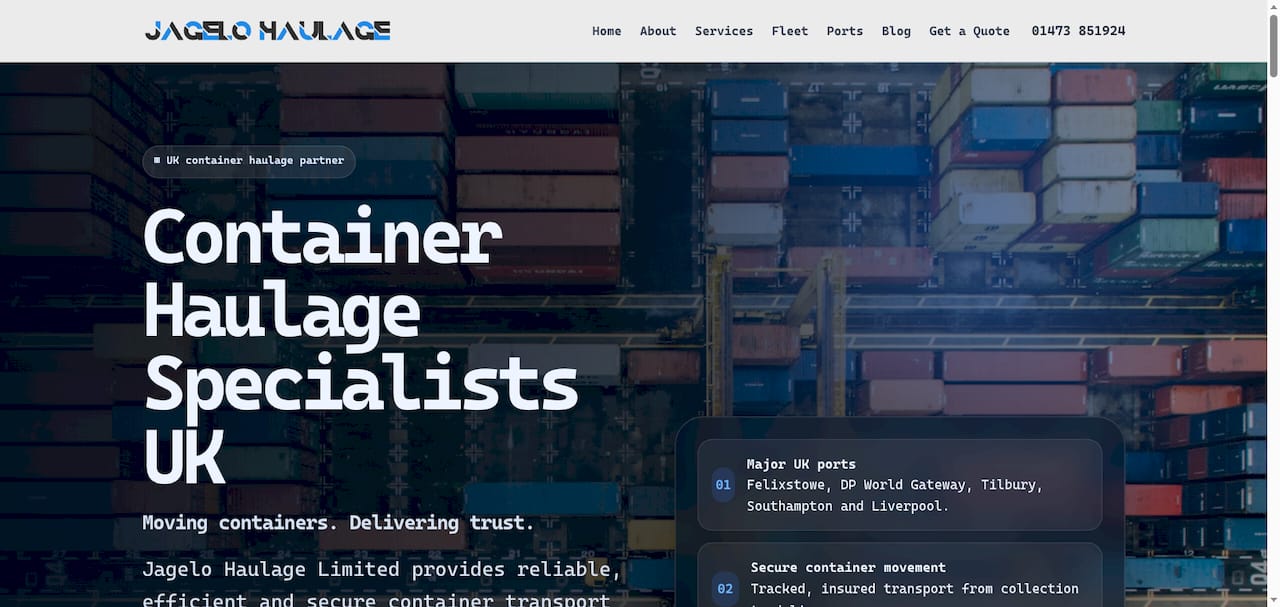
Jhaulage runs container haulage across major UK ports including Felixstowe, Tilbury, Southampton and Liverpool, with a fleet of over 40 GPS‑tracked trucks and trailers giving real‑time visibility on exactly where your container sits. That tracking data doubles as proof of arrival status when you’re reconciling GVMS against your CDS declaration, and 24/7 support means someone’s answering when a query lands outside office hours.
Practical benefits for clearance‑sensitive shipments include:
- Same‑day delivery once goods are released
- Port expertise across major UK terminals
- Secure handling for oversized and hazardous container loads
- Single point of coordination between consignee, agent and terminal
Pro Tip: Share your CDS Movement Reference Number with your haulier before the container arrives. It’s the fastest way to stop a terminal hold caused by mismatched arrival status.
Get in touch with Jhaulage to arrange tracked collection for your next container and keep your customs timeline intact from release to delivery.
Frequently asked questions
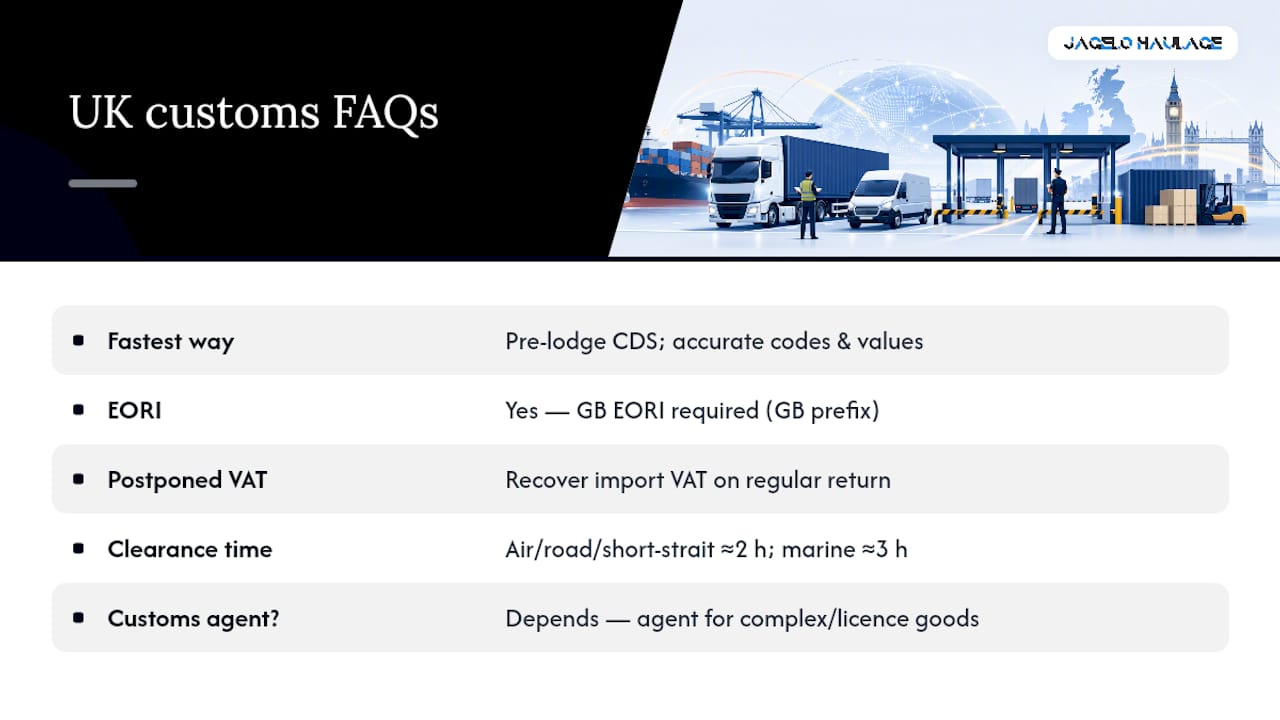
What is the fastest way to clear goods through UK customs efficiently? Pre‑lodge your CDS declaration before arrival, ensure commodity codes and invoice values are accurate, and match your haulage arrival status to the declaration so nothing stalls at the terminal.
Do I need an EORI number to import into the UK? Yes. Every importer needs a GB EORI number to submit declarations through CDS, and it must carry the GB prefix.
What is Postponed VAT Accounting and should I use it? PVA lets you declare and recover import VAT on your regular VAT return rather than paying it upfront, which most regular importers find improves cashflow significantly.
How long does UK customs clearance usually take? Air, road and short‑strait shipments typically clear within about 2 hours of document submission; marine shipments submitted during business hours usually clear within 3 hours, per HMRC’s guidance.
Should I appoint a customs agent or declare goods myself? It depends on shipment volume, commodity complexity and internal resource. Complex or licence‑controlled goods usually benefit from an agent’s CDS experience and established relationships at your ports.
This article is general information, not a substitute for advice from a qualified financial advisor. Consult a qualified financial professional about your own circumstances before acting on anything here.