Fleet Managers: First 90 Days of AI Route Optimisation in Logistics

AI route optimisation is a production-ready tactic that delivers measurable savings for fleets, provided it is modelled correctly and integrated with your existing systems. Fleets that deploy it properly report meaningful reductions in miles driven and fuel burn, alongside stronger on-time performance. The gains depend entirely on how well the system models real operational constraints, not just distance, and on running a disciplined pilot before scaling.
TL;DR:
- Correct modeling of real operational constraints and high-quality data feeds are critical for AI route optimization to deliver measurable savings and improved service.
- Core features such as real-time re-optimization, constraint resolution, agentic automation, and closed-loop learning significantly enhance system effectiveness and responsiveness.
- Successful deployment relies on a phased approach: defining success metrics, running targeted pilots, integrating with existing systems, and ongoing management.
- Data gaps, integration issues, and organizational resistance are the main barriers; continuous monitoring and feedback are essential for sustained improvement.
- The future of AI routing involves deeper automation, digital twin integration, and reliance on platform-level infrastructure, reducing dependence on standalone routing engines.
Table of Contents
- What is AI route optimisation in logistics?
- Which core capabilities actually matter?
- What measurable benefits should you expect?
- How do you implement AI route optimisation in an existing fleet?
- How do you evaluate and choose the right solution?
- What does this look like on a real container haulage fleet?
- How do you build a credible ROI model?
- What should you do in the first 90 days?
- What do real-world deployments actually show?
- What are the common challenges and limitations?
- Where is this technology heading next?
- The editorial take: why constraint modelling beats feature lists
- Sources
What is AI route optimisation in logistics?
AI route optimisation uses machine learning, historical delivery data, telematics feeds and predictive traffic modelling to build routes that account for far more than the shortest line between two points. Classic routing software solves a distance problem. AI-driven systems solve a constraint problem, weighing driver hours, vehicle capacity, port booking windows and hazardous goods rules simultaneously.
That distinction is the whole game. Kardinal, which builds route optimisation APIs for logistics operators, frames this explicitly: route optimisation is a modelling exercise, not an algorithmic shortcut. A route that looks perfect on a map can be unworkable in the yard if the software never knew a driver’s legal break was due, or that a container was oversized for a particular access road.
Feeding these systems properly means supplying accurate order data, live GPS positions, vehicle specifications (weight, height, compartment configuration) and site-level constraints such as port curfews. Most failed deployments trace back to data gaps here, not to weak algorithms. A telematics feed that drops out for twenty minutes during a live re-route, or a vehicle profile that has not been updated since a trailer swap, will quietly degrade every plan built on top of it. Get the inputs right first. The modelling only works as well as what it is told.
Which core capabilities actually matter?
Vendor feature lists tend to blur together, but four capabilities separate genuinely useful platforms from glorified mapping tools.
- Real-time re-optimisation. Traffic incidents, cancelled orders and last-minute bookings should trigger an automatic replan mid-shift, not a manual override.
- Constraint resolution. The engine needs to handle driver break rules, multi-compartment capacities, ADR hazard classifications and port access windows together, not as separate bolt-ons.
- Agentic automation. FourKites describes this as a digital assistant that automates carrier contact, appointment rescheduling and stakeholder notifications, running continuous shipment monitoring without a human chasing every exception.
- Closed-loop learning. Execution data (what actually happened on the road) should feed back into the next day’s plan, tightening the model over time rather than repeating the same assumptions.
Google’s routing infrastructure illustrates how deep the underlying feature set can go: predictive traffic, eco-friendlier routing and multi-waypoint optimisation are all standard building blocks that specialist logistics platforms layer their own constraint logic on top of.
Pro Tip: Ask any vendor demo to show you a route being re-optimised live, with a constraint violation deliberately introduced. If the system can’t explain why it changed the plan, you’re looking at a black box, not a decision-support tool.
What measurable benefits should you expect?
Vendor-reported ranges give a useful reference point, provided you treat them as ambitious ceilings rather than guaranteed outcomes. Locus, an enterprise route planning provider, publishes case metrics showing distance reductions of up to 34% alongside increased drop density and SLA adherence improvements. A conservative operation running mixed constraints (multi-depot, hazardous loads, tight port windows) should expect meaningfully smaller gains than a single-depot parcel network running simple last-mile drops.
What to track from day one: miles per stop, fuel consumed per kilometre, on-time delivery rate, failed delivery count and driver hours against plan. These five numbers tell you whether the model is actually working, independent of what the vendor’s case study claims.
Two caveats matter more than the headline percentage. First, modelling fidelity: a system that ignores your real constraints will show great numbers in a demo and disappoint in production. Second, data quality: stale vehicle profiles or patchy telematics coverage will erode any gain the algorithm is capable of delivering.
- Miles per stop and fuel per kilometre (efficiency)
- On-time delivery rate and failed delivery count (service)
- Driver hours against plan (compliance and cost)
How do you implement AI route optimisation in an existing fleet?
Rolling this out works best as a four-phase sequence, mirroring the identify, assess, implement, deploy and control approach that a University of St. Gallen framework on AI adoption recommends for operational AI generally.
- Define and prepare. Set clear success metrics (miles saved, SLA adherence, driver hours) before you touch software. Audit your order data, telematics coverage and vehicle specification records; this is where most projects lose months if skipped.
- Run a scoped pilot. Choose routes that represent your hardest constraints, not your easiest ones. A pilot built only on straightforward single-depot runs tells you almost nothing about how the system handles port curfews or mixed ADR loads.
- Integrate with execution systems. Connect the optimisation engine to your TMS and telematics platform so that what actually happens on the road feeds back into the next plan. Digital twin approaches that keep planning and execution data connected consistently outperform fragmented pipelines that plan in isolation.
- Scale and govern. Roll out beyond the pilot only once drivers understand the new workflow, dashboards are in place, and someone owns the KPIs weekly. Fleet-wide adoption stalls fastest when drivers see route changes as arbitrary rather than explained.
Pro Tip: Brief drivers on WHY routes are changing, not just what the new sequence is. A driver who understands the port booking window logic behind a reroute is far more likely to trust the next one. Reviewing your broader fleet management practices alongside this rollout tends to surface gaps in data collection before they become pilot blockers.
How do you evaluate and choose the right solution?
Procurement teams comparing platforms should work from a checklist that goes beyond feature marketing.
- Constraint coverage. Can the engine model your specific driver break rules, vehicle capacities, ADR classifications and site access windows, or only generic ones?
- Integration depth. Does it connect cleanly to your TMS and telematics feed, or does it require manual data exports?
- Run-time performance. How quickly does it re-optimise a live route when a new order or cancellation arrives, measured in seconds, not minutes?
- Reproducibility. Can the vendor rerun the exact same pilot scenario and produce consistent results, or do outputs vary unpredictably?
- Data security and SLAs. What are the contractual commitments around uptime and data handling for your live telematics feed?
Pilot acceptance criteria should combine algorithmic and execution metrics. Aptean’s guidance on AI route optimisation recommends testing against a representative slice of daily stops, including the hardest constraint combinations you actually run, and judging results on driver adherence and failed stops alongside the headline distance figures.
Watch for three red flags: outputs the vendor cannot explain, an inability to reproduce a pilot’s results on demand, and any pitch that frames the system as “set and forget.” Every credible framework, including St. Gallen’s, treats continuous monitoring as the point, not an afterthought.
What does this look like on a real container haulage fleet?
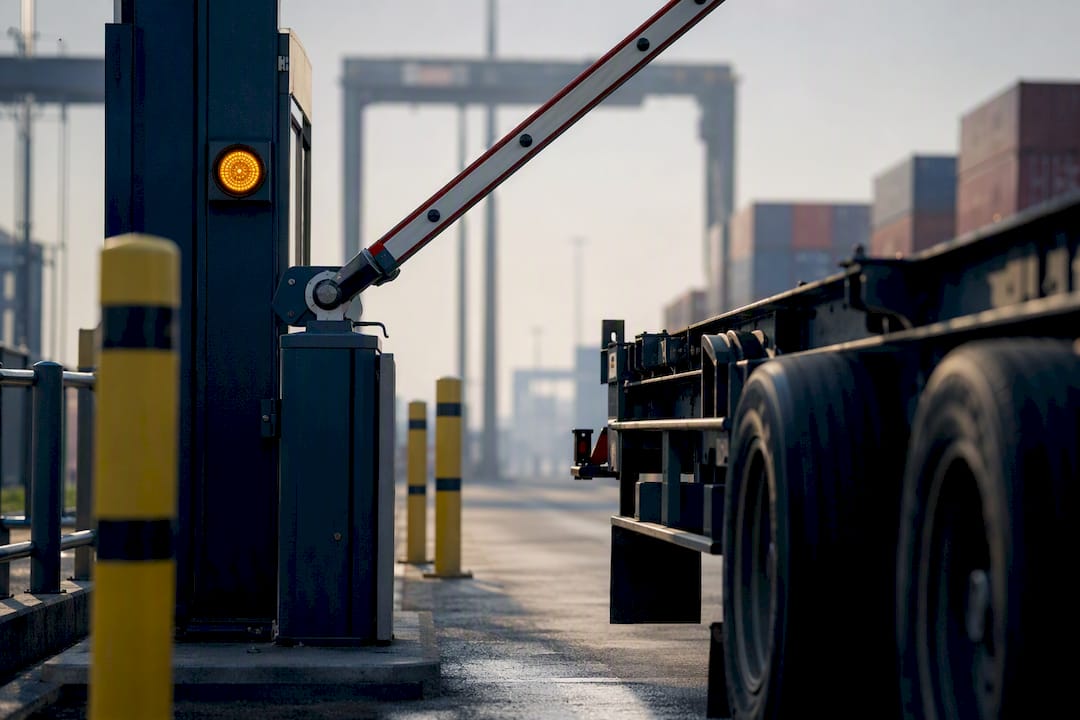
A tracked fleet with trucks and trailers, each fitted with GPS monitoring to supply continuous telemetry, is necessary for an AI planning system to function effectively. Without that real-time position data, constraint-aware routing has nothing reliable to work from.
Container haulage carries its own constraint profile that generic parcel routing tools rarely handle well. Port booking windows at terminals such as Felixstowe or Southampton are fixed and unforgiving; a route that arrives ten minutes late can mean a missed vehicle booking slot and a day’s delay. Backhaul capture (pairing an outbound container move with a return load rather than running empty) depends on matching capacity and timing across multiple bookings at once. Same-day container moves need the system to re-plan the moment a slot shifts, not at the next scheduled refresh.
Adopting this kind of planning discipline means real operational change: updated standard operating procedures for drivers, clear KPI dashboards tracking on-time port arrivals and utilisation, and named accountability for reviewing the numbers weekly rather than leaving them to a dashboard nobody opens.
How do you build a credible ROI model?
A workable ROI model starts simple: miles saved multiplied by your cost per mile, plus fuel cost reductions from the same source, plus utilisation gains from better drop density, minus any overtime avoided through smarter scheduling.
Chart these on a clear cadence rather than reviewing them once a quarter.
- Daily: on-time delivery rate, failed stops, fuel per kilometre.
- Weekly: miles per stop trend, driver hours against plan, exceptions handled automatically versus manually.
- Monthly: total distance reduction against baseline, SLA adherence trend, utilisation rate.
Set thresholds in advance for what triggers scale-up versus rework. If a pilot route consistently misses its SLA adherence target after four weeks despite stable data quality, that is a modelling problem worth revisiting before adding more routes, not a reason to expand regardless.
What should you do in the first 90 days?
- Pull a representative slice of pilot data, roughly 5 to 8% of daily stops, covering your hardest constraint combinations.
- Set acceptance criteria upfront: algorithmic metrics (distance, drop density) and execution metrics (driver adherence, failed stops).
- Run vendor demos against your own sample data and insist on reproducible pilot runs, not a generic showcase.
- Assign one internal owner, agree the KPIs, and schedule reviews at 30, 60 and 90 days.
A few months is generally enough time to see whether the modelling holds up against your real network, not just the vendor’s rehearsed scenario.
What do real-world deployments actually show?
Vendor case studies converge on a consistent pattern: gains come from constraint depth, not raw computing power. Mojro positions its platform around solving route, space, weight, time, sequence and location together, then feeding execution insights back into future planning runs rather than treating each day’s plan as a one-off calculation. That closed-loop approach is what separates a system that improves over months from one that plateaus after the first few weeks.
That sequencing matters. Fleets attempting the same jump without first fixing data gaps report far more modest results, and sometimes none at all until the underlying feeds are corrected.
The common thread across deployments that actually stick: the technology gets treated as an ongoing modelling discipline, with someone accountable for reviewing outputs weekly, rather than a one-time software purchase left running unattended.
What are the common challenges and limitations?
The biggest limitation is not the algorithm, it is the data feeding it. Telematics dropouts, outdated vehicle profiles and incomplete order details will quietly degrade route quality long before anyone notices the pattern in the numbers.
Constraint modelling is genuinely hard to get right. Kardinal’s own framing of route optimisation as a modelling problem holds because driver break rules, vehicle capacities and site access windows interact in ways that are easy to underspecify. A system that handles capacity but not ADR hazard classifications will produce routes that look fine until a hazardous load hits a restricted road.
Integration gaps cause a second class of problem. A planning engine that cannot talk cleanly to your TMS or telematics platform forces manual re-entry, which reintroduces the delays and errors the system was meant to remove. And organisational resistance is real: drivers who are handed new routes without explanation tend to revert to familiar habits at the first opportunity, undermining the model’s assumptions about compliance.
Finally, “set and forget” deployments underperform by design. Every credible adoption framework treats monitoring and retraining as ongoing work, not a one-off implementation task.
Where is this technology heading next?
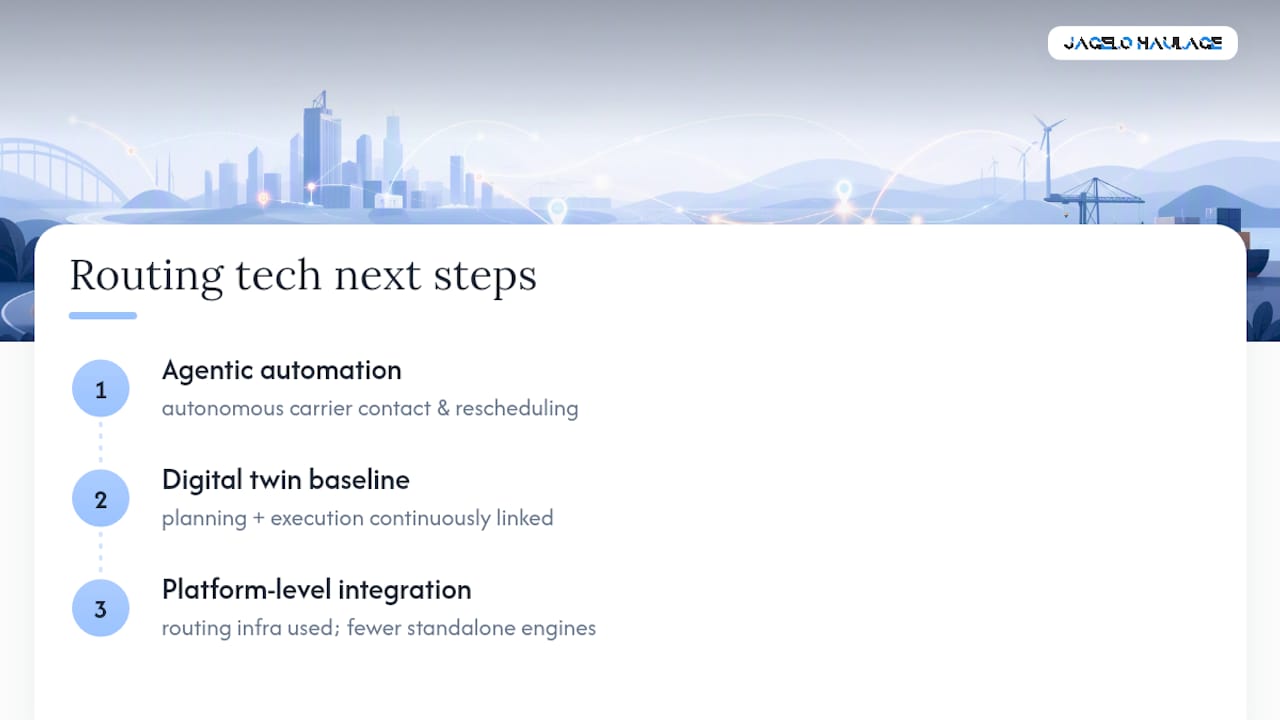
Agentic automation is moving from notification tools to genuine decision-making assistants. FourKites already frames its agentic layer as a system that handles carrier contact and appointment rescheduling autonomously, and that scope is likely to expand into more exception categories over the next few years, reducing how often a human dispatcher needs to intervene at all.
Digital twin modelling, where planning and execution data stay continuously connected, is becoming less of a differentiator and more of a baseline expectation. Research on integrated logistics pipelines makes the case plainly: fragmented systems that plan in isolation from what actually happens on the road produce sequential, suboptimal runs that never quite catch up to reality.
Expect deeper integration with platform-level routing infrastructure too. As tools like Google’s routing platform push further into predictive traffic and multi-waypoint optimisation at scale, specialist logistics vendors will increasingly build their constraint-solving layer on top of that infrastructure rather than replicating it. The practical effect for fleet managers: fewer standalone routing engines, more platforms that combine deep modelling with continuously updated execution data, and a shrinking gap between when a disruption happens and when the plan adjusts to it.
The editorial take: why constraint modelling beats feature lists
Most coverage of this topic reads like a shopping list: real-time this, AI-powered that. The genuinely useful question is narrower and less exciting to market: can the system model your actual operating constraints, and will anyone act on what it learns?
The evidence points to a specific failure mode. Fleets that treat AI route optimisation as a software swap, plugging in a new tool without fixing telematics gaps or specifying driver break rules properly, get underwhelming results and blame the algorithm. The algorithm was never the constraint. The modelling was.
Conventional advice tends to lead with headline percentage gains, which sets the wrong expectation.
Prioritise, in this order: clean data feeds, honest constraint modelling, a pilot that deliberately includes your hardest routes, and a closed feedback loop that keeps improving the plan after go-live. Everything else, including which vendor logo sits on the dashboard, matters far less than these fundamentals suggest it should.
— Vytautas
Sources
- University of St. Gallen research on AI adoption frameworks
- FourKites – agentic AI and continuous shipment monitoring
- Google Maps Platform routes product features
- Locus — enterprise route planning software use cases and metrics