7 Point UK ADR Checklist for Container Hauliers

ADR is the Agreement concerning the International Carriage of Dangerous Goods by Road, and in the UK it operates through the Carriage of Dangerous Goods and Use of Transportable Pressure Equipment Regulations 2009. Compliance hinges on four immediate priorities: correct classification, ADR instructions in writing, trained crew, and a Dangerous Goods Safety Adviser assessment where required. HSE and GOV.UK publish the authoritative texts operators should work from.
TL;DR:
- Operators must carefully classify dangerous goods and verify classification accuracy to ensure correct placarding, emergency response, and compliance with packaging standards.
- A valid ADR transport document and written instructions must be accessible within two minutes during roadside inspections, requiring backup paper copies for cross-border hauls.
- Drivers need current ADR vocational certificates to carry dangerous goods above limited limits, with refresher training required every five years to maintain legal clearance.
- Exemptions for DGSA and certain carriage types apply only to domestic UK transport; international and cross-border shipments must fully comply with ADR without relaxations.
- Regular review of ADR updates every two years is essential to remain compliant, as changes can affect UN numbers, vehicle equipment, and driver training requirements.
Table of Contents
- What ADR regulations UK mean for road haulage
- Who needs a DGSA, and when exemptions apply
- Classification, UN numbers and placarding basics
- Consignment documents and ADR instructions in writing
- Vehicle equipment, drain seals and PPE
- Driver training and ADR vocational certificates
- Authorisation notices, derogations and multilateral agreements
- What inspectors check and what happens when they find a problem
- Pre-dispatch checklist for compliant container movements
- How a specialist container haulier applies this in practice
- ADR agreements and how often they change
- Renewing ADR certificates and keeping documentation current
- Cross-border ADR compliance after Brexit
- Emergency response duties when things go wrong
- How ADR compares with other dangerous goods frameworks
- Why compliance is an operational asset, not just a legal box to tick
- Get your container movements ADR-ready with Jagelo Haulage
- Sources
What ADR regulations UK mean for road haulage
ADR is a European agreement covering the packaging, labelling, and carriage of dangerous goods by road. The UK brought it into domestic law through the CDG Regulations, which set the enforcement framework, national carriage provisions, and derogation powers that apply specifically to Great Britain.
Three bodies share oversight: the Department for Transport sets policy and issues authorisation notices, DVSA enforces on the road, and HSE provides technical guidance and inspects fixed sites. It’s worth separating two categories of movement early. National carriage within GB can benefit from specific derogations that relax certain ADR provisions. International carriage, including any container leaving GB, must meet ADR in full, with no relaxations available. The HSE’s ADR and CDG manual is the most practical single reference for mapping obligations to daily operations, and it’s updated as amendments to ADR come into force.
Who needs a DGSA, and when exemptions apply
Not every haulier needs a Dangerous Goods Safety Adviser on the payroll. The rule is more nuanced than a blanket requirement, and getting it wrong in either direction creates risk: appointing one unnecessarily wastes money, skipping one where required leaves you exposed at audit.
Two exemptions cover most GB-based operators:
- Incidental carriage exemption (ADR 1.8.3.2 and CDG Regulation 3(j)): businesses where dangerous goods transport is not the main or secondary activity, such as a general haulier occasionally moving a hazardous consignment, may not need a DGSA.
- Small-quantity exemption: operations that only ever carry limited or excepted quantities under the relevant thresholds can often sit outside the full DGSA requirement.
Neither exemption extends to international carriage. A container haulier moving dangerous goods regularly between UK ports and continental destinations should assume the DGSA requirement applies and either appoint one, contract one externally, or document clearly why an exemption holds. Our hazardous cargo compliance guide covers this decision in more depth for container operations specifically.
Classification, UN numbers and placarding basics
Every dangerous goods movement starts with classification into one of nine ADR hazard classes, from Class 1 explosives through to Class 9 miscellaneous dangerous substances. Each substance carries a UN number that determines its packing group, permitted packaging, and any special provisions. Get the classification wrong and everything downstream, from placarding to emergency response, is built on a false premise.
For container and road haulage, the packaging and tank provisions in ADR Parts 4 and 6 matter most. IBCs, tank containers, and portable tanks each have construction and testing standards tied to the substance class they carry. Placarding follows from classification: orange plates front and rear identify the vehicle as carrying dangerous goods, while diamond hazard labels on the load itself indicate the specific risk. Limited and excepted quantities carry lighter marking obligations, but the thresholds are substance-specific, so check the relevant packing instruction rather than assuming a blanket exemption applies.
Consignment documents and ADR instructions in writing
Chapter 5.4 of ADR sets out what the transport document must contain: UN number, proper shipping name, class, packing group, and quantity, among other details. That document has to travel with the load and remain accessible to the driver and to any inspecting officer throughout the journey, not filed away in the cab door pocket.
ADR instructions in writing follow a standardised four-page model. GOV.UK guidance confirms this can be printed front and back on two sheets of A4, provided all required content is present and legible.
Electronic documentation is permitted, with conditions:
- The device must not be PIN-locked in a way that blocks quick access.
- Documents must be downloadable for offline viewing, since signal loss at a port or a border crossing is not an acceptable excuse for non-production.
- A driver should be able to produce the relevant document within two minutes of being asked.
Pro Tip: Keep a printed backup of ADR instructions in the cab for any cross-border leg. GOV.UK’s own guidance flags offline access as the main weak point in electronic-only systems, and a flat battery at Dover is not a defence.
The GOV.UK guidance on electronic documentation is the primary reference here and worth bookmarking, since it’s the section most likely to be updated as digital practices evolve.
Vehicle equipment, drain seals and PPE
ADR specifies equipment that must be carried according to the hazard labels displayed. Getting this list wrong is one of the most common roadside findings.
- General equipment: wheel chocks, warning signs or cones, high-visibility vests, a torch, and eye protection for every crew member.
- Fire extinguishers matched to vehicle weight and load type.
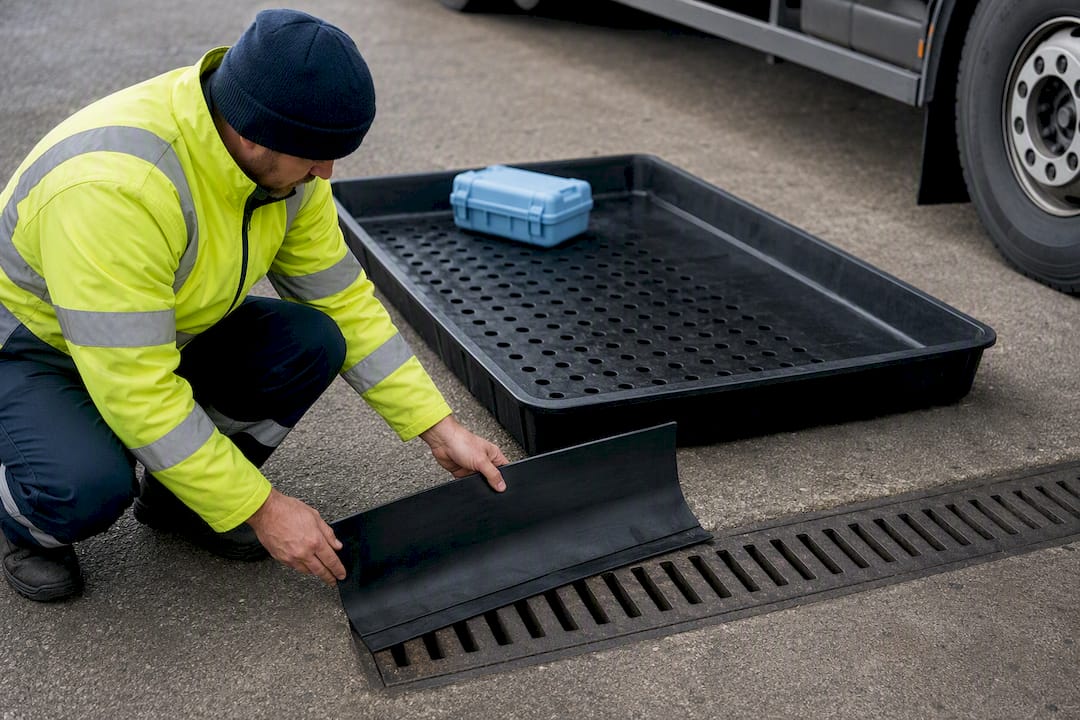
- Drain seals and a means of collecting spillage are required specifically where the load carries labels indicating a risk to the environment, such as Class 9 or certain Class 3 substances. This is the item container hauliers most often overlook, because it doesn’t apply to every load, only to specific label combinations.
- Additional protective equipment depending on the substance class, from chemical-resistant gloves to escape masks for particular toxic gas classifications.
Container chassis and tank vehicles need periodic checks against ADR construction and marking requirements, separate from the standard MOT and operator licence inspection regime.
Pro Tip: Build the equipment list into your vehicle pre-check sheet by label type rather than as one generic checklist. A driver checking for a drain seal only when the load actually needs one saves time and avoids the false confidence of a “tick everything” habit.
Driver training and ADR vocational certificates
Any driver carrying dangerous goods above the limited-quantity thresholds needs an ADR vocational training certificate. Basic training covers general awareness and safety; class-specific modules add cover for substances such as explosives or radioactive material, and a separate tank endorsement is required for tank or tank-container carriage.
Certificates run for five years, with refresher training required before expiry to avoid a gap in cover. Fleet managers carry the recordkeeping burden here: a driver whose certificate has lapsed is not legally permitted to carry the load, regardless of experience. Build certificate expiry dates into whatever system already tracks CPC hours and licence checks, and verify originals rather than relying on a driver’s word. Our guide to driver compliance in haulage sets out the wider recordkeeping picture.
Authorisation notices, derogations and multilateral agreements
The Secretary of State for Transport can issue authorisation notices and exception notices permitting specific deviations from standard ADR rules, but these apply to GB carriage only, come with conditions, and are time-limited. Relying on one without reading the small print is a common way operators end up non-compliant while believing they’re covered.
Multilateral agreements (MAs) work differently, permitting temporary derogations agreed between contracting parties for cross-border movements. If you’re operating under an MA, GOV.UK guidance is clear that a copy must be carried in the vehicle. An inspector who asks for it and gets a shrug will treat the load as though no derogation exists at all. Cross-border journeys deserve extra caution here: an MA valid between two specific states doesn’t automatically extend to a third country your route passes through.
What inspectors check and what happens when they find a problem
DVSA and HSE inspections at the roadside or on site tend to follow a predictable sequence. Officers check the transport document first, then placarding and labels against the actual load, then vehicle equipment against what the hazard labels require, then ADR instructions in writing, and finally driver competence and certification.
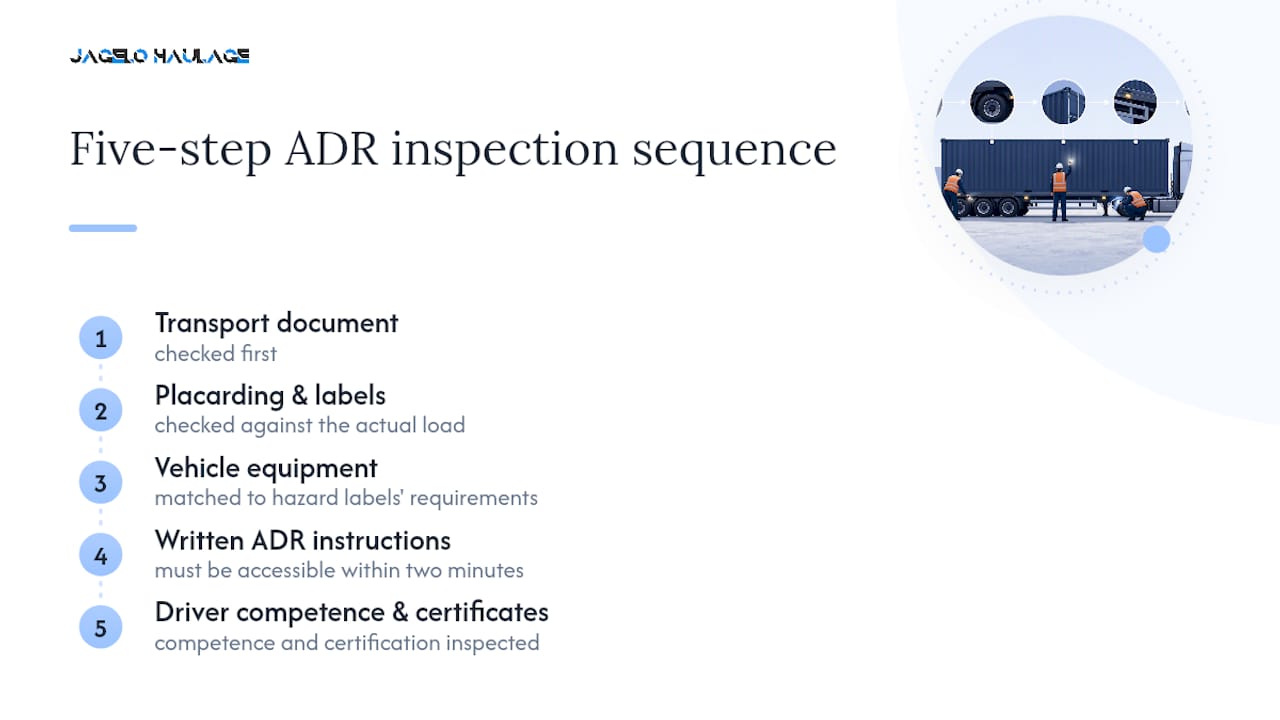
Common findings include missing or expired driver certificates, incorrect or absent placarding, ADR instructions that exist but aren’t accessible within the two-minute window, and missing drain seals on loads that require them. Outcomes range from verbal advice for minor issues to prohibition notices that take a vehicle off the road immediately, through to prosecution for serious or repeated breaches.
Keep inspection records and any correspondence with enforcement bodies on file. If a prohibition notice is issued and you believe it’s wrong, there’s a formal appeals route, but the burden sits with the operator to demonstrate compliance at the time of the check, not after the fact.
Pre-dispatch checklist for compliant container movements
Run this before every dangerous goods dispatch, not just the ones that feel high-risk:
- Confirm classification, UN number, and packing group match the consignor’s declaration.
- Verify the transport document is complete and stored where the driver can reach it.
- Confirm ADR instructions in writing are present, current, and accessible within two minutes.
- Check vehicle equipment against the specific hazard labels on this load, including drain seals where required.
- Verify the driver’s ADR certificate is valid for the class and vehicle type being used.
- Confirm emergency contact details are on the transport document and known to the driver.
- If operating under an authorisation notice or MA, confirm the copy is in the vehicle.
Build this into dispatch software or a paper template so it’s repeatable rather than dependent on memory. Our container transport compliance checklist expands this into a full pre-departure template.
How a specialist container haulier applies this in practice
A tracked fleet with GPS across major UK ports gives a practical advantage here: dispatchers can confirm a vehicle’s location and status alongside its ADR documentation rather than treating compliance as a separate paper exercise. Managing driver certificates and instructions in writing within the same system used for routing and delivery windows keeps both visible together. This is offered as an operational example, not legal advice, and each operator’s specific duties still depend on its own classification and DGSA position.
ADR agreements and how often they change
ADR itself is renegotiated on a two-year cycle, with revised editions taking effect on 1 January of odd-numbered years, so 2025 and 2027 mark the most recent and next scheduled updates. Amendments cover everything from new UN numbers for emerging chemical products to revised packaging standards and updated vehicle construction requirements.
This cycle matters more to UK operators than it might first appear. A vehicle or packaging type approved under one edition can fall out of compliance simply because the rulebook moved, not because anything on the vehicle changed. The transitional period built into each new edition, typically six months, gives operators time to adjust, but it also means two versions of ADR can be technically valid simultaneously during the changeover window.
Practically, this means a compliance calendar needs an ADR review point every two years, not just an annual audit. Fleet managers should check three things at each update: whether any UN numbers carried regularly have changed packing group or provisions, whether vehicle equipment requirements have shifted for the hazard classes carried, and whether driver training syllabuses have been revised in a way that affects refresher timing.
HSE’s manual is updated to reflect each new ADR edition, generally with a lag of a few months as UK guidance catches up with the international text. Relying solely on the previous edition’s guidance into a new cycle is a common and avoidable gap, particularly for operators who don’t move dangerous goods often enough to notice a change has happened.
Renewing ADR certificates and keeping documentation current
Driver ADR vocational certificates run for five years from the date of the qualifying examination. Refresher training must be completed and the new examination passed before the existing certificate expires, not after. A lapsed certificate means the driver cannot legally carry loads above the limited-quantity thresholds until requalified, with no grace period.
The refresher course itself is shorter than initial training but covers the same structure: general awareness, plus any class-specific or tank modules the driver holds. Fleet managers should build renewal reminders at least three months ahead of expiry, since course availability through approved training providers can tighten around common expiry periods.
DGSA certification follows a similar principle but on its own cycle. Advisers hold a certificate of qualification valid for five years, and DGSAs must sit a refresher examination to renew. Where a business appoints an external DGSA rather than an in-house one, verifying that the adviser’s own certificate is current is the operator’s responsibility, not an assumption to make on trust.
Documentation renewal isn’t limited to people. Vehicle approval certificates for tanks and specialist ADR vehicles carry their own periodic testing and certification cycle, separate from standard roadworthiness testing, and typically tied to tank inspection intervals rather than a fixed calendar date. Keeping a single register that tracks driver certificate expiry, DGSA certification, and vehicle approval dates together, rather than three separate spreadsheets, is the simplest way to avoid a renewal slipping through unnoticed. A missed renewal discovered at the roadside is a prohibition notice waiting to happen, not a paperwork inconvenience.
Cross-border ADR compliance after Brexit
Leaving the EU didn’t change the UK’s underlying ADR obligations, since ADR is a United Nations agreement that the UK acceded to independently of EU membership. What changed is the administrative layer around border crossings: customs declarations, transit documentation, and border checks now apply to container movements between GB and the EU that didn’t exist in the same form before.
For dangerous goods specifically, this means an ADR-compliant consignment now needs its transport document and instructions in writing to align with customs paperwork rather than travelling as a purely internal EU movement. A driver crossing at Dover or Holyhead may face separate checks from customs and from dangerous goods enforcement, and delays at one can compound the other if documentation isn’t consistent across both.
GB derogations under the CDG Regulations remain firmly domestic. Any relaxation that applies to national carriage within Great Britain has no standing once a load crosses into Northern Ireland under the protocol arrangements or onward into the EU. Operators who’ve grown used to a GB-specific easement need to treat every cross-border leg as full ADR compliance with no shortcuts, and check whether a multilateral agreement is needed for the specific route and substance involved.
Northern Ireland carries its own nuance under the Windsor Framework arrangements, effectively continuing to follow EU-aligned rules for goods movements in ways that don’t apply to Great Britain. A container haulier regularly moving between GB ports and Northern Ireland or the Republic of Ireland should treat that route as needing separate verification each time regulatory alignment shifts, rather than assuming last year’s paperwork process still holds.
Emergency response duties when things go wrong
ADR requires every dangerous goods vehicle to carry a documented emergency response plan appropriate to the load, and drivers must know it before they need it, not read it for the first time during an incident. The instructions in writing document itself sets out the immediate actions: stop the vehicle safely, warn other road users, contact emergency services with the correct UN number and class information, and avoid actions that could worsen a leak or fire.
Emergency contact numbers on the transport document need to connect to someone who can give a technical briefing to fire and rescue services on arrival, not a generic office switchboard. This is where the paperwork discipline covered earlier pays off directly: an incident responder who can’t get UN number and hazard class information within minutes is working blind on a scene that may already be dangerous.
For container haulage specifically, spillage containment matters more than it might for a straightforward box load. The drain seals and collecting equipment mentioned earlier in vehicle checks exist precisely for this scenario, to stop a contained leak becoming an environmental incident before the emergency services arrive. A vehicle without that equipment on a load that requires it turns a manageable spill into a much larger problem.
Reporting obligations follow after the immediate response. Serious incidents involving dangerous goods carriage may trigger reporting duties to HSE, and operators should keep incident records regardless of severity, since a pattern of near-misses on a particular route or substance is exactly the sort of thing a DGSA should be reviewing. Building a short incident debrief into standard practice, even for near-misses, closes the loop between what the emergency response plan says on paper and what actually happens on the road.
How ADR compares with other dangerous goods frameworks
Operators moving containers through UK ports often deal with more than one dangerous goods framework in a single supply chain, and the differences matter more than they might expect. Sea legs fall under the International Maritime Dangerous Goods (IMDG) Code, while air freight follows the International Civil Aviation Organization’s Technical Instructions, commonly implemented through IATA’s Dangerous Goods Regulations. ADR governs only the road leg.
The classification systems share a common UN numbering foundation, which helps, but the packaging, labelling, and documentation requirements between modes are not identical. A container arriving by sea under IMDG packaging and labelling may need re-checking against ADR requirements before it continues by road, rather than assumed to already comply. This is a genuine risk point at ports: cargo that was perfectly compliant for its sea leg can fail an ADR check on the quayside if nobody verifies the transition.
One further wrinkle worth flagging for legal and procurement teams: ADR is also the standard abbreviation for “alternative dispute resolution” in a UK legal and consumer context, an entirely unrelated concept covering mediation and arbitration schemes for resolving disputes outside court. The overlap in terminology occasionally causes confusion in contracts or search results, so it’s worth being explicit in any internal documentation about which ADR is meant, particularly when dangerous goods compliance and commercial dispute clauses might both appear in the same haulage contract.
The practical takeaway for UK freight operators managing multimodal container movements is to treat each mode’s rulebook as a distinct checkpoint rather than assuming compliance carries over automatically from one leg to the next.
Why compliance is an operational asset, not just a legal box to tick
Solid ADR practice reduces insurance friction, avoids the costly delays a prohibition notice causes, and signals to freight forwarders that a haulier can be trusted with their most demanding cargo. The operators who treat it as routine, embedded into dispatch checks and reviewed monthly rather than dusted off before an audit, are the ones who rarely get caught out.
— Vytautas
Get your container movements ADR-ready with Jagelo Haulage
A tracked fleet of trucks and trailers operates across major UK ports with GPS visibility on every movement and support available for operational questions outside office hours.
For freight forwarders and logistics operators managing dangerous goods alongside standard container loads, that combination matters: dispatch visibility and compliance documentation sitting in the same operational picture, rather than tracked separately and reconciled after the fact. If you need a container movement handled with ADR awareness built into the process from booking through to port-to-door delivery, get in touch with Jagelo Haulage for a quotation, or raise your DGSA and documentation requirements directly with the team before your next dispatch.
Sources
- ADR, CDG Regs and Dangerous Goods Safety Advisors
- The Carriage of Dangerous Goods and Use of Transportable Pressure Equipment Regulations 2009