A transparent haulage quote is often the exception rather than the rule in the current UK logistics market. For many operational managers, container transport costs remain an unpredictable variable that can fluctuate overnight due to shifting fuel surcharges and complex port levies. You likely feel that budgeting for the movement of goods has become a defensive exercise rather than a disciplined financial strategy. It is difficult to maintain a lean supply chain when unexpected port detention fees or opaque energy adjustment mechanisms disrupt your bottom line.
This guide provides a professional breakdown of the 2026 haulage landscape to help you regain control over your logistics expenditure. We'll examine the specific components of modern rates, including current port fee structures and the critical differences between merchant and shipping line haulage. By understanding these strategic nuances, you can move away from reactive spending and towards a model of predictable budgeting and reliable on-time delivery. We will also identify specific opportunities for cost optimisation within your port-to-door operations to ensure your cargo moves with maximum efficiency and security.
Key Takeaways
- Understand the fundamental variables that dictate haulage rates, including container dimensions and the precise calculation of fuel surcharges.
- Evaluate the operational and financial differences between merchant haulage and shipping line models to determine the most efficient route for your cargo.
- Identify practical strategies to lower inland transport expenditure by improving site efficiency and utilising scheduled container deliveries.
- Master the complexities of container transport costs by accounting for the latest port levies and energy adjustment mechanisms across major UK terminals.
- Learn how professional logistics management and modern fleet technology provide the stability required to protect your margins during supply chain disruptions.
Primary Factors Influencing Container Transport Costs in the UK
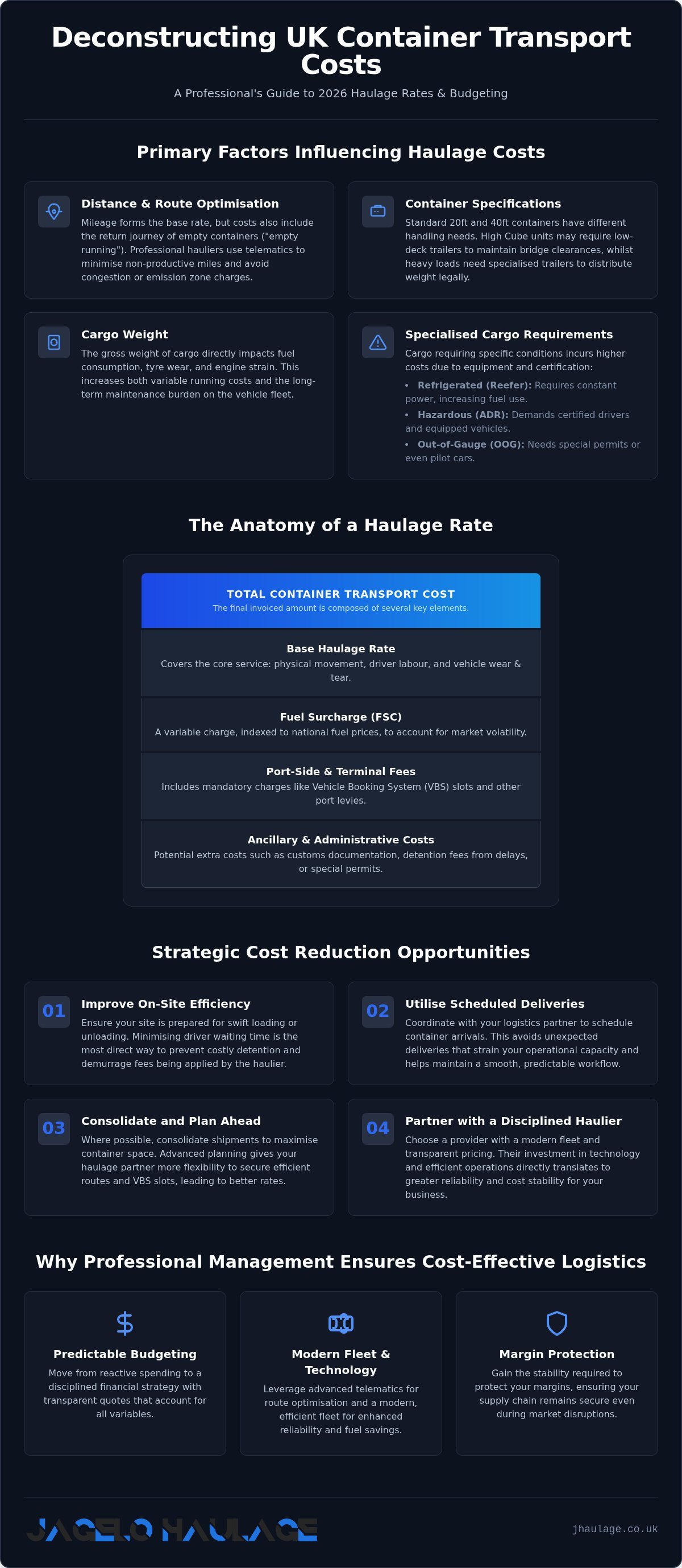
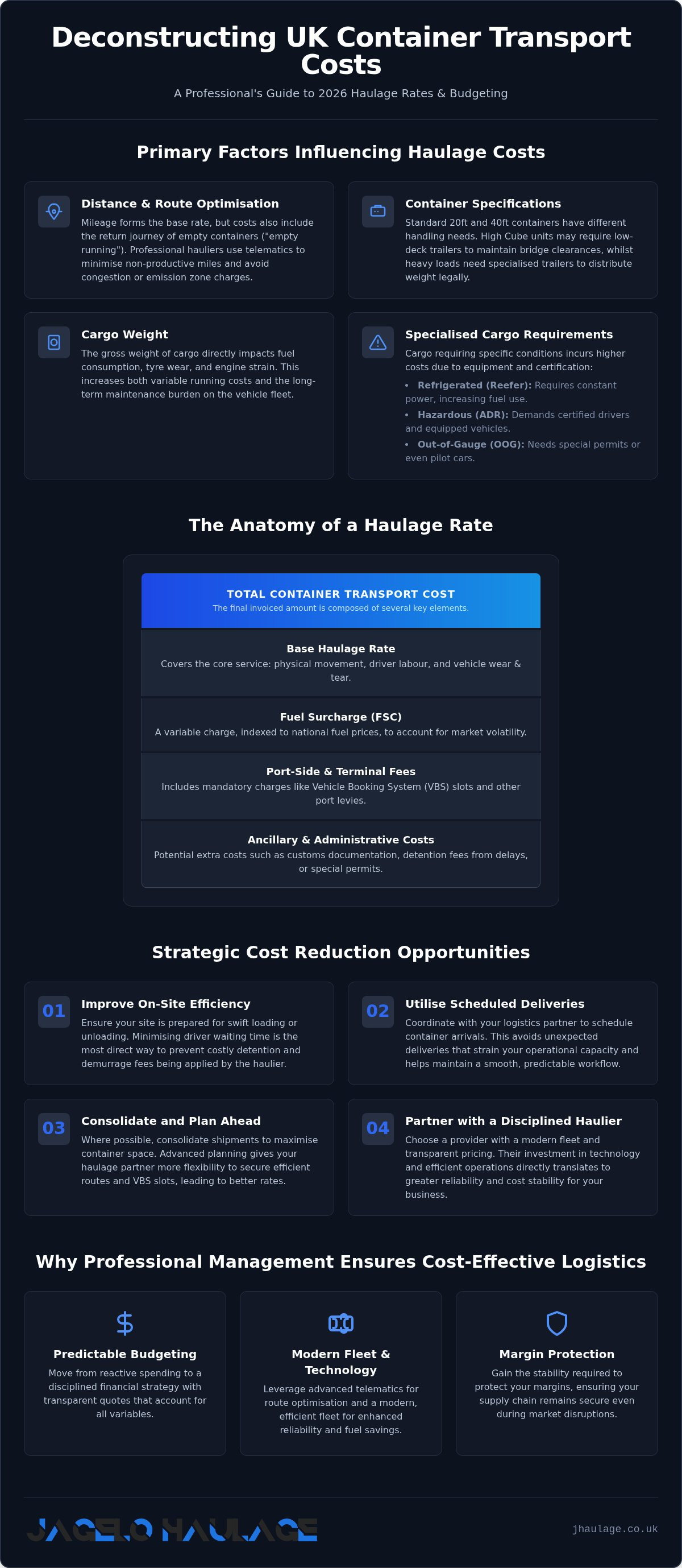
Calculating container transport costs requires a detailed understanding of both fixed and variable operational expenses. While many assume price is purely a function of distance, the reality of UK haulage involves a complex interplay of port-side fees, equipment requirements, and fuel efficiency. A disciplined approach to these factors ensures that logistics budgets remain predictable even during periods of market volatility.
Distance and Route Optimisation
Mileage serves as the foundation for any haulage quote, but it's rarely the final figure. Logistics providers must account for the total journey, including the return of empty equipment to the terminal. This "empty running" significantly impacts the rate, as the vehicle consumes fuel and driver hours regardless of whether a load is present. Efficient route planning is essential to minimise these costs. Professional hauliers use advanced telematics to avoid congestion hotspots and low-emission zones that carry heavy daily charges. This methodical approach ensures that the primary driver of cost remains the physical movement of goods rather than administrative or operational waste.
Container Specifications and Equipment
The physical dimensions of the cargo dictate the vehicle and trailer configuration required. Since the development of the global containerization system, standardised sizes like 20ft, 40ft, and High Cube units have streamlined logistics. However, each requires specific handling. A 20ft container carrying heavy industrial materials may require a specialised sliding skeletal trailer to distribute weight legally across the axles. High Cube containers, which offer extra vertical space, often necessitate low-deck trailers to ensure bridge clearances are maintained.
Cargo weight directly influences fuel consumption and road tolls. Heavier loads put greater strain on the engine and tyres, increasing the maintenance burden on the fleet. Beyond standard dry vans, specialised requirements add layers to the pricing structure:
- Refrigerated (Reefer) units: These require power from the truck's engine or an integrated generator, increasing fuel use.
- Hazardous (ADR) goods: These demand drivers with specific certifications and vehicles equipped with safety kits.
- Out-of-gauge (OOG) cargo: Items that exceed standard container dimensions require pilot cars or special permits.
Port-side efficiency is another critical factor. Most major UK terminals, such as Felixstowe and London Gateway, utilise a Vehicle Booking System (VBS). These systems charge hauliers for specific time slots. If congestion causes a driver to miss a window, or if the port experiences delays, additional costs accrue. These fees are often passed through to the client, making the choice of a disciplined haulage partner vital for maintaining stable container transport costs.
Breaking Down the Components of a Haulage Rate
Understanding the distinction between a base haulage rate and the total landed cost is essential for accurate logistics budgeting. The base rate typically covers the physical movement of the goods, including driver labour and vehicle wear. However, the final invoice for container transport costs often includes several variable surcharges and port-side levies that must be accounted for to avoid financial discrepancies. A disciplined approach to these components allows operational managers to move from reactive spending to a model of predictable expenditure.
Fuel Surcharges and Economic Variables
The fuel surcharge (FSC) is a floating mechanism designed to address the volatility of diesel and energy prices. In 2026, most professional hauliers index their FSC against national price averages to maintain transparency. This indexing ensures that the transport rate remains fair even as global markets fluctuate. According to the UK road freight market report, fuel remains one of the most significant variable costs for operators, necessitating a clear and consistent surcharge policy. Fuel surcharges act as a stabilising mechanism that protects the haulier from sudden market spikes whilst ensuring the client only pays a rate reflective of current energy prices.
Port-Side Fees and Administrative Costs
Beyond the road transit itself, specific port-side fees are applied to every laden import container. These charges vary significantly depending on the terminal of entry. For example, as of May 2026, the Energy Adjustment Mechanism (EAM) at DP World London Gateway is £26.51 per container, whilst DP World Southampton applies a rate of £23.07. At Hutchinson Port Felixstowe, the Green Energy Transfer (GET) levy is £26.16, supplemented by a Security and Infrastructure charge of £38.06. These fees are mandatory and are typically passed through by the haulier at cost.
Administrative efficiency is also required to manage ancillary costs such as demurrage and detention. Demurrage refers to the storage fees charged by the port when a container remains on the quay beyond the agreed "free time," with UK rates in 2026 ranging from £50 to £150 per day. Detention fees occur when the container is held outside the port for too long before being returned empty. You can mitigate these risks by working with a partner who provides transparent haulage quotes and proactive delivery scheduling. Proper management of Vehicle Booking System (VBS) slots is also vital; missed windows at major hubs often result in additional charges and operational delays that inflate the total container transport costs.
Merchant Haulage vs Shipping Line Haulage: Cost Implications
Selecting the appropriate inland transport model is a critical decision that directly impacts the stability of container transport costs. Importers generally choose between merchant haulage, where they arrange transport independently, and shipping line haulage, where the carrier manages the final leg of the journey. Whilst both models move the container from the port to the warehouse, the financial and operational outcomes differ significantly. A disciplined evaluation of these models reveals that the choice is not merely administrative; it is a strategic calculation of supply chain efficiency.
The Advantages of Merchant Haulage
Merchant haulage provides the importer with full control over the delivery schedule. By contracting a specialist haulier directly, you gain the ability to synchronise container arrivals with warehouse labour shifts and storage capacity. This level of coordination is rarely possible with carrier-arranged transport. Working with a dedicated partner allows for direct negotiation of rates, ensuring that your container transport costs are reflective of the actual service provided rather than a generic carrier fee. For a deeper technical breakdown, you can review our guide on Merchant Haulage vs Shipping Line Haulage.
The UK road freight market analysis highlights that market resilience often depends on the ability to manage operational variables effectively. Merchant haulage facilitates this by removing the "black box" of carrier pricing. You receive a transparent quote that includes the base rate and any applicable surcharges, such as the port-specific Energy Adjustment Mechanisms discussed in previous sections. This transparency eliminates the risk of hidden administrative mark-ups that carriers often apply to their haulage services.
When Shipping Line Haulage Might Cost You More
Shipping line haulage is often marketed as a convenience, but it frequently results in higher total landed costs. Carriers prioritise their own equipment repositioning and vessel schedules over the specific needs of the importer. This "carrier convenience" model can lead to unpredictable delivery windows, forcing warehouses to maintain expensive standby labour or face delays in stock availability. If the carrier misses a port window or fails to return an empty container on time, the importer may still be liable for detention fees, despite having no control over the transport process.
Inflexible carrier scheduling also increases the risk of quay rent and demurrage. Carriers often lack the responsiveness required to manage the complex port logistics of major UK hubs like Felixstowe or London Gateway. By contrast, a professional haulier acts as a strategic partner, managing VBS slots and port-to-door transit with the precision required to protect your margins. Choosing merchant haulage ensures that the safety and efficiency of your operations remain the priority, rather than a secondary consideration for a global shipping line.
Managing and Reducing Your Inland Transport Expenditure
Operational discipline is the most effective tool for lowering long-term container transport costs. Whilst many managers focus on negotiating the base rate, significant savings are often found in the elimination of operational friction. Inefficient warehouse practices and poor data sharing create hidden expenses that do not appear on an initial quote but frequently inflate the final invoice. By refining the "port-to-door" workflow, you can ensure that your logistics budget remains protected from unnecessary surcharges.
Improving Operational Efficiency
Minimising driver dwell time at your facility is a priority for cost control. Hauliers typically include a set period of "free time" for loading or unloading, after which hourly waiting charges apply. Implementing a "drop and swap" model, where a driver leaves a full container and immediately collects an empty unit, significantly improves fleet utilisation. This approach removes the need for the driver to wait for the cargo to be processed, allowing the vehicle to return to the port or its next collection point without delay.
Clear communication regarding container release numbers and PINs is also vital. If a driver arrives at a port or warehouse only to find that the cargo is not cleared or the documentation is incorrect, the resulting failed delivery fee can be substantial. Providing accurate, real-time data to your haulage partner prevents these wasted journeys. Moving towards scheduled deliveries rather than reactive bookings also yields benefits. A structured delivery calendar allows for better route optimisation and helps to stabilise your container transport costs throughout the seasonal peaks of the trade year.
Choosing a Strategic Partner for Long-Term Savings
The lowest initial quote often carries the highest risk of failure. Unvetted transport providers may lack the infrastructure to handle complex port logistics, leading to missed VBS slots and subsequent port fines. A strategic partner prioritises reliability and security, utilising a modern fleet to minimise the risk of mechanical breakdowns. Jagelo Haulage operates a fleet of over 40 modern trucks and trailers, ensuring that your cargo moves according to strict protocols and arrives on time.
Evaluating a haulier based on their operational reach and responsiveness is essential. A provider with a disciplined management structure can manage the complexities of Felixstowe, Southampton, and London Gateway more effectively than a broker-based service. This professional oversight protects your margins by ensuring that every container delivery is executed with precision. To secure a reliable solution for your inland logistics, you can request a professional haulage quote that reflects the true value of a managed supply chain.
Why Professional Management Ensures Cost-Effective Logistics
Professional management of container transport costs requires more than just a tracking application. It demands a deep understanding of UK port protocols and the ability to navigate shifting regulatory environments with precision. With over 15 years of industry experience, Jagelo Haulage provides the disciplined oversight needed to manage these complexities. Expertise in major hubs such as Felixstowe, Southampton, and London Gateway ensures that your cargo moves within a framework of security and operational competence. This seasoned approach transforms transport from a simple physical action into a strategic outcome for your business.
Fleet Modernisation and Efficiency
Our fleet of over 40 modern trucks and trailers serves as the foundation for our reliable service delivery. We treat vehicle maintenance as a core operational priority rather than a secondary task. This focus on equipment quality prevents breakdown-related delays and the associated secondary costs that often disrupt logistics budgets. Consistent availability of high-specification vehicles ensures that we can meet your delivery windows without compromise. Modern fleet technology also enables our team to provide responsive customer support, delivering the real-time tracking data you need to manage warehouse labour and inventory flow effectively.
The Jagelo Haulage Approach to Transparent Pricing
Jagelo Haulage approaches every contract with a commitment to no-nonsense, professional haulage solutions. We don't provide generic quotes that leave you vulnerable to unexpected port-side charges. Instead, we offer a transparent breakdown that accounts for the specific logistical requirements of your cargo. This methodical approach allows you to achieve predictable outcomes and maintain long-term financial stability. We position ourselves as a strategic partner rather than a simple service provider, integrating our operations with your supply chain to drive efficiency.
Secure and professionally managed transport is a strategic investment in the resilience of your business. By choosing a partner who understands the high stakes of the supply chain, you protect your margins from the hidden costs of failure. Our team follows strict protocols to ensure the safety and efficiency of every movement. To align your logistics with a partner that prioritises performance and results, you can request a professional container transport quote today. Our solution-oriented service ensures that your container transport costs remain a manageable and predictable part of your operational framework.
Optimising Your 2026 Haulage Strategy
Managing container transport costs in 2026 requires a disciplined approach to both port-side variables and inland operational efficiency. This guide has detailed how the transition to merchant haulage and the refinement of warehouse workflows can protect your margins from unpredictable surcharges. By prioritising transparency in fuel indexing and the strategic management of VBS slots, you can move away from reactive spending towards a model of functional reliability.
Jagelo Haulage provides the professional oversight required to secure your supply chain. We offer nationwide coverage from major UK maritime hubs, supported by 15 years of port logistics expertise. Our modern fleet of over 40 specialised trucks ensures that your cargo moves according to strict safety protocols and arrives on time. This commitment to operational excellence allows you to focus on your core business whilst we manage the complexities of the road freight market.
To stabilise your inland logistics, secure your logistics with a professional container haulage quote from Jagelo Haulage. We look forward to establishing a dependable partnership that delivers consistent results for your operations.
Frequently Asked Questions
How much does it cost to transport a shipping container in the UK?
Total container transport costs depend on the transit distance, container dimensions, and current port-side levies. Whilst industry benchmarks suggest average shipping rates, road haulage is calculated based on specific operational variables such as fuel indexing and equipment requirements. A professional quote accounts for the base rate plus variable surcharges like the Energy Adjustment Mechanism. This ensures that the final figure is reflective of actual market conditions and established port protocols.
What is the difference between merchant haulage and shipping line haulage?
Merchant haulage allows the importer to contract a specialised transport provider independently, offering greater control over delivery scheduling and warehouse coordination. Shipping line haulage is a carrier-arranged model where the shipping line manages the inland leg. Whilst the carrier model is often marketed as a convenience, it frequently lacks the flexibility of merchant haulage. Choosing a dedicated partner ensures that your cargo movements are prioritised according to your specific operational needs rather than carrier repositioning.
Why do fuel surcharges vary between different haulage companies?
Fuel surcharges vary because haulage companies utilise different base prices and indexing methods to calculate the floating mechanism. Some operators index against national diesel price averages, whilst others use proprietary internal data. Additionally, fleet efficiency plays a role; modern trucks with lower fuel consumption allow for more stable surcharges. Transparency in how these fees are calculated is a hallmark of a professional haulier, as it protects the client from arbitrary price hikes and market volatility.
Are there extra costs for transporting 40ft containers compared to 20ft?
Transporting a 40ft container typically incurs higher costs than a 20ft unit due to increased fuel consumption and specific equipment requirements. Larger containers require dedicated skeletal trailers and may face higher Vehicle Booking System (VBS) charges at certain UK terminals. Additionally, the weight of a 40ft laden container impacts the vehicle's operational wear and road tolls. These factors are integrated into the haulage rate to ensure the transport remains legally compliant and operationally efficient.
What happens to the transport cost if my container is delayed at the port?
Delays at the port result in ancillary charges such as demurrage and quay rent, which accumulate daily once the agreed free time expires. In 2026, UK demurrage rates often range from £50 to £150 per day. Furthermore, if a haulier misses a scheduled VBS window due to port congestion, additional administrative fees may apply. Professional management of these logistics is essential to prevent these avoidable expenses from inflating your total container transport costs and disrupting your budget.
Can I reduce my container transport costs by booking in advance?
Booking in advance allows for superior route optimisation and increases the likelihood of securing preferred VBS time slots at major ports. This proactive approach reduces the risk of failed deliveries and waiting charges, which often occur with last-minute bookings. A structured delivery schedule also enables hauliers to improve fleet utilisation, potentially leading to more competitive rates. Stable, long-term planning is one of the most effective strategies for maintaining a predictable logistics budget throughout the trade year.
What are VBS charges and who is responsible for paying them?
Vehicle Booking System (VBS) charges are mandatory fees paid to port terminals to reserve a specific time for container collection or drop-off. Major hubs like Felixstowe and London Gateway use these systems to manage traffic flow and reduce terminal congestion. Whilst the haulier initially pays the VBS fee to the port authority, these costs are typically passed through to the client as a separate line item. Efficient management of these bookings is critical for ensuring reliable and timely deliveries.
Are haulage rates inclusive of insurance and port security fees?
Professional haulage rates generally include standard Goods in Transit insurance, which protects the cargo during road transit. However, port-specific security and infrastructure levies are usually treated as additional pass-through costs. For example, Felixstowe currently applies a Security and Infrastructure charge of £38.06 per laden container. It's essential to verify which administrative and security fees are included in your initial quote to ensure a clear understanding of the final landed cost of your goods during transport.