A missed vehicle booking slot at a major UK port is more than a minor delay; it's a breakdown in the integrity of your entire supply chain. Logistics managers recognise that during peak maritime seasons, the pressure on internal fleets often exceeds capacity, leading to unreliable delivery windows and increased port fees. Securing a professional container haulage subcontractor isn't merely about finding extra vehicles. It's about integrating a disciplined partner that maintains the same high standards of safety and punctuality as your own operation.
You likely understand the strain of managing overflow while ensuring every driver meets the latest UK transport regulations, such as the Smart Tachograph 2 mandate. This article details the essential standards and operational requirements for successful subcontracting in the current market. We'll explore how a reliable partnership provides the scalability needed to handle volume spikes without compromising on compliance or port efficiency. You'll gain a clear understanding of how professional haulage support integrates with complex vehicle booking systems to protect your cargo's journey from port to destination.
Key Takeaways
- Understand why shipping lines and forwarders rely on a specialised extension of their network to maintain operational scalability.
- Identify the critical compliance standards, such as Euro 6 emissions and valid operator licensing, required for secure nationwide port access.
- Compare the flexibility of merchant haulage against carrier-controlled logistics to find the most efficient model for your specific cargo requirements.
- Learn how a disciplined container haulage subcontractor ensures seamless integration with vehicle booking systems at major UK maritime hubs.
- Discover how a modern, professionally managed fleet provides the security and punctuality essential for high-stakes supply chain management.
Defining the Container Haulage Subcontractor: More Than Just Transport
A container haulage subcontractor serves as a specialised extension of a larger logistics network. They don't simply move boxes; they provide the technical capability and fleet capacity required to maintain the flow of goods across the country. Shipping lines and freight forwarders depend on these partners to manage the complex transition between maritime arrival and inland delivery. This relationship allows primary carriers to scale their operations without the financial burden of maintaining an oversized permanent fleet.
There is a distinct difference between professional haulage organisations and informal "man-with-a-van" operations. A high-calibre subcontractor operates with a disciplined infrastructure that includes robust fleet maintenance, trained drivers, and comprehensive insurance. They project a sense of steadfast professionalism that mirrors the industrial nature of the sector. This reliability ensures that every container remains secure whilst in transit, reflecting the high stakes of modern supply chain management.
The Vital Link in the UK Supply Chain
Subcontractors bridge the critical gap between major maritime ports and regional distribution centres. Since the history of containerization began, the efficiency of this link has determined the success of global trade. Maintaining consistent service levels across third-party fleets is essential for protecting the reputation of the lead logistics provider. Functional reliability is the core requirement for any subcontracting agreement. If a partner cannot guarantee punctuality and compliance, the entire supply chain faces disruption.
Why Businesses Outsource to Specialist Hauliers
Outsourcing allows businesses to manage seasonal overflow and maritime peaks with precision. Specialist hauliers provide immediate access to established Vehicle Booking System (VBS) accounts at major ports, which are often difficult for smaller entities to secure. These partners understand the specific operational nuances of each terminal. A professional subcontractor reduces operational risk for forwarders by ensuring every load adheres to strict safety protocols and legal transit requirements. By partnering with an expert like Jagelo Haulage, forwarders gain the security of a modern fleet and fifteen years of industry expertise.
Essential Standards for High-Calibre Subcontracting Partners
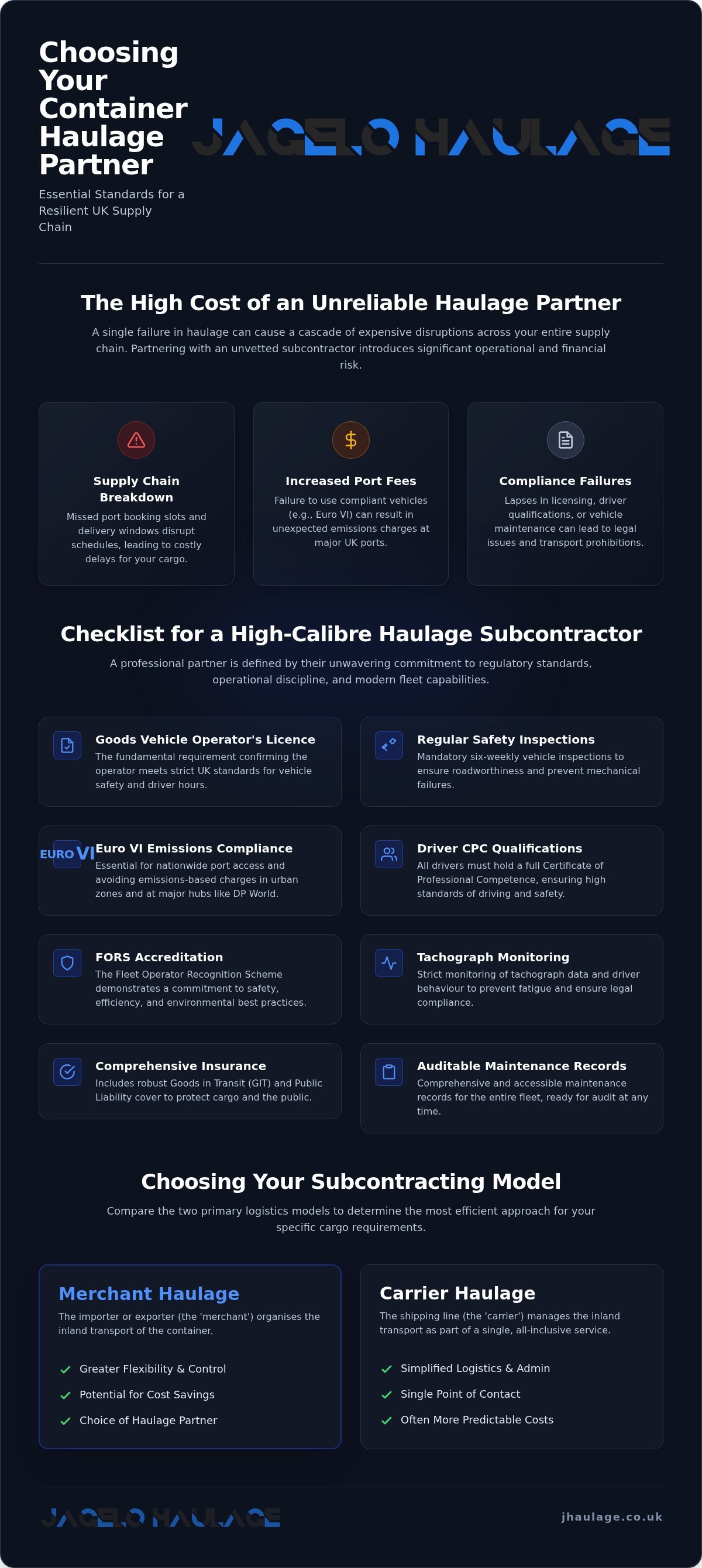
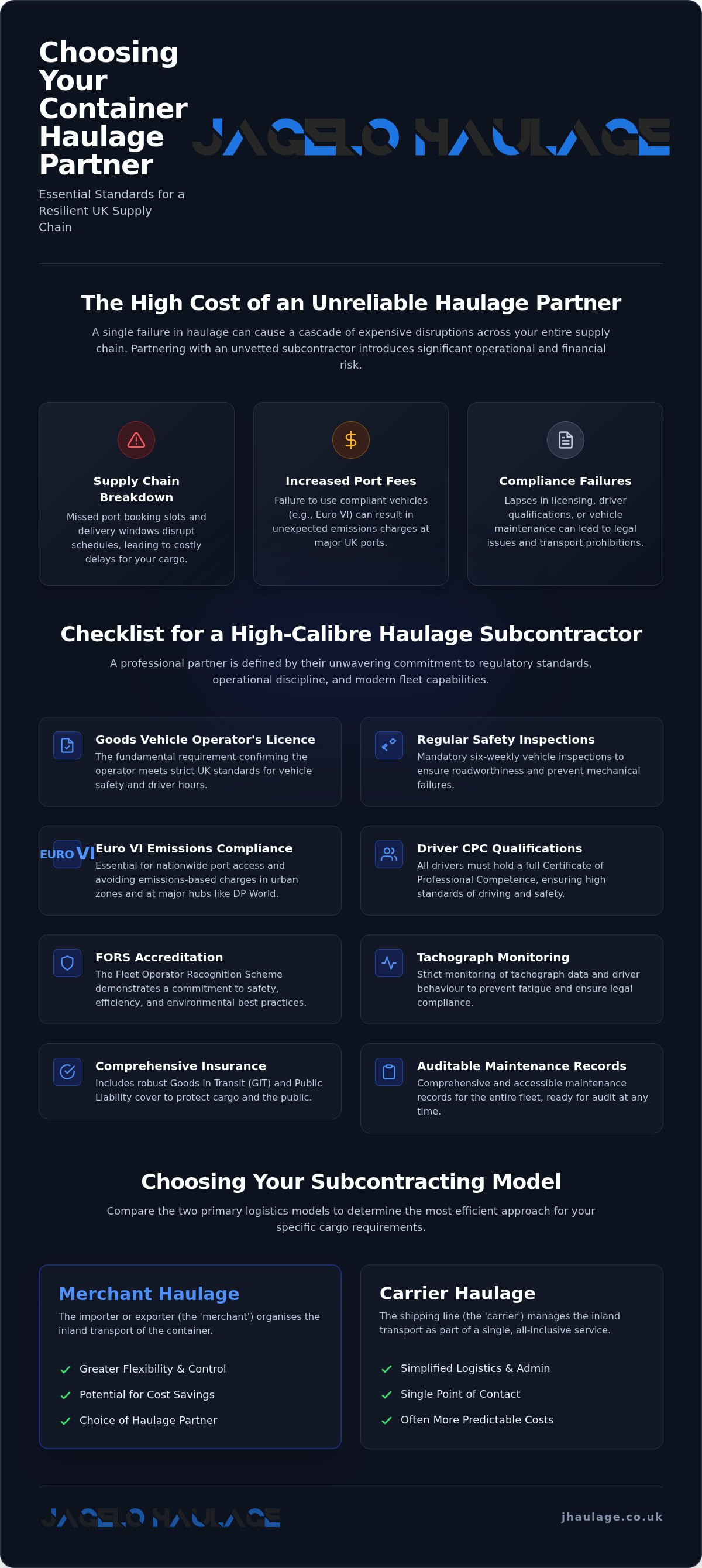
A container haulage subcontractor must meet rigorous regulatory benchmarks to ensure the safety and legality of the supply chain. The most fundamental requirement is a valid Goods Vehicle Operator’s Licence. This document confirms that the operator adheres to strict standards regarding vehicle safety and driver hours. Compliance with Euro 6 emissions standards is equally vital for nationwide access. Many UK ports and urban zones now enforce emissions charges, such as the revised VBS charges at DP World hubs. Using Euro VI compliant vehicles avoids these additional costs and supports corporate environmental targets.
Adherence to the Fleet Operator Recognition Scheme (FORS) often defines the quality of a transport partner. This voluntary accreditation demonstrates a commitment to safety, efficiency, and environmental protection. It provides a clear framework for measuring the performance of third-party fleets. Forwarders who prioritise these standards ensure their cargo is handled by a disciplined organisation that values operational excellence over mere vehicle availability.
Compliance and Regulatory Frameworks
Professional subcontractors maintain comprehensive insurance policies to protect the cargo and the public. This includes robust Goods in Transit (GIT) cover and public liability insurance. According to Logistics UK's annual report, the industry continues to face evolving regulatory pressures, making the choice of a compliant partner more critical than ever. Compliance isn't a one-time event; it requires constant vigilance and investment in training.
- Regular six-weekly vehicle safety inspections to ensure roadworthiness.
- Full Driver Certificate of Professional Competence (CPC) qualifications for all staff.
- Strict monitoring of driver behaviour and tachograph data to prevent fatigue.
- Comprehensive maintenance records that are available for audit at any time.
Modern Fleet Capabilities
The scale of a subcontractor’s fleet directly impacts their ability to provide consistent availability. A modern fleet of over 40 trucks ensures that overflow capacity is always manageable, even during peak maritime seasons. Modern equipment reduces the likelihood of mechanical breakdowns, which often cause cascading delays at port terminals. Real-time GPS tracking has become a standard requirement for modern logistics. It provides forwarders with precise data on container location and estimated arrival times. This transparency allows for better planning at inland distribution centres.
If you require a partner that meets these rigorous operational benchmarks, you can request a professional haulage quote to secure your capacity. A disciplined organisation understands that driver professional competence is a non-negotiable standard. Ongoing training ensures that drivers can navigate complex port environments and manage the high stakes of container transport. This level of expertise prevents the administrative errors that lead to missed vehicle booking slots.
Merchant vs Shipping Line Haulage: Choosing a Subcontracting Model
The choice between merchant and shipping line haulage determines who holds the operational reins of the inland transit. In the merchant model, the freight forwarder or cargo owner takes direct responsibility for arranging the transport from the port. Shipping line haulage, by contrast, is a carrier-controlled service where the shipping line organises the delivery as part of a through-bill of lading. A disciplined container haulage subcontractor like Jagelo Haulage possesses the operational flexibility to integrate with both frameworks, providing a seamless service for forwarders and carriers alike. For a deeper analysis of these commercial structures, you can read our strategic comparison of Merchant Haulage vs Shipping Line Haulage.
The Advantages of Merchant Haulage Solutions
Merchant haulage offers increased visibility and control over the delivery timeline. Forwarders aren't restricted by the carrier's choice of haulier; they can select a specific partner based on a proven reliability record. This transparency helps businesses avoid the "black box" of carrier-controlled logistics, where information about the container's status is often delayed or incomplete. By managing the subcontracting directly, forwarders ensure that their specific delivery requirements and site protocols are followed strictly. This model is particularly effective for time-critical cargo that requires precise coordination with inland distribution centres.
Partnering for Shipping Line Requirements
Shipping lines require partners that can handle high-volume port collections with absolute precision. According to UK port freight statistics, millions of containers move through UK terminals annually, creating a constant demand for reliable subcontracted capacity. International carriers rely on a professional container haulage subcontractor to uphold their service promises whilst adhering to complex international protocols. Jagelo Haulage brings over 15 years of experience to these partnerships, ensuring that every collection meets the stringent standards set by global shipping lines.
The value of a seasoned subcontractor lies in their ability to navigate the technical requirements of different lines. This includes managing specific documentation and adhering to terminal-specific safety rules. Whether operating under a merchant or shipping line instruction, the goal remains the same: the safe and punctual delivery of the container. A professionally managed fleet provides the security needed to protect the interests of all stakeholders in the maritime supply chain. Through consistent performance, a subcontractor becomes a strategic asset rather than just a physical service provider.
Operational Excellence: Managing Port Logistics and Nationwide Delivery
Success in UK logistics depends on the ability to navigate the nation's primary maritime hubs with precision. Felixstowe, Southampton, and DP World London Gateway serve as the entry points for the majority of the UK's containerised trade. A professional container haulage subcontractor must master the specific operational nuances of each terminal to ensure fluid movement. This expertise prevents the administrative bottlenecks that often delay cargo at the quayside. For a comprehensive look at these environments, refer to our Port Logistics Services UK reference guide.
Vehicle Booking Systems (VBS) act as the gatekeepers for these terminals. They're designed to prevent port congestion by regulating the flow of HGVs entering and exiting the port estates. A disciplined haulier maintains active, high-standing VBS accounts to secure the most efficient collection slots. Failure to manage these windows effectively leads to wasted driver hours and missed delivery targets. By treating VBS management as a core competency, a subcontractor ensures that every vehicle arrival is purposeful and productive.
Mastering the Port Collection Process
Demurrage and detention charges represent a significant financial risk for forwarders. These costs accumulate rapidly when containers aren't collected or returned within the agreed "free time" period. Established relationships with port authorities and terminal operators allow a subcontractor to resolve minor logistical hurdles before they escalate into significant delays. An expert haulier organises port collections by synchronising VBS slots with driver rest cycles to maximise fleet productivity. This methodical approach ensures that cargo moves from the quayside to the road without unnecessary friction.
Nationwide Reach and Same-Day Deliveries
Inland container haulage presents distinct challenges, particularly when moving goods from coastal hubs to regional distribution centres across the UK. Maintaining secure container transport requires disciplined operational protocols, including regular status updates and strict adherence to planned routes. Responsive support for urgent, same-day delivery requirements is a hallmark of a high-calibre partner. This level of service depends on a consistent communication rhythm. Clients receive clear, factual data regarding their cargo's progress throughout the journey, providing the security needed for effective inventory management.
Securing a partner that understands these technical requirements is essential for maintaining a resilient supply chain. You can book a container delivery service to secure your nationwide logistics requirements. A professional organisation doesn't just provide a vehicle; they provide a managed outcome that protects your operational efficiency.
Partnering with Jagelo Haulage: Professionalism in Every Mile
Jagelo Haulage operates as a disciplined, independently owned container haulage subcontractor. We understand that the movement of goods is the backbone of the UK economy. Our organisation doesn't just provide transport; we offer a secure, professionally managed extension of your supply chain. With a modern fleet of over 40 trucks and trailers, we maintain the operational reach required to serve all major maritime hubs. This capacity ensures that we can scale with your demand whilst maintaining the high standards of punctuality your clients expect.
A Disciplined Approach to Logistics
Jagelo Haulage focuses on the fundamentals of safety, efficiency, and clear communication. Whilst some competitors are relative newcomers to the sector, our 15-year track record makes us a master of the fundamentals in UK haulage. We've refined our internal protocols to ensure every container is handled with technical competence and care. Our commitment to maintaining a modern container transport fleet ensures that mechanical reliability is never a concern for our partners. We prioritise functional reliability over self-promotion, focusing on delivering results that protect your operational efficiency.
National Coverage with a Strategic Outcome
We position our service as a strategic partnership rather than a simple logistical task. Our ability to handle diverse cargo types and navigate complex logistics requirements allows us to provide protected outcomes for every container moved across the UK. We understand the high stakes involved in port-to-door deliveries, where a single error can disrupt an entire production line or retail schedule. By following strict protocols and maintaining a disciplined communication rhythm, we eliminate the uncertainty often associated with third-party transport.
Initiating a partnership with Jagelo Haulage is a straightforward process designed for operational managers. We provide the security of a seasoned professional who follows protocols strictly and understands the importance of every vehicle booking slot. If you require a dependable partner that prioritises safety and efficiency above all else, our team is ready to integrate with your logistics framework. We deliver the consistency and functional reliability that modern UK supply chains demand.
Securing Your Supply Chain Through Strategic Partnership
A professional container haulage subcontractor serves as a critical component in a resilient logistics network. The transition from port to door demands more than just vehicle availability; it requires disciplined VBS management, strict adherence to Euro 6 standards, and the technical competence to navigate terminal protocols. Whether you utilise merchant haulage for greater control or integrate with shipping line requirements, the reliability of your transport partner directly impacts your operational outcome. Choosing a partner that understands these technicalities ensures that your supply chain remains secure and efficient.
Jagelo Haulage provides the security of over 15 years of operational expertise and a modern fleet of 40+ trucks and trailers. Our national coverage from all major UK ports provides the reach your business needs to scale with confidence. We prioritise functional reliability and safety in every mile, ensuring your cargo reaches its destination punctually. You can discuss your container haulage requirements with our professional team today to secure a dependable extension for your fleet. We look forward to supporting your logistics goals with the steadfast professionalism your supply chain deserves.
Frequently Asked Questions
What is the role of a container haulage subcontractor in the UK?
A container haulage subcontractor acts as a specialised transport partner that fulfills the inland delivery of shipping containers on behalf of freight forwarders or shipping lines. They provide the physical fleet and driver expertise necessary to move cargo from maritime terminals to regional distribution centres. This role is essential for managing seasonal volume spikes and ensuring that primary logistics providers can scale their operations without the fixed costs of maintaining an oversized permanent fleet.
What qualifications must a haulage subcontractor possess?
High-calibre subcontractors must hold a valid Goods Vehicle Operator’s Licence and comprehensive insurance, including Goods in Transit (GIT) and public liability. Every driver must maintain a valid Certificate of Professional Competence (CPC) to ensure they meet legal safety standards. Many professional organisations also seek FORS accreditation, which demonstrates a commitment to operational efficiency and road safety. These qualifications serve as a benchmark for reliability and regulatory compliance in the haulage sector.
How do subcontractors manage collections from major UK ports like Felixstowe?
Subcontractors manage port collections by utilising terminal-specific Vehicle Booking Systems (VBS). These digital platforms regulate HGV traffic at hubs like Felixstowe and Southampton to prevent terminal congestion. A disciplined partner synchronises these booking windows with driver rest requirements to maximise efficiency. This methodical approach is vital for avoiding port demurrage and detention charges, which accumulate rapidly if containers aren't collected within the port's designated free-time period.
Is a subcontractor responsible for container insurance during transit?
Professional subcontractors carry Goods in Transit (GIT) insurance to protect the cargo whilst it's under their control. This insurance provides financial security for the freight forwarder and the end client in the event of unforeseen incidents. Whilst the primary carrier may have their own umbrella policy, the subcontractor’s specific GIT cover ensures that the physical transport phase is fully protected. It's a standard requirement for any reputable container haulage subcontractor operating in the UK.
Can a haulage subcontractor provide same-day container delivery?
Same-day container delivery is possible when a subcontractor has the fleet capacity and port proximity to execute urgent instructions. This service involves collecting a container from the terminal and delivering it to the inland destination within a single operational cycle. It requires precise coordination of VBS slots and driver availability to meet tight deadlines. For time-critical cargo, this responsive support helps businesses maintain inventory levels and meet urgent retail or manufacturing demands.
What is the difference between merchant haulage and shipping line haulage for subcontractors?
The difference lies in who instructs the subcontractor and controls the logistics chain. In merchant haulage, the freight forwarder or cargo owner arranges the transport directly, allowing for greater flexibility and partner selection. Shipping line haulage is carrier-controlled, where the shipping line manages the delivery as part of their service. A versatile subcontractor integrates with both models, following the specific site protocols and documentation requirements mandated by either the forwarder or the carrier.
How does a subcontractor integrate with a freight forwarder’s operations?
Integration occurs through consistent communication and the use of real-time tracking data. Professional subcontractors provide freight forwarders with precise arrival times and status updates, allowing for better coordination at the delivery site. This collaborative approach ensures that documentation, such as delivery notes and container interchange receipts, is handled accurately. By acting as a transparent partner, the subcontractor helps the forwarder maintain a high level of service for the final cargo recipient.
Why is Euro 6 compliance important for UK haulage subcontractors?
Euro 6 compliance is a regulatory requirement for accessing various UK ports and urban Clean Air Zones without incurring daily penalties. At DP World terminals, for example, VBS emissions charges are tiered based on the vehicle's Euro standard, with newer Euro VI D and E vehicles receiving lower rates or credits. For a container haulage subcontractor, maintaining a modern, compliant fleet is essential for controlling operational costs and supporting the environmental targets of their corporate clients.