A container sitting idle at the Port of Felixstowe represents more than a simple delay; it's a direct drain on your operational margin. Freight forwarders often find that Vehicle Booking System (VBS) bottlenecks and escalating demurrage charges are treated as unavoidable costs of doing business. You recognise that a fluid supply chain requires more than just booking a slot. It demands a disciplined approach to container haulage for freight forwarders that prioritises operational precision.
This guide explains how to optimise your UK logistics through professional merchant haulage and specialised equipment. We will examine the methods for achieving a seamless port-to-door transition whilst maintaining real-time visibility. You will learn how disciplined port logistics management reduces the risk of detention fees and provides the control needed for a more resilient supply chain. By implementing these strategic outcomes, you can ensure your cargo moves with the consistency and security your clients expect.
Key Takeaways
- Professional haulage serves as a strategic extension of your business. It ensures the final mile of delivery protects your operational reputation.
- Merchant haulage offers superior flexibility and control over scheduling. It provides a more cost-effective alternative to shipping line solutions.
- Modern fleet standards and Euro 6 compliance are essential for nationwide reliability. They ensure your transport operations meet current UK environmental requirements.
- Strategic container haulage for freight forwarders mitigates the financial risk of port delays. It helps prevent escalating demurrage and detention charges.
- Disciplined port logistics management creates a seamless transition from the quayside to the final destination. This approach improves overall supply chain efficiency.
The Critical Role of Professional Container Haulage for Freight Forwarders
The success of a complex global shipping operation relies on the final leg of the journey. For logistics professionals, container haulage for freight forwarders is the decisive factor that determines whether a shipment remains profitable or incurs avoidable penalties. A forwarder's strategy effectively terminates if the inland transport fails to perform. This synergy between maritime planning and road execution ensures that the service promise made to the end client is fulfilled. Without disciplined haulage operations, even the most sophisticated supply chains can collapse at the quayside.
The final mile of container transport often defines a forwarder’s reputation. Whilst the sea freight leg is largely standardised, the road transport phase is subject to local variables such as port congestion and Vehicle Booking System (VBS) availability. A reliable haulier acts as a strategic extension of the forwarder's own team. They provide the nationwide reach necessary to service diverse delivery points whilst maintaining the port-specific expertise required to clear terminals quickly. This level of operational discipline is what separates a simple delivery from a secure logistical outcome.
Bridging the Gap Between Sea and Land
The transition from international maritime routes to the UK road network involves significant technical complexity. This process sits at the heart of intermodal freight transport, where the efficiency of the road leg is critical to the overall transit time. Freight forwarders require partners who understand the specific operational behaviours of major UK hubs like Felixstowe, London Gateway, and Southampton. Managing port logistics services UK as a specialist subcontractor requires more than just a fleet. It requires a deep understanding of terminal procedures, customs requirements, and vehicle booking systems. A haulier who masters these fundamentals can mitigate the risks of delays that lead to costly demurrage charges.
The Value of an Independent Haulage Partner
Choosing an independent contractor like Jagelo Haulage offers distinct advantages over standard shipping line haulage. Independence provides the flexibility in scheduling that larger, more rigid organisations cannot match. Jagelo Haulage expertise allows for more responsive scheduling, which is vital when port congestion or vessel delays occur. With 15 years of industry experience, an independent specialist understands how to navigate UK port bureaucracy effectively. This expertise is backed by a modern fleet of over 40 trucks, providing the capacity needed for high-volume operations. Working with a dedicated merchant haulage provider allows freight forwarders to regain control of their delivery timelines. This control is essential for maintaining the high standards of service and reliability that modern supply chains demand.
Merchant Haulage vs Shipping Line Haulage: Choosing the Right Model
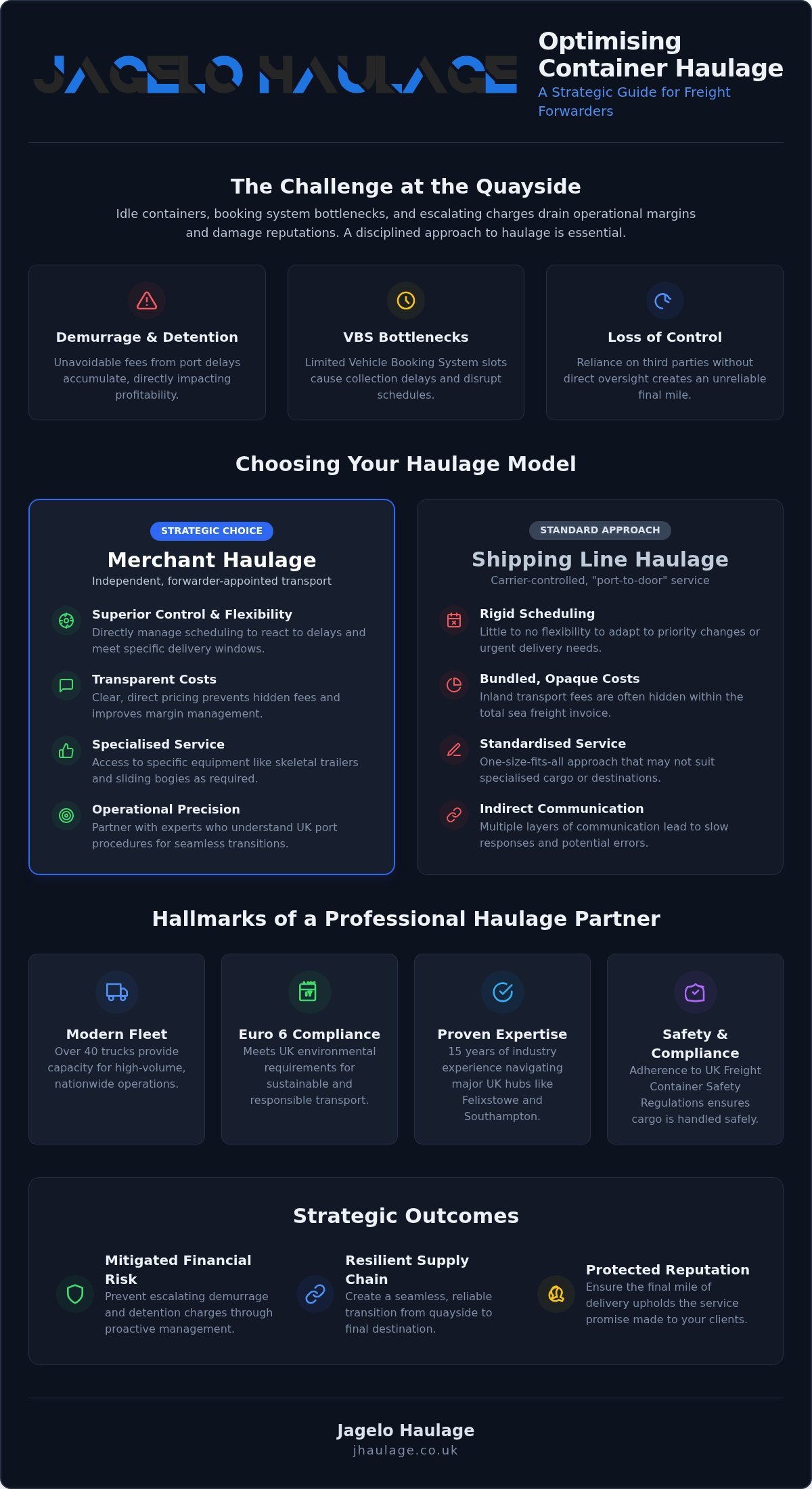
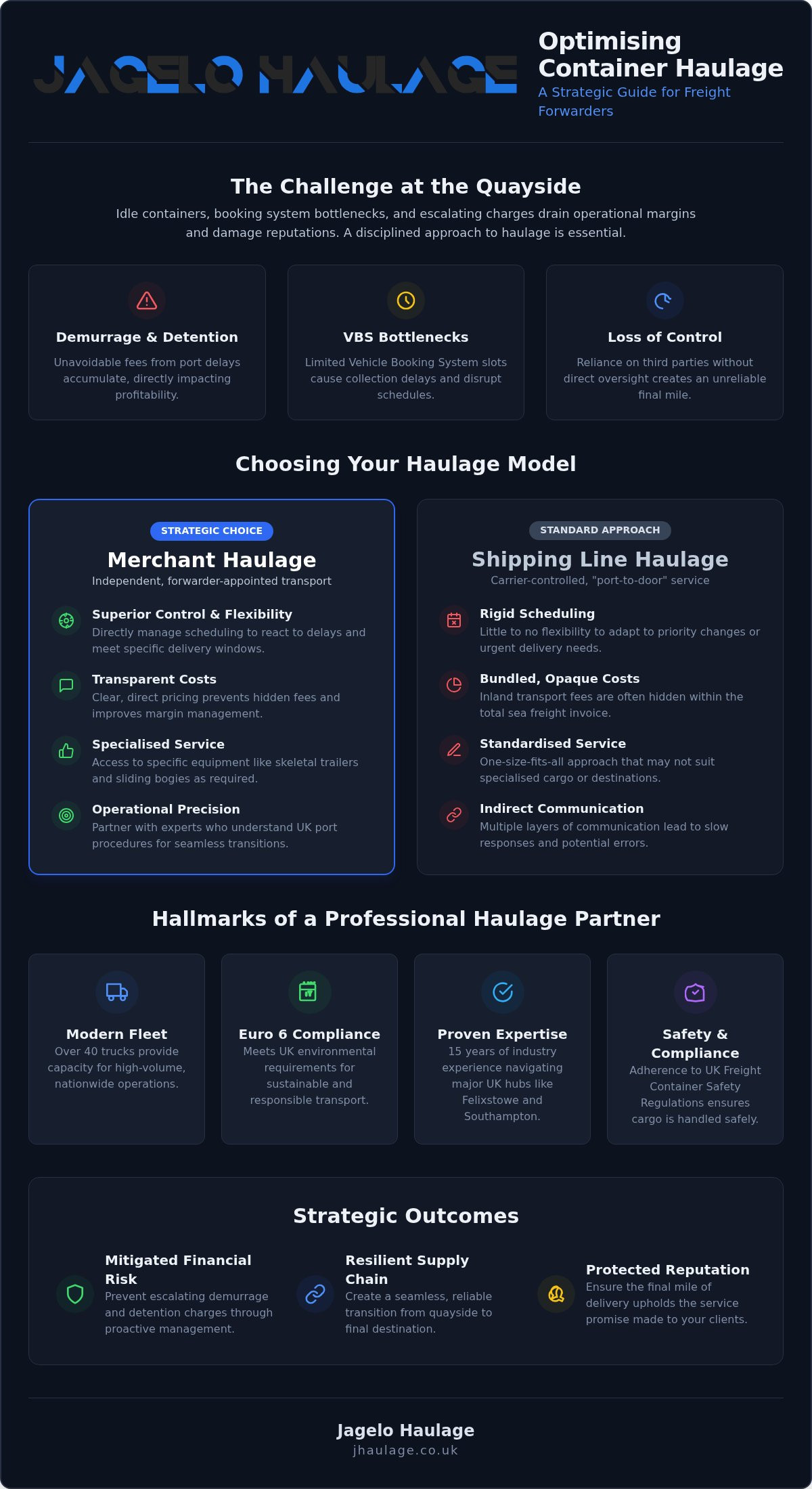
The choice between merchant haulage and shipping line haulage represents a fundamental decision in margin management. For many operators, the default reliance on shipping lines for inland transport is being replaced by more disciplined, independent models. Effective container haulage for freight forwarders requires a level of oversight that carrier-controlled transport rarely provides. Whilst shipping lines offer a bundled "port-to-door" service, they often lack the granular flexibility needed to navigate specific delivery windows or urgent priority changes.
Forwarders are increasingly pivoting towards merchant haulage to regain control over their supply chain costs. In a merchant haulage model, the forwarder appoints a dedicated haulier to collect the container from the terminal. This allows for direct communication and transparent pricing. It also places the responsibility for managing the "merchant" aspect of the contract firmly in the hands of a specialist partner. This partner ensures that every box handled meets the statutory requirements outlined in the UK Freight Container Safety Regulations, maintaining high standards of maintenance and examination during transit.
The Strategic Advantage of Merchant Haulage
Merchant haulage provides greater transparency in both scheduling and expenditure. You can select specialised equipment, such as skeletal trailers or sliding bogies, tailored specifically to the cargo requirements. This model also allows you to manage demurrage and detention risks more proactively. By using a partner with 15 years of industry experience, you can ensure containers are returned to the quay before free-time periods expire. For a deeper analysis of these benefits, read our merchant haulage vs shipping line comparison. Forwarders seeking a strategic partner can request a bespoke haulage quotation to secure their 2026 capacity.
When to Utilise Shipping Line Haulage
Shipping line haulage may be a tactical choice in specific scenarios where convenience outweighs the need for direct control. It simplifies the booking process by keeping the entire journey under a single Bill of Lading. However, this convenience often comes at the expense of operational visibility. Forwarders often lose the ability to track containers in real-time once they leave the port. They also become subject to the carrier's own transport priorities, which might not align with the end client's urgent requirements. The trade-off between a simplified booking and the loss of scheduling flexibility is a critical factor in long-term supply chain planning.
Essential Fleet Standards and Equipment for Modern Port Logistics
Operational reliability depends on the physical capability of the transport assets. A modern fleet ensures nationwide service consistency. For container haulage for freight forwarders, the equipment used directly impacts the safety and speed of the delivery. Professional hauliers prioritise the maintenance of their trucks and trailers to prevent the mechanical failures that disrupt supply chain schedules. This disciplined approach to asset management provides the security that logistics managers require when moving high-volume freight across the UK.
In 2026, Euro 6 compliance is a mandatory standard for entering UK urban centres and Clean Air Zones. Hauliers who don't maintain these standards incur daily charges that erode the forwarder's margins. Professional operators follow the International Road Haulage Guidance to ensure all domestic and cross-border compliance requirements are met. This includes the mandatory adoption of Smart Tachograph Version 2 (ST2) technology for vehicles over 2.5 tonnes involved in international transport, which became effective on July 1, 2026. These digital tools provide the transparency needed to monitor driver hours and ensure operational safety.
Specialised Equipment for Container Deliveries
Sliding skeletal trailers provide the necessary versatility for modern port logistics. These trailers adjust to secure 20ft, 40ft, and 45ft containers, ensuring the weight is distributed correctly across the axles. Maintaining these trailers through rigorous protocols prevents mechanical failures that delay the supply chain. You can explore the technical requirements of these assets in our guide to the modern container transport fleet. The use of specialised equipment allows for the safe handling of varied container sizes whilst maintaining the integrity of the cargo during transit.
Security and Safety in the Haulage Chain
Protecting high-value freight requires a disciplined approach to security. Manned depots and CCTV monitoring provide a secure environment for containers during mandated driver rest periods. Fully insured container haulage is a non-negotiable requirement for forwarders who must protect their liability. Professional fleet management uses real-time tracking and driver performance tools to monitor cargo status and transit behaviour. This data-driven approach reduces the risk of roadside breakdowns and ensures every container remains on its planned operational route. By prioritising these safety standards, hauliers provide a reliable foundation for a forwarder's reputation.
Optimising Port-to-Door Deliveries: Reducing Delays and Demurrage
Port delays represent a significant financial burden for logistics providers. In 2026, daily demurrage rates in the UK typically range from £50 to £200 per container, depending on the specific port and the season. These costs directly erode the profit margins of freight forwarding operations. Strategic container haulage for freight forwarders involves more than just road transport; it requires active management of port dwell times to ensure containers move before free-time allowances expire. Most UK ports provide a standard free-time window of three to five days, making disciplined scheduling a requirement for every shipment.
Proactive container collection from major UK hubs like Felixstowe or London Gateway requires a haulier who understands the rhythm of port operations. Disciplined scheduling prevents the accumulation of quay rent and ensures that cargo reaches the end customer without unnecessary storage fees. During periods of peak port congestion, responsive customer support becomes a vital tool for maintaining supply chain visibility. A partner who provides real-time updates allows you to adjust inland transport plans before delays become a financial liability.
Navigating the Vehicle Booking System (VBS)
Hauliers must manage VBS slots with precision to ensure timely container retrieval. These booking systems act as the gatekeeper for port access, and missing a slot can lead to significant delays in the delivery chain. Many forwarders now utilise "Drop & Collect" services to maximise warehouse efficiency. This method allows a driver to drop a full container and immediately collect an empty one, reducing vehicle turnaround times. Coordinating inland container haulage with warehouse opening hours ensures that the transition from the port to the final destination remains fluid and predictable.
Preventing Demurrage and Detention Charges
Forwarders can reduce the risk of detention fees by following a structured approach to container management. Ensuring all customs documentation is accurate and that PIN or release codes are available before the vessel docks is essential for seamless port egress. You can find more detail on managing these overheads in our guide to understanding container transport costs. A disciplined checklist for freeing containers includes:
- Verifying the release status of the container at least 24 hours before vessel arrival.
- Confirming warehouse delivery capacity to avoid failed delivery attempts.
- Securing VBS slots early to align with the container's "freed" status.
- Monitoring vessel arrival times to adjust haulage bookings in real-time.
Effective scheduling protects your bottom line and ensures your clients receive their goods on time. To secure reliable capacity for your next shipment, you can request a professional haulage quote today.
Establishing a Reliable Haulage Partnership with Jagelo Haulage
Selecting a long-term partner requires a focus on performance over personality. For high-volume operators, container haulage for freight forwarders must be backed by a provider that understands the high stakes of the supply chain. Jagelo Haulage positions itself as a strategic partner rather than a simple service provider. This approach ensures that every container delivery is treated as a critical component of your broader operational framework. By prioritising the fundamentals of port logistics, the brand provides the stability needed to navigate the volatile UK logistics market.
A 40-strong modern fleet provides the necessary capacity to handle the requirements of nationwide forwarding operations. This scale allows for consistent service levels whilst maintaining the flexibility to respond to urgent port-to-door requests. Every vehicle is professionally managed to ensure secure transport operations, reducing the risk of cargo loss or transit delays. When you partner with a disciplined entity, you gain access to a logistics network that understands the importance of punctuality and strict protocol adherence. This operational reach is essential for maintaining your reputation with the end client.
A Legacy of Operational Excellence
Jagelo Haulage has spent 15 years refining its specialised service at major UK maritime hubs. This heritage has fostered a no-nonsense approach to solving the complex logistics challenges that often arise at the quayside. Forwarders trust the brand because it understands that a secure delivery is the only acceptable outcome. There's a stoic pride in the company's ability to provide protected results across diverse industry niches. This consistency has made the firm a preferred choice for operators who value functional reliability and technical competence above all else.
Next Steps for Your Logistics Strategy
Initiating a partnership involves a structured onboarding process designed to align with your specific supply chain requirements. You can request a bespoke quote for nationwide container haulage that reflects the volume and frequency of your shipments. This transparent pricing model helps you manage your margins whilst securing priority capacity at the UK's busiest terminals. Our team is ready to provide the disciplined support your freight forwarding business deserves. Contact Jagelo Haulage to discuss your requirements and begin the transition to a more reliable inland logistics solution.
Securing Your Supply Chain for 2026 and Beyond
The efficiency of your inland logistics determines the overall success of your forwarding operations. By pivoting to a merchant haulage model, you regain the control necessary to manage delivery windows and avoid the escalating costs associated with port delays. Maintaining high standards in equipment and compliance ensures your cargo moves safely through UK urban centres without incurring avoidable penalties. These strategic choices directly impact your ability to provide a seamless service to your clients whilst protecting your commercial margins.
Jagelo Haulage provides the disciplined execution required to master these logistical fundamentals. With 15 years of industry experience and a modern fleet of over 40 trucks, we offer the capacity and reliability needed to protect your professional reputation. Implementing a strategic approach to container haulage for freight forwarders transforms the final mile from a potential bottleneck into a consistent operational advantage. This level of functional reliability is essential for navigating the complexities of the 2026 supply chain landscape.
Partner with Jagelo Haulage for reliable nationwide container transport and ensure your containers reach their destination with precision. We look forward to supporting your business as a dedicated strategic partner.
Frequently Asked Questions
What is the difference between merchant haulage and shipping line haulage?
Merchant haulage is transport arranged independently by the freight forwarder or cargo owner through a private haulier. Shipping line haulage is a bundled service where the ocean carrier manages the inland delivery as part of the freight contract. Merchant haulage provides the forwarder with greater control over scheduling, equipment choice, and cost transparency.
How do freight forwarders benefit from using an independent container haulier?
Independent hauliers offer direct communication and operational flexibility that shipping lines often lack. This partnership ensures more responsive container haulage for freight forwarders, allowing for quicker adjustments to port congestion or warehouse schedule changes. Working with a specialist provides a more disciplined approach to the final mile of the supply chain.
Which major UK ports does Jagelo Haulage operate from?
Jagelo Haulage provides comprehensive coverage from all major UK maritime gateways. These include the Port of Felixstowe, London Gateway, Tilbury, Southampton, and Liverpool. This broad operational reach ensures that forwarders have a consistent partner for containers arriving at any of the UK's primary container terminals.
What equipment is used for shipping container transport?
Shipping containers are transported using specialised skeletal trailers designed to secure heavy loads. Sliding skeletal trailers are the industry standard; they adjust to accommodate 20ft, 40ft, and 45ft containers whilst ensuring correct weight distribution. These trailers are subjected to rigorous maintenance protocols to ensure the safety and integrity of the cargo during transit.
How can I avoid demurrage charges when booking container haulage?
Avoiding demurrage requires collecting containers before the port's free-time allowance, which is typically three to five days, expires. You must ensure all customs clearances are completed and release codes are provided to your haulier early. Disciplined scheduling of Vehicle Booking System (VBS) slots is essential to ensure timely retrieval from the terminal quay.
Is Jagelo Haulage’s fleet compliant with UK Clean Air Zones?
Yes, the modern fleet of over 40 trucks is maintained to meet the latest environmental standards. This includes full Euro 6 compliance, which allows our vehicles to enter UK urban centres and Clean Air Zones without incurring daily non-compliance penalties. This standard is vital for maintaining cost-effective deliveries to metropolitan warehouses.
Does Jagelo Haulage provide nationwide container deliveries?
Jagelo Haulage operates with a nationwide reach from its strategic port locations. The fleet is equipped to handle long-haul inland deliveries to any destination in the UK, providing forwarders with a reliable and secure transport solution regardless of the final delivery point. This consistency simplifies the logistics planning process for high-volume operators.
What security measures are in place for high-value container transport?
Cargo protection is managed through a combination of manned security, CCTV monitoring at depots, and real-time fleet tracking. Every container movement is fully insured, and drivers follow strict safety protocols during mandated rest periods. These disciplined measures ensure that high-value freight remains secure throughout the entire haulage chain.