Part of our guide to container haulage from Tilbury
Does your current logistics strategy account for the increasing complexity of Thames-side operations, or is your supply chain vulnerable to the next VBS bottleneck? Professional Tilbury container haulage requires more than just a fleet of vehicles; it demands a disciplined approach to port navigation and strict adherence to evolving regulatory standards. We recognise that port congestion and booking difficulties often disrupt your operational flow, which directly impacts your ability to meet customer commitments.
Reliable logistics shouldn't be a matter of chance. This article demonstrates how to streamline your supply chain by utilising expert haulage from the Port of Tilbury to any UK destination. We'll examine the methods for achieving predictable delivery windows and maintaining transparent communication throughout the transit process. You'll also discover how to ensure your operations remain fully compliant with the 2026 road safety standards, providing a secure and protected outcome for every container moved.
Key Takeaways
- Understand the strategic advantages of the Port of Tilbury as a primary gateway for UK distribution centres and the M25 corridor.
- Optimise your Tilbury container haulage by mastering the Vehicle Booking System (VBS) and utilising efficient "Drop and Swap" operational models.
- Evaluate the functional differences between merchant haulage and shipping line haulage to secure greater control over your inland transport.
- Ensure full compliance with the 2026 Direct Vision Standard (DVS) and Euro 6 emissions requirements for all Thames-side logistical operations.
- Recognise how established expertise and a modern fleet of over 40 trucks provide the stability required for reliable nationwide container deliveries.
Tilbury Container Haulage: A Strategic Hub for UK Port Logistics
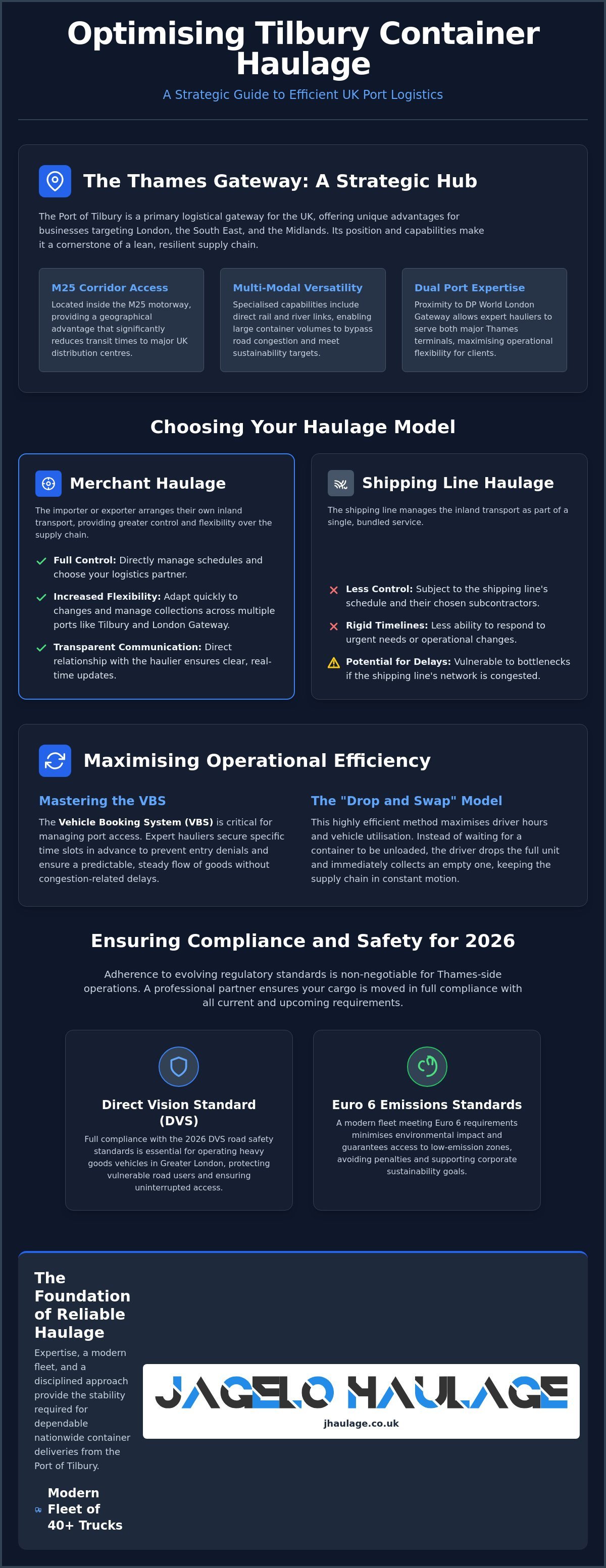
Tilbury container haulage functions as the essential connection between the Thames-side maritime terminals and the UK's inland infrastructure. For businesses importing or exporting goods, this service ensures that cargo moves efficiently from the quayside to its final destination. The Port of Tilbury serves as a primary logistical gateway, especially for operations targeting London and the South East. Its position inside the M25 motorway provides a distinct geographical advantage that reduces transit times to major distribution centres. It's a critical component for maintaining a lean supply chain in a competitive market.
In 2026, Tilbury remains a preferred entry point for a diverse range of cargo. This includes high-volume retail goods, perishable food items, and heavy industrial components. A professional haulier must possess a deep understanding of the local infrastructure. This includes the specific operational requirements of both Tilbury and the nearby DP World London Gateway. Managing these sites effectively requires a disciplined approach to scheduling and a thorough knowledge of Thames-side traffic patterns. Consistency in these operations prevents the costly delays often associated with less experienced providers.
The Significance of the Thames Gateway in 2026
The Thames Gateway occupies a unique position within the UK's port network. While Felixstowe and Southampton handle vast deep-sea volumes, Tilbury offers specialised multi-modal capabilities that include rail and river links. This versatility supports a more resilient supply chain. For businesses distributing to the Midlands and Southern England, using Thames-side ports often results in lower fuel consumption and reduced road miles. The integration of rail freight at Tilbury allows for the movement of large container volumes with high consistency, bypassing potential road congestion on the national motorway network. These multimodal links are essential for meeting modern sustainability targets whilst maintaining operational speed.
London Gateway vs. Tilbury: Logistical Nuances
Distinguishing between the two major Thames terminals is vital for strategic planning. London Gateway is designed for the world's largest deep-sea vessels, whereas Tilbury excels in short-sea container traffic and multi-modal transfers. Because these ports are located in close proximity, hauliers often serve both sites within a single shift. Choosing merchant haulage provides the flexibility required to manage collections across both terminals. This model allows businesses to retain control over their transport schedules rather than relying on the more rigid timelines often associated with shipping line haulage. A strategic partner understands how to navigate the specific entry protocols of each site to ensure seamless container movement.
Operational Efficiency: How Container Collection Works at Tilbury
Tilbury container haulage relies on precise timing and technical coordination. The port environment is highly regulated to prevent bottlenecks and ensure a steady flow of goods. Effective collection begins with a sophisticated understanding of terminal infrastructure and local traffic management. Operators who maintain 24/7 capabilities are best positioned to meet the strict windows imposed by shipping lines. This constant availability ensures that containers don't sit idle on the quay, incurring unnecessary storage charges or demurrage fees. It's a disciplined approach that prioritises the movement of cargo over all other variables.
Modern logistics providers use advanced fleet tracking to maintain visibility throughout the transit process. This technology provides real-time updates and accurate arrival estimates for the end client. For high-volume distribution sites, the "Drop and Swap" model offers a significant efficiency gain. Instead of a driver waiting for a container to be unloaded, they drop a full unit and immediately collect an empty one. This method maximises driver hours and keeps the supply chain moving without the friction of extended wait times. If you require a logistics partner that prioritises these efficiencies, you can request a professional haulage quote to see how these systems benefit your operation.
The VBS and Terminal Procedures
The Vehicle Booking System (VBS) is the primary tool used to manage port congestion at Tilbury. Hauliers must secure a specific time slot before a vehicle can enter the terminal. This process involves verifying container release details, selecting an available slot through the port's digital platform, and assigning a specific driver to the booking. Experienced operators often balance peak and off-peak slots to manage costs and avoid the heaviest traffic periods. For a successful gate release, drivers require the correct release codes, PINs, and valid identification. Any discrepancy in this documentation can lead to a rejected entry, causing significant delays in the delivery schedule.
Managing ISO Container Sizes and Cargo Types
Standard ISO containers come in various sizes, primarily 20ft, 40ft, and 45ft units. Each requires specific trailer configurations to ensure correct weight distribution and road safety. According to official UK port freight statistics, the sheer volume of containerised traffic necessitates a fleet that can adapt to these varying loads. Beyond standard units, some cargo is classified as "out-of-gauge" (OOG), meaning it exceeds the dimensions of a standard container. These loads require specialised flat-rack or open-top equipment and precise route planning to navigate the UK's road network safely. Fleet versatility is therefore essential for meeting diverse import and export requirements.
Merchant vs Shipping Line Haulage: Selecting the Optimal Model
Choosing the correct transport model is a fundamental decision for any UK business utilising Tilbury container haulage. The industry distinguishes between merchant haulage and shipping line haulage based on who holds the contract with the road transport provider. Merchant haulage occurs when the cargo owner or their freight forwarder organises the inland transport directly. In contrast, shipping line haulage, often referred to as carrier haulage, involves the ocean carrier managing the entire journey from the port to the final destination. Each model presents distinct operational consequences for your supply chain.
In 2026, many businesses are shifting toward merchant haulage to gain better control over their logistical spend. This model allows for more granular management of schedules and prevents the lack of transparency often found in bundled shipping line services. By working with independent providers, merchant haulage companies function as strategic partners. They provide tailored solutions that align with specific warehouse requirements rather than following the rigid, high-volume protocols of global carriers. This partnership ensures that your containers are handled with a level of care and punctuality that supports long-term operational stability.
The Benefits of Merchant-Led Logistics
The primary advantage of merchant-led logistics is the significant increase in transparency regarding container transport costs. When you manage your own haulage, you eliminate the hidden administrative fees often applied by shipping lines. This direct relationship facilitates immediate communication, which is vital for managing urgent or same-day delivery requirements. Furthermore, merchant haulage allows you to consolidate loads from multiple shipping lines under a single transport provider. This consolidation simplifies your administrative processes and ensures that all your Tilbury collections follow a consistent set of safety and performance standards as advocated by the Road Haulage Association (RHA).
When to Use Shipping Line Haulage
Shipping line haulage remains a viable option for low-volume importers who prefer a simplified, "all-in" service. It removes the need for the merchant to coordinate with multiple vendors, as the carrier handles the entire transit. However, this convenience often comes at the expense of flexibility. During peak times at the Port of Tilbury, carrier-controlled haulage may face delays if the line's own fleet or contracted partners are overstretched. Merchants often find they lack priority in these scenarios, leading to missed delivery windows. Understanding the distinction between "carrier haulage" and "merchant haulage" in your contracts is essential for identifying where the responsibility for delays and additional costs truly lies.
Compliance and Safety Standards for Thames-Side Haulage in 2026
Tilbury container haulage involves navigating some of the most strictly regulated road networks in the United Kingdom. Compliance isn't merely a matter of avoiding penalties; it's a fundamental component of professional risk management. Operating in proximity to London requires a disciplined adherence to evolving safety and environmental standards. For a business, selecting a haulier that prioritises these regulations ensures that cargo isn't delayed by enforcement actions or access restrictions. Membership in the Road Haulage Association (RHA) or the Fleet Operator Recognition Scheme (FORS) provides a necessary layer of trust and verifies that a provider follows established industry best practices.
Modern equipment remains the most effective tool for reducing the risk of breakdowns and delivery failures. Older fleets are statistically more prone to mechanical issues that can disrupt a carefully planned supply chain. By utilising contemporary vehicles, a logistics partner provides a more protected outcome for every container moved. This reliability is essential for maintaining the predictable delivery windows that corporate clients require. If you want to ensure your operations meet all current safety and environmental criteria, you can book your Tilbury haulage with a compliant partner to secure your delivery schedule.
Direct Vision Standard (DVS) and London Logistical Safety
The Direct Vision Standard (DVS) is a critical requirement for any HGV entering Greater London from the Thames-side ports. By 2026, the "Progressive Safe System" (PSS) is the mandatory standard for vehicles that don't meet the minimum three-star rating for direct driver visibility. This system incorporates advanced 2026-specific safety technology, including active blind-spot sensors and moving-off information systems. These features protect the driver and the public whilst the vehicle enters or exits busy port zones. Adopting these systems isn't just a legal necessity; it's a strategic commitment to operational safety that prevents avoidable accidents and the subsequent logistical delays they cause.
Sustainability and Emission Controls
Environmental compliance is a significant factor for southern port logistics in 2026. Whilst Thurrock Council has maintained its opposition to ULEZ signage and extensions within its borough, most delivery routes from Tilbury lead directly into the London Ultra Low Emission Zone. Euro 6 engine standards are the absolute minimum requirement for avoiding substantial daily charges and maintaining access to the capital's distribution centres. A modern container transport fleet reduces the carbon footprint of your supply chain through superior fuel efficiency and lower particulate emissions. This transition toward high-efficiency vehicles is essential for businesses aiming to meet their own corporate sustainability targets whilst ensuring cost-effective transport.
Jagelo Haulage: Reliable Nationwide Delivery from the Port of Tilbury
Jagelo Haulage provides specialised container haulage from the Port of Tilbury to any UK destination. With over 15 years of experience in UK port logistics, the company operates as a disciplined partner for businesses requiring consistent results. Our fleet consists of over 40 modern trucks, all maintained to high standards to ensure operational stability and minimise the risk of mechanical failure. Whilst many providers focus on local deliveries within Essex, we position our Tilbury container haulage as a truly national solution. We understand that your supply chain extends far beyond the port gates, reaching distribution centres in the Midlands, the North, and the South West. This national reach is supported by a robust infrastructure that ensures your cargo remains secure from the moment it leaves the terminal.
The professionally managed nature of our operation focuses on security and punctuality above all else. We don't rely on marketing hyperbole; instead, we let our performance and results define our brand. By maintaining a fleet of modern, Euro 6 compliant vehicles, we provide the functional reliability necessary to navigate the complexities of the UK's road network. Our drivers follow strict protocols to ensure that every container delivery is executed with precision. This disciplined approach provides you with the quiet confidence that your goods will arrive within their designated windows, regardless of the destination's distance from the Thames-side terminals.
Why Partner with Jagelo Haulage?
Success in this sector depends on functional reliability and a masterly grasp of the fundamentals. Jagelo Haulage has established a proven track record at major maritime hubs, including Tilbury, London Gateway, Felixstowe, and Southampton. This multi-port expertise allows us to manage complex logistical requirements with quiet confidence and technical precision. Our customer support team is trained to understand the specific urgency of port collections, ensuring that VBS bookings and gate procedures are handled without error. We prioritise the safety and efficiency of every operation, treating each delivery as a strategic outcome. Every load is fully insured and moved using secure, disciplined protocols to protect your cargo throughout its entire journey across the UK road network.
Getting Started: Your Tilbury Transport Quote
Securing a merchant haulage quote is a straightforward process designed for maximum operational efficiency. When you contact our team, providing accurate container details, weight specifications, and your required delivery windows allows us to plan the most effective route. This technical preparation is essential for maintaining the punctuality and predictable delivery windows that our clients expect for their inland container haulage. We treat every container delivery as a strategic outcome rather than a simple physical task, ensuring that your logistical framework remains resilient and protected. You can contact Jagelo Haulage today to secure your Tilbury container transport and benefit from a professionally managed logistics partnership that understands the high stakes of your supply chain.
Securing Your Supply Chain Through Disciplined Port Logistics
Navigating the complexities of Thames-side terminals requires a partner that prioritises functional reliability and strict adherence to protocol. Effective Tilbury container haulage is no longer just about proximity; it's about maintaining a modern fleet that meets the 2026 Direct Vision Standard and Euro 6 requirements. By selecting a merchant haulage model, your business retains the control and transparency necessary to manage costs whilst ensuring punctual deliveries across the UK road network. These fundamentals are essential for any resilient logistical framework.
Jagelo Haulage brings over 15 years of industry experience and a fleet of more than 40 modern trucks to every operation. We specialise in both Merchant and Shipping Line haulage, providing a strategic outcome that protects your cargo and supports your broader operational goals. Our disciplined approach to port logistics ensures that your containers move from the quayside to their final destination without avoidable friction. We invite you to Request a Professional Tilbury Haulage Quote from Jagelo Haulage to see how our expertise can stabilise your distribution network. We look forward to supporting your long-term logistics strategy.
Frequently Asked Questions
What are the main container terminals at the Port of Tilbury?
London Container Terminal (LCT) and the newer Tilbury2 terminal are the primary hubs for containerised cargo. LCT handles the majority of short-sea container traffic, whilst Tilbury2 focuses on multi-modal operations including Ro-Ro and bulk goods. Understanding the specific terminal for your cargo is essential for coordinating a successful collection. Each site has its own entry protocols and booking requirements that our drivers follow strictly to ensure operational efficiency.
How does the Vehicle Booking System (VBS) affect haulage times at Tilbury?
The Vehicle Booking System (VBS) functions as the primary mechanism for regulating vehicle flow into the port. Hauliers must secure a specific time slot before a vehicle can enter the terminal. This system ensures that Tilbury container haulage remains orderly and predictable. Efficient management of these bookings prevents driver wait times and keeps the supply chain moving without the friction of port congestion or unexpected terminal delays.
Do you offer haulage from both Tilbury and London Gateway?
Yes, we provide professional haulage services from both the Port of Tilbury and DP World London Gateway. Because these ports are located within ten miles of each other, our fleet operates across both sites to support Thames-side supply chains. This proximity allows for flexible collection schedules across the region's major maritime hubs. We treat both locations with the same level of disciplined coordination and technical precision.
What is the difference between merchant haulage and carrier haulage?
Merchant haulage is transport organised by the cargo owner or their agent, whereas carrier haulage is organised by the shipping line. Merchant haulage offers greater flexibility and transparency, allowing businesses to select their own transport partner and manage delivery windows more precisely. This model provides you with a direct point of contact and more granular control over your inland transport costs and schedules.
Are your vehicles compliant with the London Direct Vision Standard (DVS) for 2026?
Our fleet meets the 2026 London Direct Vision Standard (DVS) through the implementation of the Progressive Safe System. This includes the installation of blind-spot sensors and moving-off information systems on all relevant vehicles. These features are mandatory for HGVs operating within the Greater London area. We prioritise these safety standards to ensure uninterrupted access to the capital's distribution networks and to protect all road users during transit.
Can you deliver containers from Tilbury to any location in the UK?
We deliver containers from Tilbury to any location across the UK mainland. Our national reach includes major distribution centres in the Midlands, the North, and the South West. We specialise in inland container haulage that connects maritime hubs to your specific warehouse or industrial site. This nationwide service ensures that your cargo moves from the quayside to its final destination under a single, professionally managed transport framework.
What information do I need to provide for a container haulage quote?
An accurate haulage quote requires the container size, gross weight, and the collection and delivery postcodes. We also need to know if you require a live tip or a "drop and swap" operation at your site. Providing these details alongside your preferred delivery window allows our team to calculate a precise and transparent rate. This technical information is vital for planning the most efficient route for your container deliveries.
Do you handle out-of-gauge (OOG) or hazardous container loads from Tilbury?
Handling out-of-gauge (OOG) or hazardous container loads requires specialised equipment and ADR-certified drivers. We recommend that clients specify these requirements at the point of enquiry to ensure the correct vehicle and driver allocation. Our team understands the technical complexities of moving non-standard cargo and follows all safety protocols strictly. This disciplined approach ensures that your specialised cargo is moved with the same level of security as standard ISO units.