How shipping containers are classified: the complete guide

Shipping containers are classified by size, type, cargo suitability, and condition under a framework of international ISO standards that govern every unit moving through global supply chains. The four core standards governing how shipping containers are classified are ISO 668, ISO 1496, ISO 1161, and ISO 6346, each addressing a distinct dimension of container specification. For logistics professionals, shipping companies, and import-export businesses, understanding this classification system is not optional. It determines transport compatibility, cargo security, legal compliance, and ultimately the cost and reliability of every shipment.
What are the international standards that define shipping container classification?
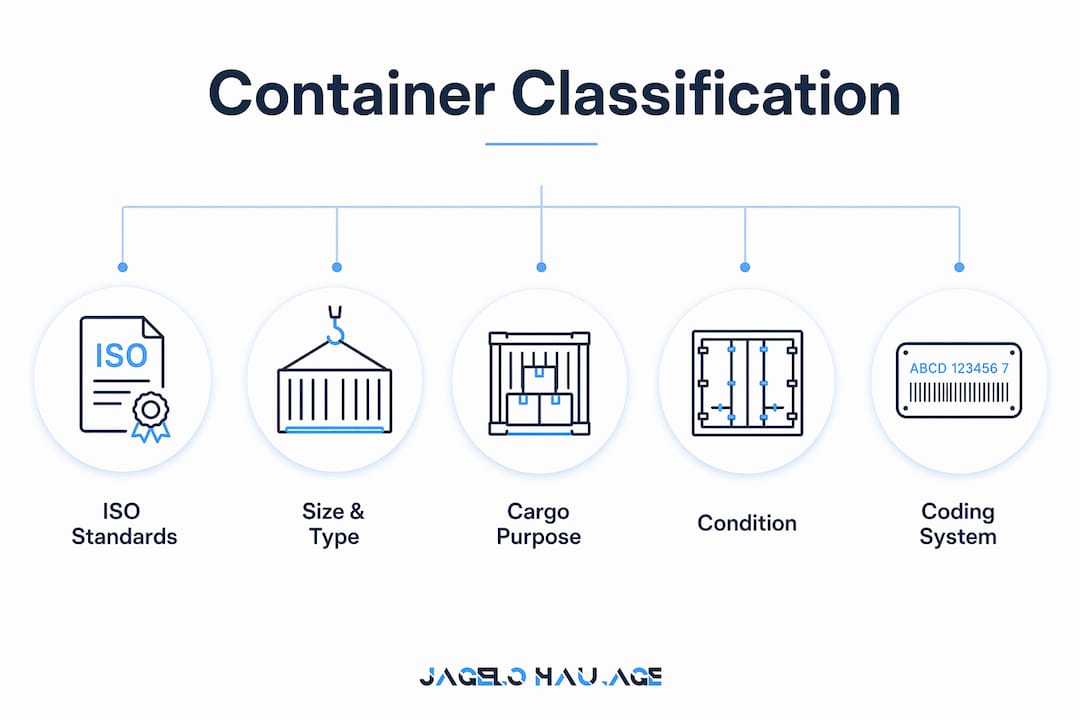
The classification of shipping containers rests on four ISO standards, each with a specific technical remit. Together, they create a globally interoperable system that allows containers to move between ships, rail, and road without modification.
- ISO 668 defines standardised container sizes, ratings, and corner casting placements. It specifies the nominal lengths, widths, and heights that ports and carriers worldwide recognise.
- ISO 1496 sets the testing and performance requirements containers must meet, covering structural integrity under stacking loads, racking forces, and weathering.
- ISO 1161 covers the corner castings that are the critical interface for lifting, securing, and stacking. Every container must have ISO-compliant corner castings to be handled by standard port equipment.
- ISO 6346 establishes the container identification and coding system, encoding ownership, equipment category, size, and type into a unique alphanumeric code.
Beyond these four standards, the Convention for Safe Containers (CSC) plate serves as the mandatory safety certification for any container used in international intermodal transport. A valid CSC plate must be renewed approximately every 30 months. Without it, a container is legally prohibited from international intermodal handling, regardless of its physical condition.
The ISO framework is fundamental to global trade efficiency. Without standardised dimensions and lifting interfaces, trans-shipment costs and handling complexity would increase drastically across every port and rail terminal in the world.
Pro Tip: When procuring containers for export, always request documentary evidence of the current CSC plate expiry date. A container that looks structurally sound but carries an expired plate cannot legally be used for international transport, and discovering this at the port gate creates costly delays.
How are shipping containers categorised by type and cargo purpose?
Container type is the most operationally significant dimension of classification. The wrong container type for a given cargo creates financial, legal, and safety risks. Shipping container types divide broadly into two categories: general cargo and specific cargo.

General cargo containers
General cargo containers, commonly called dry freight or standard containers, handle the majority of global trade. They are fully enclosed, weatherproof steel boxes suited to non-perishable goods. Standard dry freight containers are constructed from weathering steel (Corten steel) with steel corner castings and a heavy-duty wood or bamboo floor. This construction gives them the durability required for repeated intermodal use across sea, rail, and road.
Specific cargo containers
Specific cargo containers are engineered for goods that dry freight units cannot safely carry.
- Refrigerated containers (reefers) maintain precise temperature ranges for perishable goods such as pharmaceuticals, fresh produce, and frozen foods. They carry their own refrigeration unit and require a power supply at port.
- Tank containers transport liquids, gases, and hazardous materials in a cylindrical tank mounted within a standard ISO frame.
- Open top containers have a removable roof, allowing cargo too tall for a standard box to be loaded by crane from above.
- Flat rack containers have collapsible or fixed end walls with no sides or roof, used for heavy machinery, vehicles, and oversized project cargo.
Container size categories
Container lengths range from 10ft to 53ft, with the 20ft and 40ft units dominating international trade. The 53ft variant is used primarily in North American domestic transport and does not conform to standard ISO intermodal specifications for global shipping. The 40ft High Cube container provides approximately 13% more volume than a standard 40ft container at similar freight rates, making it the most frequently used unit in international trade. That volume advantage at comparable cost explains why High Cube units now account for a growing share of global container movements.
| Container type | Typical use | Key feature |
|---|---|---|
| 20ft dry freight | General cargo, dense goods | Standard intermodal unit |
| 40ft dry freight | High-volume general cargo | Double the capacity of 20ft |
| 40ft High Cube | Voluminous lightweight cargo | Extra 30cm height over standard |
| Reefer | Perishables, pharmaceuticals | Integrated refrigeration unit |
| Flat rack | Machinery, oversized cargo | No sides or roof |
| Tank | Liquids, gases, hazardous materials | Cylindrical tank in ISO frame |
Pro Tip: Shipping temperature-sensitive goods in a dry container because reefer capacity is unavailable is never an acceptable workaround. Incorrect container use risks cargo damage and severe legal or financial consequences, including shipment detainment at the port of destination.
In what ways does container condition classification impact transport and compliance?
Container condition grading is a parallel classification system that operates alongside type and size. It determines whether a container is fit for a specific purpose, from export to storage, and carries direct legal implications for intermodal transport.
The three standard condition grades are:
- One-Trip: The container has made a single journey from the manufacturer, typically from Asia. It is effectively new, with minimal wear, and commands the highest resale price.
- Cargo Worthy (CW): The container is structurally sound and certified for continued use in international transport. It holds a valid CSC plate and passes inspection against defined structural criteria.
- Wind and Watertight (WWT): The container is sealed against weather but does not meet the structural requirements for export certification. It is suitable for storage or domestic use only.
The distinction between Cargo Worthy and Wind and Watertight is critical. Many containers sold in the resale market lack valid export certification. Logistics professionals must verify CSC plate status and condition grade before committing a container to an intermodal movement. Accepting a WWT unit for an export shipment exposes your operation to cargo damage claims, port authority penalties, and shipment delays that compound demurrage and detention costs.
Pro Tip: Request a third-party condition survey report for any second-hand container before it enters your supply chain. The cost of an independent inspection is negligible compared to the financial exposure of a failed CSC plate check at a port gate.
What is the role and structure of ISO container coding systems in classification?
ISO 6346 encodes critical engineering and ownership data into every container’s identification number. Understanding this coding system allows logistics professionals to extract container specifications directly from the unit itself, without consulting a separate database.
A standard container identification number follows this structure:
- Owner code (four letters): identifies the container operator or leasing company.
- Equipment category identifier (one letter): “U” for freight containers, “J” for detachable freight container-related equipment, “Z” for trailers.
- Serial number (six digits): a unique number assigned by the owner.
- Check digit (one digit): validates the preceding characters mathematically.
Beyond the identification number, ISO 6346 size and type codes convey dimensions and equipment type in a compact format. The code “42G1,” for example, indicates a 40ft standard general purpose container. The first character encodes length, the second encodes height, and the third and fourth characters encode equipment type. Terminals use these codes to automate stacking, loading sequences, and crane operations, which is why code accuracy is an operational requirement, not a bureaucratic formality.
| Code position | Character | Information encoded |
|---|---|---|
| 1st | Length code | Container nominal length |
| 2nd | Height code | Container height category |
| 3rd–4th | Type code | Equipment type and door configuration |
The distinction between nominal and actual dimensions is also encoded in this system. A container labelled as 20ft does not measure exactly 20ft in physical length. The actual dimension is slightly shorter to accommodate the twist-lock couplers used in stacking. This is not an error in the standard. It is a deliberate engineering decision that enables modular combinations of different container lengths on a single vessel or rail flat car.
How do container size categories facilitate global intermodal transport and stacking?
Container size categories are engineered for physical interoperability, not merely for commercial convenience. The ISO 668 standard defines lengths, widths, heights, stacking strengths, and corner casting placements precisely so containers of different lengths can be securely combined and stacked in standardised ports and transport modes.
The key size variants in active global use are:
- 20ft General Purpose (GP): The baseline unit of container measurement, from which the Twenty-foot Equivalent Unit (TEU) derives. Dense, heavy cargo suits this format.
- 40ft General Purpose: Carries double the volume of a 20ft at lower cost per cubic metre, suited to lighter, bulkier goods.
- 40ft High Cube: Adds approximately 30cm of internal height over the standard 40ft, giving meaningful additional cubic capacity for voluminous cargo.
- 45ft Pallet Wide: Used in European road and rail transport for palletised goods requiring maximum floor area.
- 53ft: A North American domestic standard not compatible with standard ISO intermodal specifications.
Physical container lengths are slightly shorter than their nominal designations. This gap accommodates twist-lock couplers, which secure containers to each other and to the vessel cell guides or rail flat cars beneath them. Stacking strength requirements under ISO 1496 specify that a container must withstand the load of multiple fully laden units stacked above it, with forces transmitted through the corner castings defined by ISO 1161.
Pro Tip: When planning a shipment that mixes 20ft and 40ft containers on the same vessel booking, confirm with your carrier that the vessel’s cell guide configuration supports the combination. Not all vessels accommodate mixed-length stacks in every bay position, and a late discovery can force costly re-booking.
Key takeaways
The classification of shipping containers by ISO standards, type, condition, and coding is the operational foundation of compliant and cost-effective intermodal transport.
| Point | Details |
|---|---|
| ISO standards govern classification | ISO 668, 1496, 1161, and 6346 define size, construction, corner castings, and container coding globally. |
| Container type must match cargo | Using the wrong container type risks cargo damage, shipment detainment, and legal or financial penalties. |
| Condition grading affects legality | Only Cargo Worthy containers with a valid CSC plate are legally permitted in international intermodal transport. |
| ISO 6346 codes carry engineering data | Size and type codes such as “42G1” enable automated terminal handling and encode actual container specifications. |
| Physical size differs from nominal | Containers are slightly shorter than their nominal length to accommodate twist-lock couplers for safe stacking. |
Classification in practice: what experience actually teaches you
The technical framework around container classification is well documented. What the standards do not tell you is how often classification errors surface at the worst possible moment, specifically at the port gate or during a customs examination.
In my experience working within UK port logistics, the most common and costly mistake is not selecting the wrong container type outright. It is assuming that a container sourced from a third party has been verified against the relevant standard. Cargo Worthy status is not a permanent attribute. A container that passed inspection 18 months ago may no longer hold a valid CSC plate today, and the responsibility for verifying that falls on the operator presenting it for loading, not on the shipping line.
The second pattern I see repeatedly is a misunderstanding of size codes. Logistics teams book a 40ft slot and receive a 40ft High Cube unit, or vice versa. The height difference matters enormously when the container must pass under a road bridge or fit within a specific warehouse loading bay. The UK port logistics environment at ports like Felixstowe and Southampton has become increasingly precise about pre-arrival documentation, and a size code discrepancy between the booking and the physical unit creates delays that cascade through the entire supply chain.
The practical lesson is straightforward. Treat container classification as an operational input, not a background administrative detail. Verify the ISO 6346 code against the physical unit. Confirm the CSC plate expiry date before the container leaves the depot. Match the container type to the cargo specification before booking, not after. These steps take minutes. The delays and costs they prevent can run to thousands of pounds per incident.
— Vytautas
Jhaulage: container haulage built around classification compliance
Matching the right container to the right movement, and then executing that movement without error, is precisely what Jhaulage does across the UK’s major ports.
Jhaulage operates a fleet of over 40 GPS-tracked trucks and trailers, handling diverse container types and sizes across Felixstowe, Tilbury, Southampton, and Liverpool. Every movement is managed with full awareness of ISO and CSC requirements, so your containers arrive at their destination compliant and on schedule. Whether you are moving 20ft general purpose units or 40ft High Cube reefers, Jhaulage provides 24/7 support and port-to-door service built on the classification knowledge that keeps supply chains moving. Contact Jhaulage to discuss your container transport requirements.
FAQ
What standards govern how shipping containers are classified?
Shipping containers are classified under ISO 668, ISO 1496, ISO 1161, and ISO 6346, which define dimensions, structural performance, corner castings, and container identification coding respectively.
What is the difference between Cargo Worthy and Wind and Watertight containers?
A Cargo Worthy container holds a valid CSC plate and meets structural requirements for international intermodal transport. A Wind and Watertight container is sealed but not certified for export use.
What does the ISO 6346 code “42G1” mean?
The code “42G1” identifies a 40ft standard general purpose container. The first character encodes length, the second encodes height, and the third and fourth characters encode equipment type and door configuration.
Why are containers physically shorter than their nominal length?
Physical container length is slightly shorter than the nominal designation to accommodate twist-lock couplers, which secure containers to each other and to vessel cell guides or rail flat cars during stacking.
How often must a CSC plate be renewed?
A CSC plate must be renewed approximately every 30 months. A container with an expired CSC plate is legally prohibited from international intermodal transport, regardless of its physical condition.
Recommended
- Logistics for Shipping Containers: A Comprehensive Guide to UK Port Transport | Jagelo Haulage
- Shipping Container Transport: The Strategic Guide to UK Port Logistics | Jagelo Haulage
- Road Haulage for Containers: A Professional Guide to UK Port Logistics | Jagelo Haulage
- How containers are loaded onto trucks: 2026 guide | Jagelo Haulage