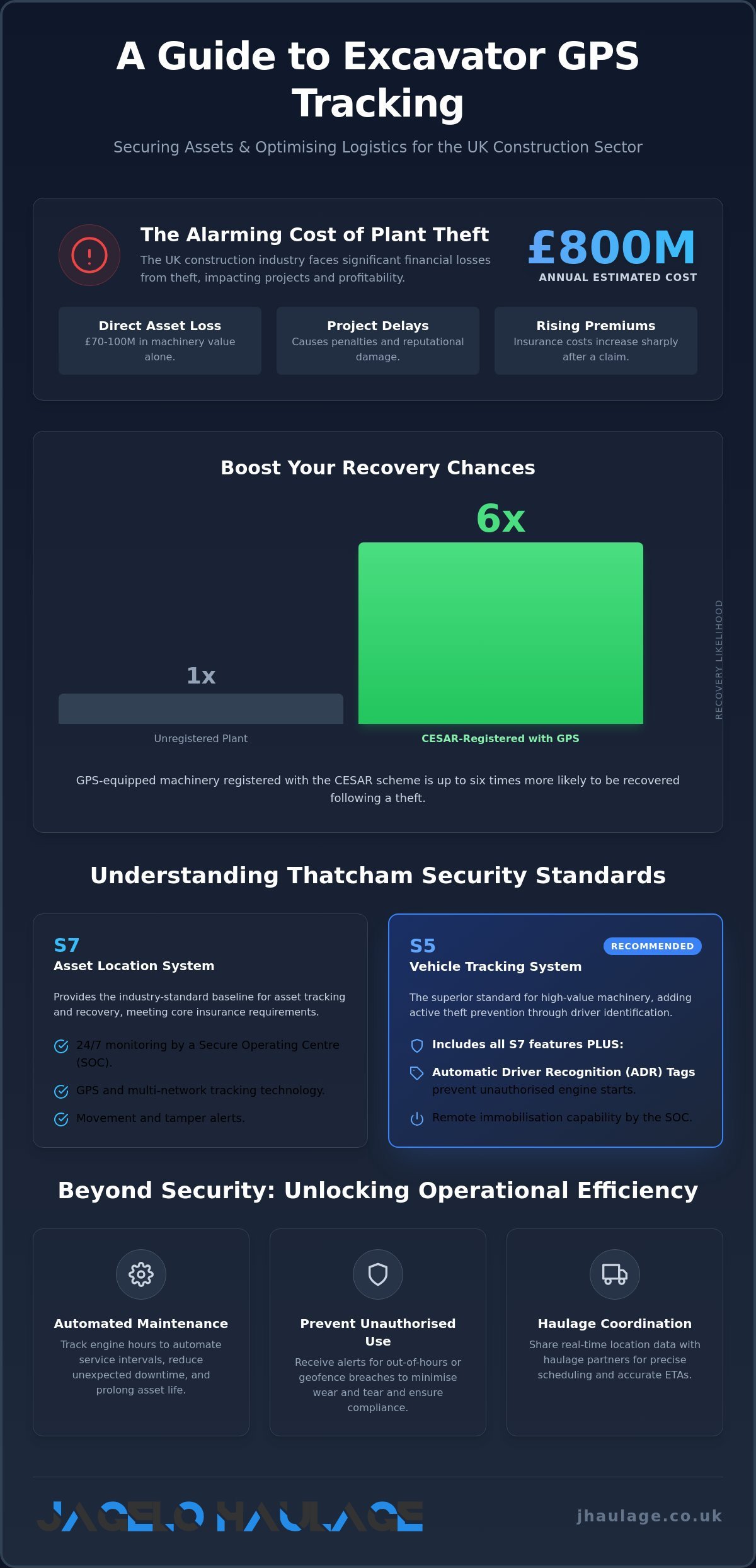
With the annual cost of construction plant theft in the UK reaching an estimated £800 million, site security is no longer a passive concern for plant managers. You likely understand the frustration of rising insurance premiums and the operational paralysis that follows the loss of a primary asset. Implementing robust excavator gps tracking is the most effective method to mitigate these risks and maintain control over your fleet. It's a necessary step for any business that values operational continuity and asset protection in a high-risk environment.
This guide explores how advanced tracking technology secures your machinery and optimises the logistics of plant movement across the UK. You'll discover the differences between S7 and S5 Thatcham security standards and how these systems provide the data required for precise haulage scheduling. We will examine how integrating these tools leads to reduced insurance costs and lower risks of asset loss. By the end of this article, you'll understand how to transform your excavators from vulnerable targets into disciplined, data-driven units that support your broader logistical goals.
Key Takeaways
- Understand why traditional security is no longer sufficient and how digital monitoring provides a more reliable defence against plant theft.
- Identify the specific Thatcham categories, such as S7 and S5, that are essential for maintaining insurance compliance and securing your assets.
- Discover how excavator gps tracking provides the telematics data needed to automate maintenance intervals and reduce engine idling costs across your fleet.
- Learn how to integrate real-time location data with professional haulage services to improve delivery coordination and provide more accurate arrival times.
- Establish a clear strategy for auditing your machinery and implementing a protection plan that aligns with current UK security regulations.
The Critical Role of GPS Tracking in Modern Excavator Management
The UK construction sector faces a persistent threat from organised plant theft. Traditional site security, such as perimeter fencing or physical locks, often fails to deter professional criminals targeting high-value machinery. Excavator gps tracking has evolved from a secondary security measure into a core requirement for modern asset management. This shift reflects a move from simple location beacons to sophisticated telematics that offer real-time data on machine health and location. For plant owners and their haulage partners, this technology provides the operational certainty required to manage complex project timelines with confidence.
The transition to advanced digital monitoring allows for a more disciplined approach to fleet oversight. Modern systems don't just report a set of coordinates; they integrate with the broader operational framework of a business. Using a professional vehicle tracking system ensures that every asset is accounted for, regardless of its location on a national project. This level of technical capability is essential for maintaining the high standards of safety and efficiency that the industry demands.
The Economic Impact of Asset Loss
The estimated annual cost of construction plant theft in the UK is £800 million. This figure includes direct theft, vandalism, and project delays. Whilst the value of the stolen machinery itself is between £70-100 million annually, the indirect costs often prove more damaging to a company's bottom line. Project delays lead to penalty clauses and damage professional reputations. Insurance premiums also rise sharply following a claim, especially if the asset wasn't protected by a recognised tracking solution. Rapid recovery is essential; the likelihood of locating a machine drops significantly after the first 24 hours. CESAR-registered equipment fitted with GPS is up to six times more likely to be recovered than unregistered plant.
Visibility Across Multiple Sites
Managing machinery spread across national projects requires a centralised approach to data. Real-time location monitoring provides total transparency for fleet managers. They can verify that an excavator is exactly where it's supposed to be without visiting the site in person. This level of visibility also helps to reduce the unauthorised use of equipment during out-of-office hours or weekends. Unauthorised use increases wear and tear and leads to unexpected maintenance costs. By integrating these tracking insights with professional haulage services, companies can coordinate the movement of assets with precision. This ensures that plant arrives on site exactly when the project schedule demands it, creating a more predictable and secure supply chain.
Understanding Thatcham Categories and Tracking Technology
Thatcham Research sets the security benchmark for the UK insurance industry. These standards ensure that excavator gps tracking systems meet rigorous criteria for reliability and performance. The two primary categories relevant to plant machinery are S7 and S5. S7 trackers provide the baseline for asset location and recovery, requiring 24/7 monitoring by a Secure Operating Centre (SOC). For high-value machinery, insurers often mandate S5 trackers. These enhanced systems include Automatic Driver Recognition (ADR) tags, which trigger an immediate alert if the engine starts without the authorised tag present.
The persistent problem of heavy equipment theft makes these technical distinctions critical for operational security. Whilst S7 is suitable for smaller equipment, the immobilisation features of S5 offer a superior layer of protection. These standards don't just protect the asset; they validate your insurance policy and can lead to reduced premiums. If you're planning a project that requires the movement of high-value machinery, you can request a haulage quote to ensure your tracked assets are moved by a professional partner.
Hardwired vs Battery-Powered Devices
Hardwired units connect directly to the machine's electrical system. They provide constant data streaming and engine diagnostics, such as fuel levels and engine hours. This is the preferred choice for primary excavators that are in regular use. Battery-powered trackers are more suitable for assets without a permanent power source, such as trailers or static attachments. These units have a long battery life, often lasting three to five years, but they typically report their location less frequently to conserve power. Maintenance for hardwired units is minimal, whilst battery units require periodic checks to ensure the power cell remains operational.
Signal Reliability and Anti-Jamming Tech
Reliable communication is the backbone of any tracking system. Professional devices use multi-network roaming SIMs to maintain a signal across national projects, including remote rural areas. Sophisticated thieves often use signal jammers to block GPS or GSM frequencies. Modern, Thatcham-approved trackers include anti-jamming technology that detects interference and triggers an alert. Whilst GPS is standard for location accuracy, some systems incorporate VHF (Very High Frequency) technology. VHF can penetrate through concrete or metal containers, which is vital if stolen plant is hidden indoors or inside a shipping container during transit.
Beyond Security: Leveraging Telematics for Operational Efficiency
While the primary motivation for installing excavator gps tracking is often theft prevention, the data generated by these systems offers significant strategic advantages. Modern telematics allow plant managers to move beyond simple location monitoring and into the territory of advanced fleet optimisation. By analysing engine hour data and fuel consumption, businesses can identify inefficiencies that previously went unnoticed. For instance, monitoring engine idle time can help operators reduce idle waste by 15-20%, directly lowering operational costs and reducing the environmental impact of a project.
The transition from a reactive security stance to a proactive management style is supported by international safety standards. Aligning your fleet management with National Insurance Crime Bureau recommendations ensures that your security measures are robust, but the real value lies in how you apply this data to daily operations. Visibility into how and when a machine is used allows for better resource allocation, ensuring that high-value assets aren't sitting idle while other sites face equipment shortages.
Predictive Maintenance Scheduling
Reactive repairs are inherently expensive and disruptive. Using real-time engine hour data allows you to move towards a preventative maintenance model. Instead of servicing excavators based on arbitrary calendar dates, you can schedule maintenance based on actual usage. This ensures that every machine in your fleet receives attention exactly when it needs it, preventing minor mechanical issues from escalating into major failures. Consistent monitoring extends the overall lifespan of your equipment and ensures that your machinery is always in peak condition for the next project phase.
Geofencing and Site Compliance
Geofencing allows you to create virtual boundaries around specific work zones. If an excavator leaves a designated area without authorisation, the system triggers an immediate alert. This is vital for maintaining site compliance and ensuring that machinery stays within safe, authorised zones. Beyond security, geofences serve a practical logistical purpose. They can be configured to trigger automated arrival notifications for haulage drivers. This streamlines the coordination of plant movement, as transport teams receive precise data on when a machine is ready for collection or has arrived at its new destination.
Best Practices for Implementing GPS Tracking Across Your Fleet
Implementing excavator gps tracking requires a structured approach to ensure maximum return on investment and operational security. A successful rollout begins with a comprehensive audit of your current fleet to identify high-priority assets. You should prioritise high-value excavators or those deployed in remote, high-risk locations. Once your assets are categorised, consult your insurance provider to confirm the specific Thatcham categories required for your coverage. Selecting a tracking platform that integrates with your existing logistics and haulage software ensures that security data remains a core part of your operational workflow.
Training site managers and operators is equally vital for a disciplined implementation. Staff must understand how to interpret tracking data and, more importantly, how to respond to alerts. Establishing a clear protocol for responding to unauthorised movement alerts prevents confusion during a security breach. This protocol should define exactly who is contacted and what immediate actions are taken to verify the machine's status. If you require assistance moving your secured assets between national projects with precision, you can request a professional haulage quote to maintain your project timeline.
Choosing a Tracking Software Platform
A reliable software platform serves as the central hub for your fleet data. Look for essential features such as real-time mapping, customisable reporting, and instant mobile alerts. The interface must be intuitive enough for site staff to use effectively without extensive technical training. Under the UK GDPR and the Data Protection Act 2018, you must ensure the platform maintains high standards of data security. It's a legal requirement to have a clear policy on data usage and to inform operators that tracking is in place for legitimate business interests. For companies managing complex data across international borders, you can discover Havelock Tech for managed remote support talent for technology and operations teams based in Singapore.
Covert Installation Techniques
Professional, covert installation is a critical deterrent against sophisticated theft. If a thief can easily locate and disable a device, the primary security benefit is lost. Expert installers place trackers in non-obvious locations, such as deep within the chassis or behind internal engine panels. Regularly testing these devices is a necessary maintenance task for any fleet manager. A simple monthly check ensures the unit is still transmitting correctly and hasn't been compromised by the harsh vibrations or environmental conditions common on construction sites. This methodical approach ensures your excavator gps tracking remains a dependable component of your security framework.
Integrating GPS Data with Professional Haulage Logistics
GPS data integration represents the final stage in creating a truly secure and efficient supply chain. Whilst the previous sections focused on site security and machine health, the strategic value of this data extends to the physical movement of assets between locations. Sharing real-time coordinates with your logistics provider ensures that transport operations are based on verified facts rather than estimates. This transparency allows for the seamless coordination of container haulage and plant transport, ensuring that low-loaders are dispatched only when the machinery is confirmed as ready for collection.
Accurate arrival times (ETAs) are essential for maintaining project momentum. When a logistics partner has access to your excavator gps tracking data, they can provide precise updates to site managers at the destination. This reduces the risk of site teams standing idle whilst waiting for machinery to arrive. Monitoring assets whilst they are in transit on low-loaders also adds an extra layer of security. Any deviation from the planned route triggers an immediate alert; this ensures that your high-value plant is protected from the moment it leaves one site until it is safely offloaded at the next.
Streamlining Plant Movement
Efficient plant movement depends on the elimination of waiting time for hauliers. By knowing the exact status and location of an excavator, transport teams can optimise their routes to reflect the current distribution of the fleet. This level of coordination is particularly critical when machinery is moving through major transit hubs. Linking your tracking data to port logistics services UK allows for better management of international plant shipments. It ensures that all customs and handling requirements are met with the same precision applied to domestic site movements.
The Future of Connected Logistics
The landscape of plant management is evolving rapidly as we move through 2026. The integration of 5G and Internet of Things (IoT) sensors is making excavator gps tracking more responsive and data-rich than ever before. We are seeing a shift towards fully automated logistics scheduling, where machines communicate their own readiness for transport based on project completion data. Jagelo Haulage prioritises these secure, data-driven transport solutions to provide clients with a disciplined and predictable service. This commitment to technical excellence ensures that your machinery remains a productive and protected asset throughout its entire operational lifecycle.
Securing Your Fleet for Future Operational Success
Protecting your assets requires a disciplined approach that combines advanced technology with professional logistics. By implementing Excavator gps tracking, you transition from a reactive security posture to a proactive management model. This transition ensures your machinery meets Thatcham standards whilst providing the telematics data needed to optimise maintenance and fuel efficiency. You've seen how these tools transform vulnerable plant into data-driven units that support your broader project goals.
The final step in this strategic framework is aligning with a dependable transport partner who understands the technical requirements of modern plant movement. Jagelo Haulage provides the professional expertise required for high-stakes machinery movement, backed by over 15 years of industry experience. We operate a modern fleet of over 40 trucks and trailers, specialising in secure port and inland logistics across the UK. Our team ensures that your secured assets are transported with the same level of protection and precision they receive on-site.
Our solution-oriented approach allows you to focus on project delivery whilst we manage the complexities of the supply chain. You can contact Jagelo Haulage for secure and reliable plant transport solutions to begin your next project with total confidence in your fleet's security and efficiency.
Frequently Asked Questions
Do I need a GPS tracker for my excavator by law in the UK?
No specific UK law mandates the use of GPS trackers for plant owners, but they are a standard requirement for most insurance policies covering high-value machinery. You must also comply with the UK GDPR and the Data Protection Act 2018. This requires you to inform your operators that tracking is active for legitimate business interests, such as security and maintenance scheduling.
How much does an insurance-approved GPS tracker cost for an excavator?
Hardware costs for insurance-approved trackers range from approximately £99 for battery-powered units to £462 for professionally installed, hardwired systems. Monthly monitoring and subscription fees typically fall between £9 and £22 per asset as of July 2026. These costs are often offset by the long-term savings gained through reduced insurance premiums and lower risk of asset loss.
Can a GPS tracker drain the battery of my machinery?
Modern hardwired trackers have an extremely low power draw and won't drain a healthy battery during normal operations. These devices are designed to enter a low-power sleep mode when the engine is switched off to preserve charge. Alternatively, you can opt for independent battery-powered units that operate on their own internal power source for up to five years.
What is the difference between an S5 and an S7 Thatcham tracker?
An S7 tracker is the entry-level standard for stolen vehicle recovery, requiring 24/7 monitoring by a Secure Operating Centre. The S5 category provides an enhanced level of security by adding Automatic Driver Recognition (ADR) tags. This system triggers an immediate alert if the machine is started without the authorised tag present, providing a superior defence for high-value excavators.
How does geofencing work for plant equipment on construction sites?
Geofencing uses GPS coordinates to establish a virtual perimeter around a specific work zone or storage yard. If the machinery crosses this digital boundary, the system sends an instant notification to your mobile device or control centre. This allows for immediate action if an asset is moved without authorisation, either by staff or by potential thieves.
Will a GPS tracker work if the excavator is stored inside a metal container?
Standard GPS signals are often blocked by metal, but professional excavator gps tracking systems frequently incorporate VHF technology. VHF signals can penetrate concrete and metal shipping containers, which is vital for recovery if stolen plant is hidden out of sight. This ensures that recovery teams can still locate your machinery even in challenging environments.
Can GPS tracking data be used to lower my plant insurance premiums?
Insurers often provide significant discounts or lower excesses for fleets equipped with Thatcham-approved tracking devices. Demonstrating a disciplined approach to security and asset recovery makes your business a lower risk to the provider. Many insurers mandate these systems as a condition of coverage for any machinery valued over a certain threshold, typically £50,000.
How often should I test my excavator GPS tracking device?
You should perform a signal test on your excavator gps tracking device at least once a month to ensure it is transmitting correctly. Regular testing confirms that the internal battery or hardwired connection hasn't been compromised by the harsh vibrations and environmental conditions found on construction sites. This methodical check ensures your security framework remains reliable throughout the year.