What is ISO container standard: the 2026 guide

The ISO container standard is the internationally recognised framework defining how shipping containers are built, measured, tested, marked, and safely operated to ensure seamless global trade. As of 2026, this framework rests on four main ISO specifications: ISO 668 (dimensions and classification), ISO 1496 (structural testing), ISO 6346 (coding and identification), and ISO 1161 (corner fittings), all supported by the 1972 International Convention for Safe Containers (CSC). For logistics professionals managing container shipping across UK ports such as Felixstowe, Tilbury, Southampton, and Liverpool, understanding these specifications is not optional. Compliance determines port clearance, insurability, and the operational reliability of every container movement in your supply chain.
What is ISO container standard and what does it regulate?
The ISO container standard is a set of international technical specifications governing how freight containers are designed, constructed, tested, identified, and handled across all transport modes. Its purpose is to provide a universal framework enabling any container worldwide to be transferred between ships, trains, and road vehicles without reloading cargo. That single principle underpins the entire modern intermodal logistics system.
Each of the four core standards addresses a distinct layer of container compliance:
- ISO 668 classifies container sizes, types, and maximum gross weights. It defines the nominal external dimensions that determine how containers are stacked, stored, and transported across different modes.
- ISO 1496 specifies construction requirements and the structural testing regime containers must pass, covering stacking loads, racking forces, and floor strength. A container that fails ISO 1496 testing cannot be certified for active shipping.
- ISO 6346 defines the container identification system, including the owner code, equipment category identifier, serial number, and check digit. These codes enable global traceability and standardised tracking across every port and logistics system.
- ISO 1161 specifies the dimensions and tolerances of corner castings, the structural fittings that allow containers to be locked, lifted, and stacked. These castings are the physical interface between the container and every crane, spreader bar, and twist lock in the world.
The CSC Convention operates alongside these ISO standards as the operational safety and inspection regime. It mandates that every container used in international trade carries a valid CSC plate, confirming it has passed structural testing and is approved for use. Without a valid CSC plate, a container cannot legally enter most ports or obtain cargo insurance.
What are the common ISO container sizes and types used in 2026?
ISO container dimensions are defined by ISO 668 and cover a range of standard sizes suited to different cargo profiles and logistics workflows. The five most common configurations in active use are the 20ft General Purpose (GP), 20ft High Cube (HC), 40ft GP, 40ft HC, and 45ft HC.

| Container type | External length | External height | Internal volume | Typical use |
|---|---|---|---|---|
| 20ft GP | 6.058 m | 2.591 m | ~33.2 m³ | Dense or heavy cargo |
| 40ft GP | 12.192 m | 2.591 m | ~67.7 m³ | General freight |
| 40ft HC | 12.192 m | 2.896 m | ~76.4 m³ | Volumetric cargo |
| 45ft HC | 13.716 m | 2.896 m | ~86.0 m³ | High-volume shipments |
| 20ft HC | 6.058 m | 2.896 m | ~37.5 m³ | Lightweight bulky goods |
The 40ft High Cube provides approximately 10–13% more internal volume than a standard 40ft GP, with roughly 76.4 m³ versus 67.7 m³. That difference is significant when you are maximising cargo density across a full container load shipment. The shipping industry trend increasingly favours 40ft HC and 45ft units for their superior volumetric efficiency, aligning with the growing demand for fewer, fuller container movements.
Beyond general purpose units, ISO classification also covers refrigerated containers (reefers), open-top containers, flat-rack containers, and tank containers. Each type carries its own ISO specification for construction and testing, though all share the same corner casting interface defined by ISO 1161.
Pro Tip: Always verify the actual internal dimensions of a container before fitting specialised equipment or racking systems. ISO defines nominal external sizes, but internal measurements vary between manufacturers and can shift further with age and repair history.
How do ISO container standards ensure global interoperability and safety?
ISO standards achieve global interoperability through two mechanisms: standardised external dimensions and a universal corner fitting interface. Because every ISO-compliant container shares the same external footprint and corner casting geometry, containers transfer globally between ships, trains, and trucks without any modification to handling equipment. A container loaded at a factory in Guangzhou can be discharged at Felixstowe and delivered by road without a single dimensional conflict.
Safety compliance centres on the CSC plate and the inspection regime it represents. Key compliance requirements include:
- Valid CSC plate: Mandatory for all containers in international trade. Operating without a valid CSC plate leads to immediate detention at ports and carries direct financial consequences including demurrage and detention costs.
- Periodic inspection: CSC-certified containers must undergo approved examination at defined intervals. Inspection records must be current and available for port authority review.
- Corner casting integrity: Rust, deformation, or fractures in corner castings immediately disqualify a container from stacking or lifting operations. This is the most common physical defect triggering operational red flags at UK ports.
- Structural condition: Floors, walls, and roof panels must meet the load-bearing requirements set by ISO 1496. Visible damage to these elements raises questions about CSC compliance even if the plate is current.
Non-compliance carries real financial risk. A container detained at port for an invalid CSC plate generates demurrage charges from day one. If the container is also uninsurable due to lapsed certification, any cargo loss or damage falls entirely outside the cover of your freight insurance policy.
Pro Tip: Before accepting any container for a shipment, physically inspect the CSC plate for validity date and check all eight corner castings for deformation or corrosion. This two-minute check prevents costly port detention and insurance disputes.
What nuances should logistics professionals know about ISO containers?
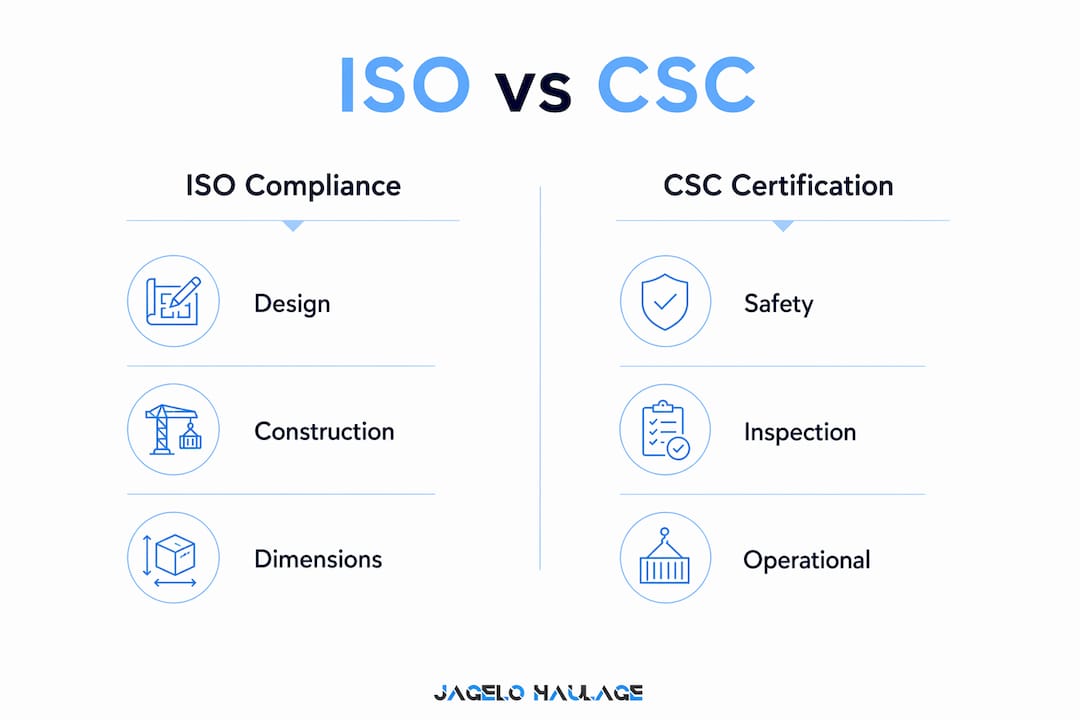
The most important distinction in container compliance is the difference between ISO-compliant and CSC-certified. A container can be built entirely to ISO design specifications and still be uninsurable for international trade if its CSC certification has lapsed or was never obtained. ISO compliance confirms the container was designed and built correctly. CSC certification confirms it is currently safe and legally approved for active intermodal transport. These are not the same thing, and conflating them is a common and costly error.
Manufacturer variation adds another layer of complexity. ISO defines nominal sizes and minimum performance requirements, but internal dimensions vary between manufacturers due to differences in structural design, floor construction, and panel thickness. A container from one manufacturer may offer several centimetres less internal width than a nominally identical unit from another. For standard general freight this rarely matters. For fitted-out containers carrying specialised equipment or refrigeration units, those centimetres are operationally critical.
Material condition compounds this further. Container dimensions in resale markets can vary due to wear and repairs despite nominal ISO standards. Corten steel, the standard material for dry freight containers, resists corrosion effectively when intact, but weld repairs and panel replacements can introduce dimensional inconsistencies. Practitioners recommend verifying manufacturing records and physical container condition alongside the CSC plate to avoid hidden structural defects.
The table below summarises the key differences between ISO compliance and CSC certification:
| Factor | ISO compliance | CSC certification |
|---|---|---|
| What it confirms | Design and construction to standard | Current operational safety approval |
| Who issues it | Manufacturer (self-declared to ISO) | Approved examination body |
| Required for port entry | No | Yes |
| Required for cargo insurance | No | Yes |
| Renewal required | No | Yes, at defined intervals |
| Physical evidence | Manufacturer data plate | CSC plate with examination date |
Corner casting integrity deserves particular emphasis. ISO 1161 corner castings are the single most critical structural feature for container stacking and lifting. Even minor deformation at a corner casting invalidates the container for port operations, because crane spreader bars and twist locks depend on precise casting geometry to engage safely. A container with damaged castings cannot be stacked, cannot be lifted by standard port equipment, and cannot be legally transported until the casting is replaced and the unit re-inspected.
Key takeaways
The ISO container standard is the definitive technical framework that makes global intermodal logistics possible, and both ISO compliance and valid CSC certification are required for any container to operate legally and safely in international trade.
| Point | Details |
|---|---|
| Four core standards | ISO 668, ISO 1496, ISO 6346, and ISO 1161 together define dimensions, testing, identification, and corner fittings. |
| CSC certification is mandatory | A lapsed or absent CSC plate causes immediate port detention and renders cargo uninsurable. |
| ISO compliance differs from CSC certification | A container built to ISO specs can still be legally unfit for active shipping without valid CSC approval. |
| 40ft HC dominates in 2026 | The 40ft High Cube offers 10–13% more volume than a standard 40ft GP, making it the preferred choice for volumetric cargo. |
| Corner castings are the critical weak point | Damage to ISO 1161 corner castings immediately disqualifies a container from stacking, lifting, and transport. |
Why the compliance gap between ISO and CSC catches operators out
The distinction between ISO design compliance and CSC operational certification is, in my experience, the single most misunderstood aspect of container management in UK logistics. I have seen operators accept containers based on a manufacturer’s data plate alone, only to face port detention at Felixstowe because the CSC examination date had lapsed by several months. The cost in demurrage, re-inspection fees, and delayed cargo delivery far exceeded any saving made on the container acquisition.
What concerns me more is the growing reliance on nominal ISO dimensions without physical verification, particularly as the market for second-hand 40ft HC and 45ft containers expands. The container tracking technology available in 2026 is excellent for monitoring location and condition in transit, but it does not replace a pre-shipment physical inspection of corner castings and floor integrity.
My practical advice is straightforward. Treat the CSC plate as a live document, not a historical record. Check the examination date before every shipment, not just at the point of container acquisition. For specialised cargo, measure internal dimensions directly rather than relying on ISO nominal figures. And for any container acquired through the resale market, request the full inspection history alongside the CSC plate. These steps take minutes and prevent disputes that can take weeks to resolve.
The trend towards larger container types, particularly the 45ft HC for UK port logistics, is sound from a volumetric efficiency standpoint. But larger units also mean larger consequences when compliance fails. The discipline of verification scales with the size of the asset.
— Vytautas
How Jhaulage supports ISO container compliance across UK ports
Jhaulage specialises in the haulage of ISO standard containers across the UK’s major ports, including Felixstowe, Tilbury, Southampton, and Liverpool. Every movement handled by Jhaulage’s fleet of over 40 GPS-tracked trucks accounts for the specific handling requirements of ISO-compliant units, from standard 20ft GP containers through to 45ft High Cube units. Jhaulage’s operational expertise covers container haulage compliance requirements at each port, reducing the risk of detention and demurrage for freight forwarders, importers, and exporters who need reliable port-to-door delivery without compliance surprises.
For logistics operators who need a haulage partner that understands ISO container specifications in practice, not just in theory, Jhaulage provides 24/7 support and full port coverage across the UK’s primary container terminals.
FAQ
What is an ISO container standard?
The ISO container standard is a set of international specifications covering container dimensions, construction, testing, identification, and corner fittings, defined by ISO 668, ISO 1496, ISO 6346, and ISO 1161. These standards ensure containers are universally compatible across ships, trains, and road vehicles worldwide.
What is the difference between ISO compliance and CSC certification?
ISO compliance means a container was built to the relevant design standard, while CSC certification confirms it is currently approved as safe for active international transport. A container can meet ISO design specifications but remain uninsurable and legally unfit for shipping without a valid CSC plate.
What are the standard ISO container dimensions?
The most common ISO container sizes are the 20ft GP (approximately 33.2 m³ internal volume), 40ft GP (approximately 67.7 m³), and 40ft HC (approximately 76.4 m³), with the 45ft HC offering around 86.0 m³. All sizes share the same corner casting interface defined by ISO 1161.
Why is the CSC plate important for container shipping?
The CSC plate is mandatory for port entry and cargo insurability in international trade. Operating a container without a valid CSC plate results in immediate port detention and financial penalties including demurrage and detention costs.
How does ISO 6346 affect container tracking?
ISO 6346 defines the standardised identification code on every container, comprising an owner code, equipment category identifier, serial number, and check digit. This coding system enables consistent global traceability across all ports, shipping lines, and logistics management platforms.