Container logistics planning succeeds through proactive port dwell management rather than reactive road dispatch. When import containers land at deep-sea terminals, treating inland haulage as an afterthought inevitably triggers punitive demurrage charges, detention fees, and missed vehicle booking slots. You already know the severe operational strain of watching strict port free time evaporate whilst waiting for customs clearance confirmations and transport allocation. Scrambling to secure collection slots after discharge compromises delivery windows and leaves warehouse teams managing preventable disruptions.
Mastering a disciplined container logistics planning framework eliminates these compounding terminal penalties and secures dependable nationwide transport. Synchronising your container releases directly with dedicated haulage capacity ensures that boxes move inland without administrative friction or unexpected storage costs. Predictable movement requires structured coordination between cargo owners, terminals, and road transport operators. This operational guide details a reliable, milestone-driven process to coordinate terminal collections, manage vehicle booking systems, and select the optimal haulage model to maintain complete supply chain reliability.
Key Takeaways
- Establish a milestone-driven container logistics planning framework that synchronises customs release with prompt inland dispatch.
- Evaluate merchant haulage against shipping line haulage models to maintain direct operational control over delivery timelines.
- Protect supply chain margins by actively synchronising vehicle booking slots to prevent terminal free-time expiry and punitive demurrage fees.
- Ensure cargo security and nationwide transport reliability by integrating dedicated fleet operators into your core haulage strategy.
What Is Container Logistics Planning and Why Does It Matter?
Container logistics planning is a structured control framework that synchronises terminal collection, regulatory release, inland road haulage, and empty equipment restitution into a unified operational timeline. Rather than treating intermodal transit as disconnected handovers, effective planning coordinates each milestone from vessel berthing through to final depot return. Unplanned movements rapidly introduce administrative friction. When collection windows clash with customs holds or driver allocations, cargo owners face compounding port penalties alongside severe warehouse disruptions.
The Core Components of Container Flow
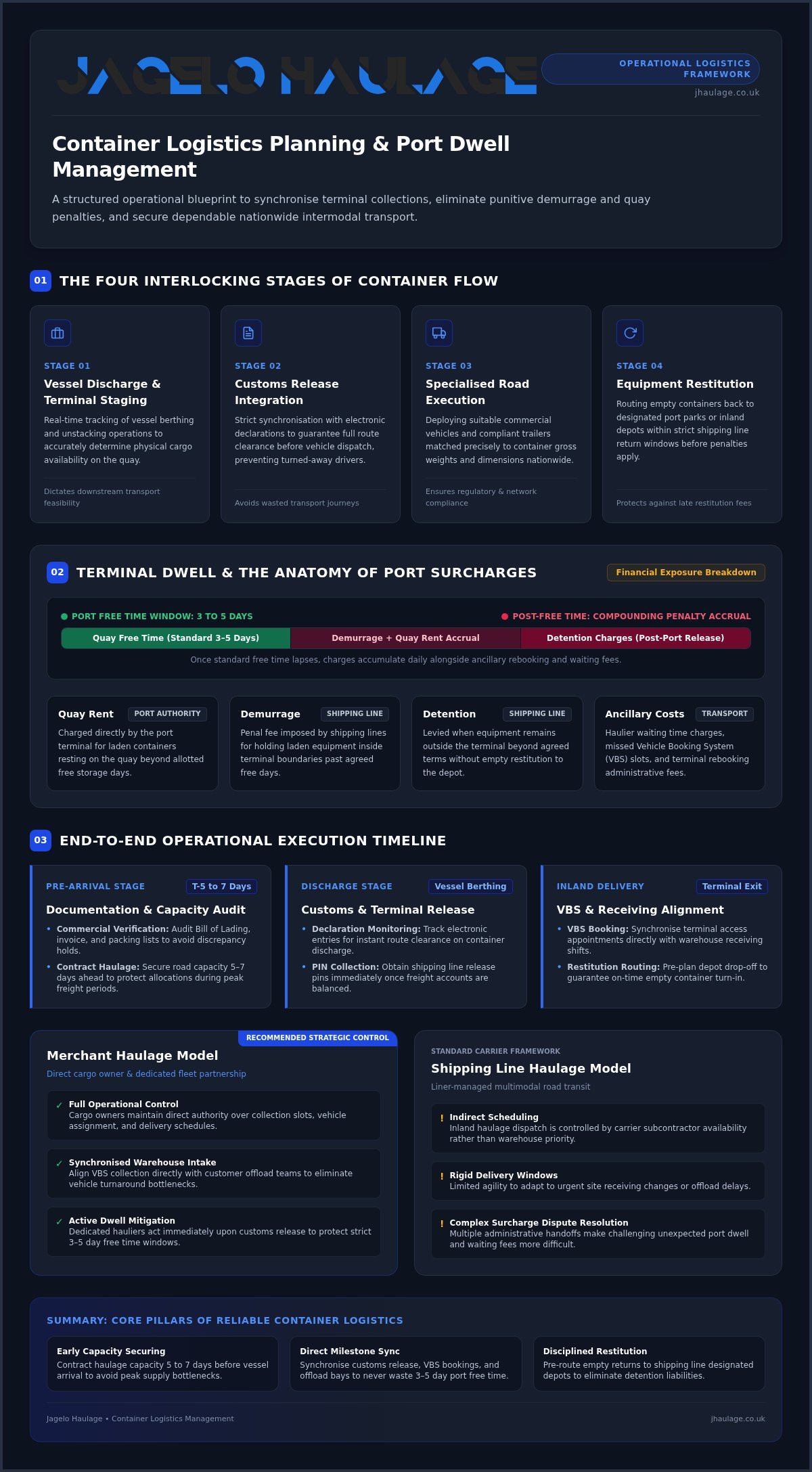
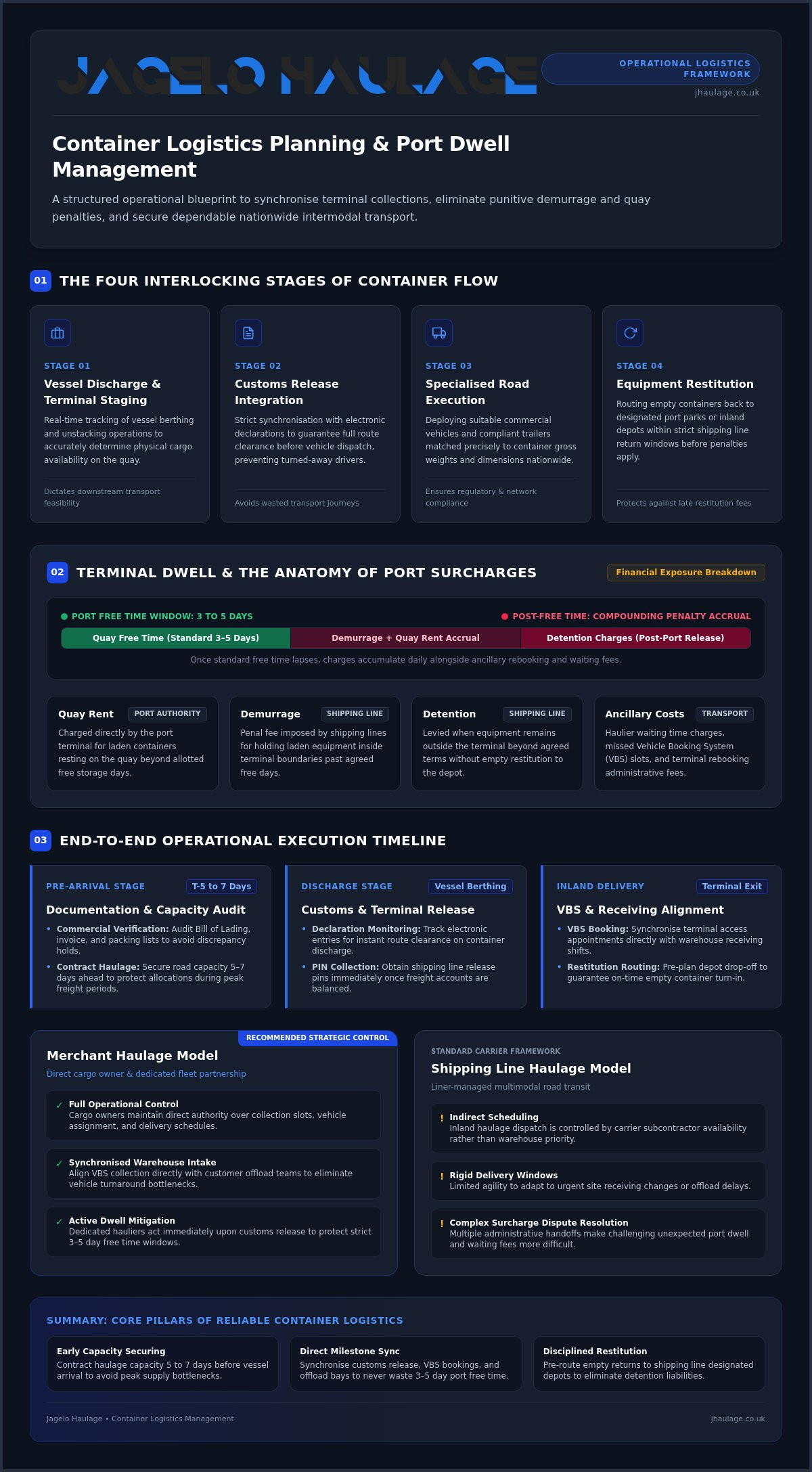
A resilient haulage workflow relies on four interlocking stages:
- Vessel discharge and terminal staging: Physical quay operations dictate downstream collection feasibility. Modern intermodal freight transport demands real-time tracking of vessel arrivals and container unstacking to anticipate cargo availability accurately.
- Customs release integration: Transport bookings must align strictly with customs status. Booking vehicle slots before port authorities and declaration systems clear the container results in wasted journeys and turned-away drivers.
- Specialised road execution: Hauliers must assign appropriate commercial vehicles and trailers to match container dimensions and gross weights, ensuring legal compliance and safe transit across the national road network.
- Empty equipment restitution: Shipping lines enforce strict return windows. Transport managers must route empty boxes back to assigned port parks or inland depots before late restitution penalties apply.
The Financial Impact of Inadequate Logistics Planning
Disjointed scheduling exposes cargo owners to escalating surcharges. Port authorities grant limited free time for containers resting on the quay, usually between three and five days. Once this window lapses, quay rent accumulates daily. Simultaneously, shipping lines charge demurrage for holding laden containers inside the terminal, and detention fees when containers remain outside the port beyond agreed return terms.
These penal rates quickly dismantle cargo profitability. For businesses evaluating exposure, our operational guidance on understanding container transport costs provides structured breakdowns of ancillary fees and budget risks. Missing terminal appointments also leads to haulier waiting charges and administrative rebooking costs. Disciplined container logistics planning mitigates these financial risks by building reliable communication buffers between shipping lines, terminals, and professional haulage operators.
How to Structure an End-to-End Container Logistics Plan
Executing an efficient container movement requires a chronological workflow that bridges port clearance with inland delivery. Rigorous planning eliminates guesswork, transforming import milestones into a predictable transport schedule. By aligning operational milestones with standards from the Chartered Institute of Logistics and Transport (CILT), freight managers can establish dependable freight controls that keep boxes moving steadily from berth to bay.
Pre-Arrival Documentation and Customs Clearance
Operational control begins well before the vessel docks. Documentation errors remain the leading cause of terminal delays, directly stalling inland collection. Implement this pre-arrival checklist:
- Commercial data verification: Audit the bill of lading, commercial invoice, and packing lists five to seven days prior to vessel arrival to eliminate customs discrepancy holds.
- Customs status monitoring: Track electronic declaration entries to ensure route clearance is granted immediately upon container discharge.
- Release pin collection: Secure shipping line commercial releases and terminal collection pin numbers as soon as freight accounts clear.
Securing Haulage Capacity and Booking Appointments
Capacity shortages penalise reactive schedulers. Road transport capacity contracted five to seven days in advance ensures vehicle allocation during peak shipping periods. Booking transport early allows hauliers to synchronise terminal access appointments with warehouse receiving shifts, preventing vehicle turnaround bottlenecks.
Disciplined container logistics planning aligns vehicle booking system (VBS) slots directly with customer offload teams. For strategic distribution models, our detailed analysis on logistics for shipping containers outlines capacity allocation techniques for nationwide inland corridors.
Delivery Coordination and Empty Container Restitution
Delivery precision protects the schedule. Transport operators must define offloading parameters clearly with receiving facilities, confirming whether the operation requires a live unload or a drop-and-swap container changeover. Drivers require unambiguous instructions regarding site access rules, health and safety protocols, and offload equipment readiness to avoid demurrage and turn-away events.
Once destuffed, empty boxes must route back to designated shipping line restitution parks without delay. Transport offices verify returned inventory via electronic interchange receipts, providing an audit trail that closes equipment detention liability. If you need disciplined capacity to secure your supply chain, you can request a nationwide haulage quote to lock in reliable fleet support.
Merchant Haulage vs Shipping Line Haulage: Strategic Control
Selecting between merchant haulage and shipping line haulage forms a decisive strategic pivot in container logistics planning. Carrier haulage transfers inland transport responsibility to the ocean line under a combined transport bill of lading. This model provides administrative simplicity by consolidating maritime freight and road haulage onto a single invoice. However, delegating inland delivery removes operational oversight. Merchant haulage, by contrast, gives cargo owners direct commercial and operational control, allowing transport managers to contract preferred road carriers and determine collection schedules.
Evaluating the Operational Trade-Offs
Carrier haulage operates strictly on ocean line operational priorities. When deep-sea container terminals face severe vessel bunching or gate congestion, ocean carriers frequently reallocate inland delivery slots across their broader customer base. Importers often discover their scheduled deliveries postponed without prior consultation.
Merchant haulage restores operational autonomy. Cargo owners contract directly with dedicated container transport operators, gaining the ability to prioritise critical boxes, adjust collection slots rapidly, and bypass carrier delays. A structured analysis of merchant haulage vs shipping line haulage demonstrates that direct fleet engagement consistently provides greater agility during periods of terminal operational pressure.
Cost Predictability and Performance Management
Direct contracting through merchant haulage eliminates opaque line administration surcharges and multi-tiered handling margins. Shippers negotiate transparent transport agreements directly with asset-owning hauliers, establishing clear pricing structures for national container transport.
Direct fleet communication also removes operational friction. When warehouse receiving bays face temporary delays or delivery windows shift, shippers communicate straight with transport dispatchers rather than routing requests through maritime call centres. Effective container logistics planning relies on these transparent communication channels. Partnering with an established nationwide operator delivers single-point operational accountability, protecting cargo security and punctuality from terminal gate to final bay.
Managing Port Free Time, Demurrage, and Terminal Booking Systems
Controlling port dwell time represents the foundation of cost-effective container logistics planning. Once a vessel unloads, a countdown begins against rigid terminal free-time allowances. When administrative processing stalls or hauliers cannot secure entry passes, cargo owners face steep, compounding penalty structures. Managing these variables requires a clear grasp of commercial charging boundaries alongside disciplined vehicle booking execution.
Understanding Free Time, Demurrage, and Detention Terms
Transport invoices often conflate storage terminology, yet the commercial lines remain distinct:
- Quay rent: Levied by the port terminal authority for ground storage space occupied by a container on the quayside after standard free time lapses. Quay rent compensates the port authority for physical footprint, whereas demurrage compensates the shipping line for equipment detention inside the terminal walls.
- Demurrage: Incurred directly from the shipping line for holding container equipment inside the port gate beyond the contractually agreed free period.
- Detention: Charged by the shipping line once an empty or loaded box leaves the port terminal and fails to return to nominated restitution depots within agreed terms.
Navigating Vehicle Booking Systems and Congestion
Accessing deep-sea container ports requires precise appointment scheduling. Vehicle booking systems (VBS) regulate terminal gate throughput by allocating finite hourly windows to hauliers. Securing these slots requires relentless operational attention. During periods of vessel bunching or landside equipment constraints, appointment inventory depletes within minutes of release.
Unprepared cargo owners risk having cleared boxes stranded on the quay simply because their haulier cannot obtain a matching gate slot before free time expires. Professional haulage partners continuously monitor terminal appointment portals, booking complementary inward and outward collection slots to safeguard agreed delivery windows. Transport controllers also maintain operational contingency protocols. When severe weather halts crane operations or terminal IT systems suffer outages, disciplined hauliers adjust collections, rerouting assets to buffer facilities before secondary penalties apply.
Protecting your freight against port storage penalties requires a transport partner that manages terminal systems with procedural discipline. You can book dedicated port container haulage to secure reliable vehicle booking slots and maintain seamless container turnarounds nationwide.
Executing Container Haulage with Professional Fleet Partnerships
Rigorous container logistics planning requires operational execution by a disciplined fleet partner. Even the most detailed transport schedules collapse if the physical haulage asset fails to arrive on time. Moving shipping containers safely across the national highway network requires modern commercial vehicles, professional drivers, and transport controllers who understand terminal procedures. Contracting an asset-owning partner bridges the gap between theoretical logistics timelines and physical delivery execution.
Key Criteria for Selecting a Container Haulier
Cargo owners should evaluate haulage providers beyond basic price considerations. Dependable transport operators maintain robust compliance frameworks that protect cargo integrity and operational continuity. Focus on these core indicators when auditing prospective partners:
- Fleet quality and equipment suitability: Ensure the carrier operates a modern, dedicated fleet of commercial vehicles and specialised skeletal trailers capable of handling varying box specifications.
- Terminal familiarity: Partner with operators possessing established workflows linking major UK container terminals directly to inland distribution centres. Experienced drivers navigate port gates efficiently, reducing turnaround delays.
- Operational experience: Prioritise hauliers with established track records; providers with over 15 years of industry experience bring proven resilience to complex logistics challenges.
- Communication and tracking: Demand real-time vehicle telematics and responsive traffic offices that deliver immediate updates on transit progress and delivery status.
Optimising Your National Distribution Network
Seamless inland container haulage aligns port collections directly with distribution centre capacities. Transport managers must coordinate delivery arrivals to match site unloading infrastructure and warehouse shift patterns. Staggering vehicle arrivals prevents site congestion, eliminates waiting time surcharges, and ensures rapid trailer turnaround.
Securing long-term fleet arrangements provides essential protection during cyclical peaks in container throughput. Rather than relying on volatile spot-market sub-contractors, forward-looking businesses integrate trusted fleet specialists into their transport strategy. Jagelo Haulage operates a dedicated fleet of over 40 modern trucks and trailers, handling both merchant and shipping line haulage operations nationwide. Establishing disciplined carrier agreements allows transport directors to secure dependable container haulage, maintaining unbroken supply chain control from terminal collection through to final empty restitution.
Securing Operational Certainty for Your Container Supply Chain
Mastering container logistics planning transforms volatile terminal dwell into a predictable, cost-effective transport schedule. By synchronising customs clearances with early vehicle booking appointments, shippers avoid punitive quay rent and demurrage penalties. Selecting dedicated merchant haulage over standard carrier options provides the direct operational autonomy needed to protect tight delivery schedules when ports face unexpected congestion.
Executing this framework requires a transport specialist committed to procedural discipline. Backed by over 15 years of specialised container haulage experience across the UK, Jagelo Haulage provides comprehensive port-to-door logistics solutions supporting both merchant and carrier haulage operations. Our modern fleet of over 40 commercial vehicles maintains steadfast operational discipline, safeguarding your cargo and preserving critical warehouse timelines. Partner with Jagelo Haulage for reliable container logistics to secure dependable nationwide transport capacity for your freight.
Frequently Asked Questions
What is the difference between demurrage and detention in container logistics?
Demurrage applies to loaded containers held inside port terminal gates past the allocated free-time allowance. Detention applies once a container departs the port facility and remains unreturned to nominated restitution depots beyond agreed contract terms. Demurrage compensates the shipping line for equipment storage at the quayside, whilst detention penalises delays during inland processing and equipment restitution. Both fees accumulate daily until cargo owners resolve the hold.
How far in advance should I arrange road haulage for incoming containers?
Road haulage should be booked five to seven days before scheduled vessel arrival. Early booking guarantees vehicle availability, particularly during peak import cycles across major national terminals. Locking in transport early allows hauliers to synchronise terminal booking appointments with warehouse receiving shifts. Proactive container logistics planning ensures transport assets are assigned before discharge delays or slot shortages jeopardise delivery deadlines.
What documents are required before a container can be collected from a port?
Hauliers require customs release verification, a valid bill of lading, and the commercial release note issued by the shipping line. Port gates also mandate unique electronic collection pin numbers or vehicle booking references before granting driver access. Operating without verified documentation leads to turned-away vehicles, abortive transport charges, and unnecessary terminal dwell that consumes contractual free time.
How do vehicle booking systems impact container delivery planning?
Vehicle booking systems regulate gate entry by allocating specific time slots for container collection and drop-off. If a slot is missed due to paperwork holds or traffic delays, hauliers must rebook, which risks delaying delivery schedules. Successful container logistics planning demands continuous monitoring of terminal booking portals to match vehicle arrival times with active slot releases and warehouse labour shifts.
Why choose merchant haulage over shipping line haulage for national distribution?
Merchant haulage provides cargo owners with direct operational autonomy and complete schedule control. While shipping line haulage delegates inland transport to ocean carriers, it often leaves shippers vulnerable to carrier-directed slot reallocations during port congestion. Direct contracts with dedicated fleet operators ensure transparent pricing, dedicated vehicle allocation, and clear communication channels across nationwide delivery routes.
What happens if a container cannot be offloaded at the customer site on schedule?
If offloading stalls, the transport operator may incur driver waiting charges after an agreed initial free period. Prolonged delays can prevent empty container restitution before shipping line detention penalties commence. In severe circumstances, hauliers may need to return the laden container to a temporary storage facility, incurring secondary lift fees, re-delivery costs, and administrative rescheduling charges.
Can modern haulage providers handle specialised or heavy shipping containers?
Established haulage contractors operate modern fleets of commercial vehicles and specialised skeletal trailers engineered to transport diverse container configurations. Asset-owning operators manage standard dry boxes, refrigerated units, and heavy 44-tonne payloads safely across the national highway network. Partnering with a disciplined fleet specialist ensures equipment compliance with gross vehicle weight limits and exact customer site delivery requirements.