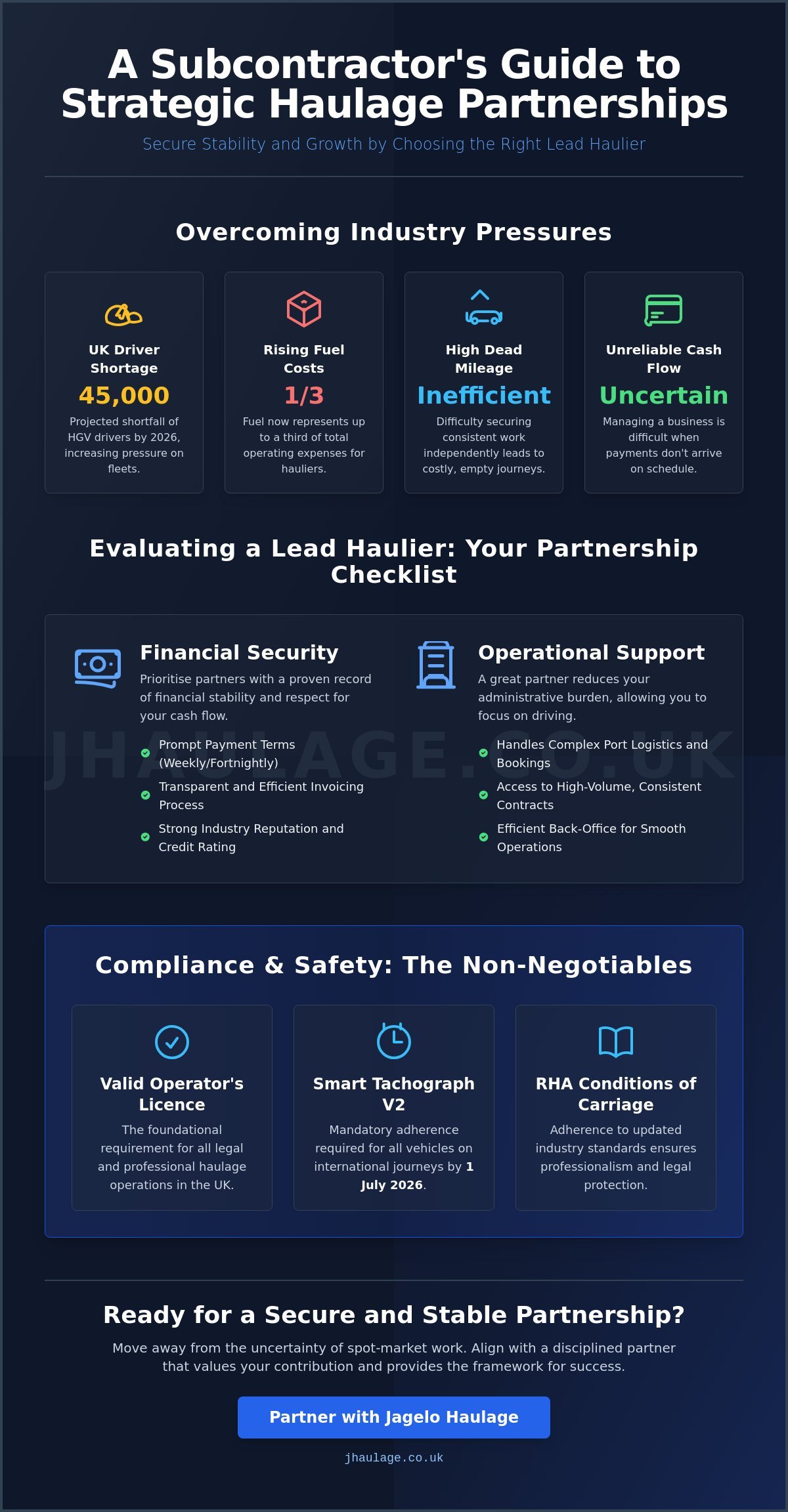
A reliable container haulage subcontractor is the backbone of a disciplined supply chain; it's a strategic partnership that rewards operational excellence with financial stability. With the UK facing a shortage of up to 45,000 HGV drivers through 2026, the pressure to maintain high vehicle utilisation is intense. You understand the difficulty of securing consistent work from major ports independently, especially when fuel costs now represent a third of your total operating expenses. It's frustrating to manage high dead mileage whilst waiting for payments that don't arrive on schedule.
This article provides a clear framework for selecting a partner that offers the stability your business requires. You'll discover the essential operational requirements, including the mandatory transition to Smart Tachograph Version 2 by July 1, 2026, and the benefits of adhering to updated RHA Conditions of Carriage. We'll preview how professional operational support and prompt payment terms transform your daily haulage activities into a secure and stable strategic outcome. By following these professional standards, you can move away from the uncertainty of spot-market work and into a structured environment built on competence and reliability.
Key Takeaways
- Understand how a container haulage subcontractor functions as a strategic fleet extension to facilitate the movement of goods between major UK ports and inland hubs.
- Identify the critical markers of a dependable lead haulier, prioritising financial stability and a proven record of prompt payment terms.
- Learn how professional partnerships reduce administrative burdens by handling complex port logistics and merchant haulage bookings on your behalf.
- Review the essential compliance standards, from valid Operator’s Licences to strict tachograph adherence, required to ensure safe and legal operations.
- Evaluate the strategic advantages of aligning with a disciplined partner that offers access to high-volume contracts and a modern, well-maintained fleet.
What is a Container Haulage Subcontractor?
A container haulage subcontractor is a professional transport entity that provides additional vehicle capacity to a lead logistics provider. These businesses specialise in the transport of shipping containers between major UK ports and inland distribution centres. Whilst they operate as independent commercial entities, they function under the operational management and scheduling of a lead haulier. This relationship ensures that the primary contractor can maintain a fluid response to fluctuating demand without the overhead of an excessively large permanent fleet. Understanding What is haulage? in this context requires a focus on the specific technical requirements of container movements, including the use of specialised skeletal trailers and adherence to strict port security protocols.
The role of a container haulage subcontractor is fundamental to the stability of the UK supply chain. These partners ensure that port logistics remain efficient, preventing bottlenecks that can occur during periods of high import volume. By integrating with a lead haulier's management system, subcontractors provide a scalable solution that maintains high professional standards across all transport activities. This arrangement allows smaller firms to access high-volume work whilst the lead haulier ensures that all safety and delivery targets are met with consistency.
The Role in the Modern Supply Chain
Subcontractors bridge the critical gap between shipping line requirements and final inland delivery locations. They provide the necessary flexibility to handle seasonal peaks in port activity, such as the increased demand seen in the lead-up to major retail periods. This capacity is vital for fulfilling merchant haulage obligations with precision. A disciplined subcontractor ensures that every container reaches its destination according to a strict schedule, which protects the integrity of the broader logistical framework and supports the continuous flow of goods.
Types of Subcontracting Arrangements
Operational structures for subcontracting vary based on the scale of the provider and the nature of the agreement. The industry typically relies on several proven models:
- Owner-driver models: These involve individual operators who provide a single vehicle and their own driving services. They offer high levels of personal accountability and are often utilised for specific, high-priority routes.
- Fleet-to-fleet partnerships: Smaller haulage firms dedicate multiple units to a lead haulier. This model provides the lead haulier with significant blocks of capacity and a single point of operational contact.
- Contractual variations: Work may be distributed on an ad-hoc basis to cover unexpected surges, or through dedicated long-term contracts that provide the subcontractor with guaranteed volumes and predictable routes.
Each model relies on a foundation of mutual trust and a shared commitment to safety. Successful partnerships are built on clear communication and a mutual understanding of the high stakes involved in port-to-door logistics.
Evaluating Partnership Criteria: What to Look for in a Lead Haulier
Evaluating a lead haulier requires a disciplined assessment of their operational and financial infrastructure. For a container haulage subcontractor, the partnership must provide more than just a volume of work. It should offer a secure environment where performance is rewarded with prompt settlement and professional support. Reliability starts with financial transparency. You should prioritise hauliers who demonstrate a proven track record of meeting payment deadlines without administrative delay. A partner that respects your time and your balance sheet is essential for long-term growth.
Payment Terms and Financial Security
Cash flow is the lifeblood of any transport operation. In an industry where fuel costs can account for a third of total running expenses, weekly or fortnightly payment cycles are essential for maintaining your fleet. You should seek partners who provide clear, transparent invoicing processes that minimise administrative friction. A lead haulier with a strong credit rating and a solid industry reputation provides the security you need to invest in your own business. This financial stability ensures that your focus remains on the road rather than on chasing overdue funds.
Operational Support and Back-Office Efficiency
Professional operational support is a hallmark of a high-tier lead haulier. This includes access to a modern, well-maintained container transport fleet and the provision of specialised equipment like skeletal trailers. A disciplined traffic desk understands the complexities of UK road haulage. They use centralised planning to minimise dead mileage and maximise vehicle utilisation. This level of coordination is critical for maintaining profitability in a competitive market.
Expertise in the Vehicle Booking System (VBS) at major ports is another non-negotiable requirement. Your partner must have the systems in place to secure bookings efficiently, reducing waiting times and ensuring smooth port entry. This operational discipline mirrors the standards required for UK haulage compliance, where every aspect of the journey is documented and managed strictly. If you're looking for a partner that values these professional standards, it's worth considering how a structured partnership can stabilise your fleet's future.
A reliable container haulage subcontractor relationship is built on mutual respect and clear communication. When the lead haulier manages the administrative burden of port logistics and merchant haulage bookings, you're free to focus on the safe and efficient movement of goods. This synergy creates a robust operational framework that benefits all parties involved in the supply chain.
The Operational Advantages of Professional Subcontracting
Professional subcontracting offers a level of operational stability that is difficult to achieve as an independent operator. When you act as a container haulage subcontractor for an established lead haulier, you immediately remove the heavy administrative burden associated with port logistics and merchant haulage bookings. Managing these bookings requires significant time and specialised knowledge of port systems. By delegating this to a partner with over 15 years of industry experience, you ensure your business remains focused on its core function: the safe and efficient movement of goods. This partnership provides access to high-volume contracts that are typically unavailable to smaller fleets, creating a more predictable revenue stream.
Operating within a disciplined framework also improves fuel efficiency through strategic routing. Lead hauliers employ professional planners to coordinate movements across the UK, ensuring that every mile driven contributes to the bottom line. This methodical approach mirrors the best practice standards championed by the Road Haulage Association, where operational discipline leads to better safety and financial outcomes. You gain the security of a large-scale operation whilst maintaining your independent business status.
Maximising Vehicle Utilisation
Expert scheduling is the primary tool for maximising vehicle utilisation. Professional traffic desks work to ensure trucks are kept moving with loaded containers, effectively eliminating the profit-killing effects of dead mileage. By balancing import collections with export deliveries, planners optimise the round-trip for every driver. This coordination reduces the time spent waiting at port terminals. Efficient scheduling means your assets are always productive, which is vital when fuel and maintenance costs remain high.
Access to Specialist Infrastructure
Subcontractors benefit from the lead haulier’s established relationships with major UK maritime hubs. This includes a deep, shared knowledge of port logistics services UK, which helps in navigating the complexities of different terminal requirements. Furthermore, many professional partnerships offer access to trailer rental schemes. These schemes allow you to expand your capacity without significant capital outlay. You can utilise high-quality skeletal trailers that meet the latest safety standards, ensuring your fleet remains modern and compliant without the financial risk of direct purchase. This access to infrastructure transforms a small operation into a strategic partner within a much larger logistical network.
Compliance and Safety: The Non-Negotiables of UK Haulage
Compliance is the foundation of a secure transport operation. It protects your business assets and the reputation of your logistical partners. A valid Goods Vehicle Operator’s Licence is the absolute baseline for any container haulage subcontractor. Without this legal authorisation, you cannot participate in the movement of goods from UK ports. Beyond the licence, strict adherence to driver hours and tachograph regulations is essential for safety and legal standing. You must stay informed of shifting requirements, such as the mandate for all goods vehicles over 2.5 tonnes used for international transport to be fitted with a Smart Tachograph Version 2 by July 1, 2026. Even for domestic port-to-hub movements, maintaining these high technical standards demonstrates the operational discipline that lead hauliers require.
Safety protocols during container loading and transit are non-negotiable. Every twistlock must be checked, and every load must be secure before the vehicle leaves the terminal. You must also maintain fully insured status for both your vehicles and the Goods in Transit. This insurance provides the necessary protection against unforeseen incidents, ensuring that your business remains financially stable. Professionalism in the haulage sector means leaving nothing to chance. If you're ready to align your operation with a partner that values these protocols, join a fleet that prioritises safety and compliance.
Industry Standards and Accreditations
The Fleet Operator Recognition Scheme (FORS) remains a critical benchmark for excellence in 2026. Many major UK maritime hubs and distribution centres now prioritise subcontractors who hold FORS Silver or Gold status. Meeting these standards shows a commitment to environmental efficiency and road safety. Additionally, all new HGV designs must meet the Direct Vision Standard (DVS) from 2026 to improve driver visibility in urban environments. Specialised training for port-centric operations provides a competitive advantage, whilst ensuring your vehicles meet the latest environmental specifications helps you avoid the daily charges for non-compliant HGVs in Clean Air Zones, which can reach £100 per day.
Maintaining High Professional Standards
High professional standards extend to the physical condition of your fleet. Rigorous vehicle maintenance schedules are vital to prevent roadside breakdowns that disrupt the supply chain. A well-maintained vehicle is a reliable vehicle. Driver behaviour also plays a significant role in the reputation of the lead haulier. Drivers are the primary point of contact at ports and delivery sites; their conduct must be disciplined and punctual. Secure container transport protocols are also essential for preventing cargo theft and damage, ensuring that every strategic outcome is a successful delivery. This level of masterly performance is what separates a standard provider from a strategic partner.
Partnering with Jagelo Haulage: A Strategic Move for Your Fleet
Jagelo Haulage provides a disciplined operational environment that transforms the role of a container haulage subcontractor into a strategic partnership. Our business model prioritises functional reliability and the safety of the UK supply chain. We maintain a modern fleet of over 40 trucks, ensuring that our subcontractors operate alongside high-quality equipment and professional drivers. With a strategic presence at the most critical maritime hubs, including Felixstowe, Southampton, and Tilbury, we offer the geographical reach necessary for consistent volume and reduced dead mileage.
Communication within our traffic desk is clear and declarative. We understand that your contribution is vital to the efficiency of port logistics. Our management team focuses on reducing administrative friction, allowing you to concentrate on the movement of goods. This no-nonsense approach creates a stable environment where your business can thrive without the uncertainty of spot-market fluctuations. We value the expertise you bring to our operations and treat every subcontractor as a key component of our strategic outcomes.
Why Jagelo Haulage Stands Out
Our expertise is built on over 15 years of managing complex logistics for shipping containers. This experience allows us to navigate the unique challenges of UK port operations with quiet confidence, making us a preferred partner for any professional container haulage subcontractor. We take stoic pride in our ability to provide protected outcomes for our clients and partners alike. Our commitment to functional reliability ensures that your trucks stay on the road, minimising the downtime that affects your profitability. We don't just offer work; we provide a structured framework for operational excellence.
How to Start Your Partnership
The onboarding process at Jagelo Haulage follows a strict professional protocol to ensure all partners meet our high standards. We welcome enquiries from owner-drivers and small fleet operators who share our commitment to discipline and safety. The initial enquiry process is straightforward, focusing on your current capacity and operational reach. We seek partners who prioritise masterly performance and follow protocols strictly.
To begin the onboarding protocol, you'll need to provide specific documentation, including your valid Goods Vehicle Operator’s Licence and proof of comprehensive insurance. We also require evidence of your commitment to tachograph compliance and driver training. This rigorous approach protects the integrity of our fleet and the security of the cargo we transport. If you're ready to secure a stable future for your operation, contact Jagelo Haulage today to discuss subcontractor opportunities. We look forward to establishing a partnership based on mutual competence and functional reliability.
Securing the Future of Your Haulage Operation
Operational stability in the transport sector depends on the strength of your partnerships. A disciplined approach to compliance, maintenance, and scheduling ensures that your business remains resilient against market fluctuations. By prioritising financial security and professional back-office support, you can eliminate the administrative friction that often hinders growth. Choosing to work as a container haulage subcontractor for a lead haulier that values these standards is a strategic decision that protects your long-term interests.
Jagelo Haulage provides the infrastructure and expertise required to stabilise your fleet's daily activities. We offer national coverage across all major UK ports, backed by over 15 years of industry experience and a modern fleet of more than 40 trucks and trailers. Our focus remains on masterly performance and functional reliability in every movement. We invite owner-drivers and fleet operators who share our commitment to excellence to join our professional network. Partner with Jagelo Haulage for reliable container subcontracting and experience the benefits of a structured, outcome-oriented partnership. We look forward to supporting your business as it moves toward a more secure and productive future.
Frequently Asked Questions
What are the typical payment terms for a container haulage subcontractor?
Payment terms for a container haulage subcontractor typically range from seven to fourteen days. Disciplined lead hauliers understand that fuel accounts for approximately one third of your operating costs; therefore, prompt settlement is essential for your cash flow. We prioritise transparent invoicing to reduce administrative friction. This predictable payment cycle allows you to manage your fleet with confidence and maintain high professional standards without financial strain.
Do I need my own trailer to subcontract for a haulage company?
You don't always need your own trailer to begin a partnership. Many established hauliers provide skeletal trailers or offer trailer rental schemes as part of their subcontractor support package. This arrangement allows you to expand your fleet capacity without significant capital outlay. It's a strategic way to access specialised equipment that meets the latest safety specifications whilst maintaining your independent business status.
Which UK ports do container haulage subcontractors usually operate from?
Subcontractors primarily operate from major UK maritime hubs such as Felixstowe, Southampton, Tilbury, and London Gateway. These ports are the focal points of the UK's containerised trade and offer the highest volume of work. Strategic presence at these locations ensures that your vehicles remain utilised. Professional lead hauliers coordinate movements across these ports to provide national coverage for their clients.
What insurance is required for container haulage subcontracting?
Mandatory insurance includes comprehensive motor insurance and Goods in Transit (GiT) cover. You must also maintain public liability insurance to protect against third party risks during loading and transit. These policies are non-negotiable requirements for any professional container haulage subcontractor. They provide the security needed to handle high value cargo whilst protecting your business from the financial impact of unforeseen operational incidents.
Can I choose between day work and tramping as a subcontractor?
Flexibility between day work and tramping is often available depending on the lead haulier’s requirements. Day work typically involves local turns between ports and inland distribution centres; this allows drivers to return to base daily. Tramping involves longer routes across the UK and requires overnight stays. You can choose the model that best fits your driver's preferences and your vehicle's operational capacity.
How does a lead haulier help in reducing dead mileage for subcontractors?
A lead haulier reduces dead mileage through centralised traffic planning and expert scheduling. Planners coordinate import collections and export deliveries to ensure your truck stays loaded for the majority of its journey. This methodical approach increases your profitability by maximising vehicle utilisation. It turns every route into a strategic outcome rather than just a simple delivery, ensuring your assets are always productive.
Is it better to choose merchant haulage or shipping line haulage work?
Both merchant haulage and shipping line haulage offer distinct advantages for a container haulage subcontractor. Merchant haulage work is often more varied and involves direct coordination with freight forwarders or cargo owners. Shipping line haulage is usually higher volume and follows more rigid carrier protocols. Most successful subcontractors maintain a balance of both to ensure a steady work volume and high vehicle utilisation across the UK port network.
What compliance documents will I need to provide during onboarding?
You'll need to provide a valid Goods Vehicle Operator’s Licence and current insurance certificates during the onboarding protocol. We also require tachograph records and proof of vehicle maintenance schedules to ensure safety compliance. Additional documents may include FORS accreditation or evidence that your vehicles meet the Direct Vision Standard (DVS). These documents confirm your commitment to the high professional standards required in the modern haulage sector.