Benefits of port-to-warehouse delivery for UK importers

Port-to-warehouse delivery cuts inland haulage legs, lowers total landed costs, and accelerates time-to-market for UK importers. The core mechanism is straightforward: by moving containers directly from terminal gate to a port-adjacent or bonded warehouse, you eliminate the redundant inland leg that adds mileage, driver hours, and demurrage exposure. Providers such as Jagelo Haulage Limited operate across Felixstowe, Tilbury, Southampton, and Liverpool, giving importers a single contracted workflow from vessel discharge to warehouse receipt. HMRC permits customs warehouse storage near port estates, deferring import duty and VAT until goods leave bond — a material cashflow advantage for high-value or seasonal shipments.
When port-to-warehouse delivery is the right call:
- Containerised shipments destined for concentrated customer zones within a day’s ground reach of a major UK port
- High-value or seasonal goods where duty deferment under bonded storage materially improves working capital
- Shipments requiring light finishing, labelling, or pallet rework before onward distribution
- Recurring import programmes where pre-booked drayage slots reduce demurrage risk
Table of Contents
- 1. How port-to-warehouse delivery reduces your costs and speeds up delivery
- 2. Inventory handling gets simpler with consolidation and cross-docking
- 3. Bonded warehousing near ports gives you real cashflow control
- 4. Port-to-warehouse delivery gives you predictability and operational resilience
- 5. Fewer road miles mean lower emissions and a stronger sustainability case
- 6. What does port-to-warehouse delivery actually cost, and how long does it take?
- 7. How to adopt port-to-warehouse delivery: a practical checklist
- 8. How Jagelo Haulage delivers port-to-warehouse operations across the UK
- Key takeaways
- The case for port-centric thinking goes deeper than cost
- Jhaulage: port-to-warehouse delivery built for UK container importers
- Useful sources and further reading
1. How port-to-warehouse delivery reduces your costs and speeds up delivery
Removing a single inland haulage leg directly reduces drayage mileage, driver hours, fuel cost, and the risk of empty return runs. Each of those line items compounds: a shorter drayage distance means less exposure to road congestion, fewer missed Vehicle Booking System (VBS) slots, and a lower probability of containers sitting at the terminal accruing demurrage charges. Demurrage can reach hundreds of pounds per container per day when collection is delayed, so tighter turnaround windows translate directly into cost avoidance.
On the time-to-market side, pre-arranged gate appointments and pre-filed customs documentation mean containers move from terminal to warehouse within hours rather than days. For seasonally sensitive goods — fashion, fresh produce, promotional stock — that compression in dwell time can be the difference between landing on shelf before a peak window or missing it entirely.
Last-mile delivery typically accounts for 30–40% of total shipping costs, and relocating fulfilment closer to port entry points materially reduces per-unit delivery costs in many network configurations. Port-centric warehousing positions your stock at the first stable point in the domestic supply chain, shortening the final distribution radius and reducing the premium service spend that accumulates when inland DCs are too far from demand.
2. Inventory handling gets simpler with consolidation and cross-docking
Port-adjacent warehousing simplifies consolidation and transloading, which means you can hold fewer SKUs in inland distribution centres and replenish regional markets faster. Rather than moving a full container hundreds of miles to a central DC before breaking it down, you perform that operation at the port estate, where handling infrastructure, labour, and onward transport connections are already concentrated.

Port-centric logistic zones permit fuller container stuffing and faster retrieval from terminal gates, reducing empty container movement and improving turnaround. Cross-docking at a port container freight station (CFS) allows you to receive a full container load (FCL), sort by destination, and despatch palletised loads to multiple regional nodes in a single operation, cutting handling touches and transit inventory simultaneously.
Value-added operations — labelling, bagging, pallet rework, and even light assembly — can be performed on the port estate before goods enter the domestic distribution network. Ports can provide this processing close to import entry points, avoiding unnecessary inland transport of unready goods and accelerating time-to-market for products that would otherwise require a separate finishing step at an inland facility.
Key inventory benefits at a glance:
- Fewer handling touches between vessel and shelf
- Reduced transit inventory and lower carrying costs
- Faster replenishment cycles to regional markets
- Pallet rework and labelling completed before onward despatch
- Smaller safety-stock requirements at inland DCs
Pro Tip: Use transloading at the port when your shipment contains multiple SKUs destined for different regional nodes, or when your container weight exceeds practical road limits for a single inland delivery. Move full containers inland only when a single customer or DC absorbs the entire load and the destination is within a cost-effective drayage radius.
3. Bonded warehousing near ports gives you real cashflow control
Bonded port warehouses defer import duty and VAT until goods physically leave the customs warehouse, which is a practical cashflow advantage for importers handling seasonal or high-value stock. Rather than paying duty on arrival, you draw down goods progressively as orders are fulfilled, aligning duty payments with revenue receipts. HMRC’s guidance on customs warehouse eligibility sets out which goods and operators qualify, and port estates typically host approved customs warehouse operators who can manage the administrative requirements on your behalf.
Port warehouses and container freight stations near terminals commonly handle bonded storage, cross-docking, cold storage, and other specialised functions, making them natural single-stop facilities for importers who need both customs compliance and operational flexibility. Re-export without entry into UK customs territory is also possible from a bonded facility, which is valuable for goods in transit or for managing returns on international orders.
Common questions logistics teams ask about bonded storage:
- Which goods are eligible for customs warehouse treatment under HMRC rules?
- Can we perform value-added operations (labelling, repacking) while goods remain in bond?
- What documentation is required to move goods out of bond into free circulation?
- How does bonded storage interact with duty suspension regimes such as Inward Processing Relief?
- What are the approved operator requirements for running a customs warehouse?
4. Port-to-warehouse delivery gives you predictability and operational resilience
Consolidating handoffs under a single port-to-warehouse workflow reduces the number of independent failure points that create cascaded delays. When drayage, terminal gate appointments, and warehouse intake are coordinated by one provider rather than three separate parties, misaligned schedules and miscommunication are structurally less likely. Consolidating providers under a single point of accountability streamlines the inbound flow and reduces delays caused by misalignment between ocean carriers, terminal operators, and inland transport teams.

Real-time GPS tracking on containers and trucks gives operations managers live visibility from terminal gate to warehouse bay. Pre-arranged VBS appointments reduce gate queuing, and centralised SLAs create a single escalation path when something does go wrong. The practical result is more predictable labour planning at the receiving warehouse: teams know when trucks will arrive, which eliminates the overtime spikes and casual labour costs that follow unplanned late arrivals.
Operational resilience benefits:
- Reduced container dwell time at terminal, lowering demurrage exposure
- Fewer missed cut-offs through pre-booked gate appointments
- Live container and truck GPS tracking for end-to-end visibility
- Centralised SLA management with a single accountable provider
- More consistent warehouse labour scheduling, reducing unplanned overtime
Integrated port-to-door logistics that secure inland capacity before vessel arrival reduce container dwelling at terminals and lower the risk of demurrage. Pre-arrival planning is the single most effective mitigation: booking drayage slots and pre-filing customs documentation before the vessel berths keeps containers moving from the moment they are discharged.
5. Fewer road miles mean lower emissions and a stronger sustainability case
Shorter drayage distances and higher truck utilisation reduce fuel consumption and CO2 emissions per container moved. When a warehouse sits adjacent to the port rather than 150 miles inland, the road leg shrinks proportionally, and each truck run carries a higher payload relative to the distance travelled. Port-centric solutions reduce inland transport legs, cutting fuel use and emissions while lowering exposure to road traffic bottlenecks.
“Ports can integrate and optimise the various operations and activities so as to reduce costs and add value to customers and users. The contemporary role of ports often extends from providing services at the traditional sea/land interface to being a good location for value-added logistics services.”
Source: UNCTAD
Intermodal options strengthen the sustainability case further. Rail combined with short-haul drayage from deep-water ports can reduce congestion, lower emissions, and help offset driver shortages by moving longer legs by rail. For corporate sustainability teams reporting Scope 3 emissions, port-centric operations provide a defensible reduction in transport-related emissions that can be quantified against a baseline inland-DC model.
6. What does port-to-warehouse delivery actually cost, and how long does it take?
The timeline from vessel arrival to warehouse clearance typically runs across five phases: vessel discharge, terminal handling, customs checks, drayage, and warehouse receipt. Pre-booked inland capacity and pre-filed customs documentation compress that timeline materially, with well-coordinated movements completing the full sequence within 24–48 hours of container release.
Core cost drivers to model:
- Drayage: mileage-based charge from terminal gate to warehouse; the primary variable cost
- Terminal handling charges (THC): levied by the terminal operator on container lift-off
- Customs brokerage: fees for entry preparation, classification, and duty calculation
- Storage in bond: daily or weekly rate for goods held in a customs warehouse
- Transload labour: cost of breaking bulk, palletising, and labelling at the port CFS
- Last-mile fulfilment: onward pallet or parcel distribution from the port warehouse
| Phase | Typical time band | Primary cost item |
|---|---|---|
| Vessel discharge to terminal release | 24–48 hours | Terminal handling charge |
| Customs clearance (pre-filed) | 2–8 hours | Customs brokerage fee |
| Drayage to port warehouse | 1–4 hours | Drayage mileage rate |
| Warehouse receipt and put-away | 2–6 hours | Handling and labour |
| Bonded storage (if applicable) | Per day until duty paid | In-bond storage rate |
Pre-booking drayage before vessel arrival is the single most effective way to tighten these windows. Operators who secure slots in advance consistently achieve faster container release and lower demurrage exposure than those relying on spot capacity. For guidance on avoiding demurrage fees, pre-arrival planning is the foundation of every effective mitigation strategy.
7. How to adopt port-to-warehouse delivery: a practical checklist
Adopt port-to-warehouse delivery by securing bonded or port-adjacent warehousing, pre-booking drayage capacity, and clarifying customs responsibilities before the first vessel arrives. The most common implementation failures stem from mismatched appointment windows and incomplete documentation — both of which are preventable with structured pre-arrival planning.
Implementation checklist:
- Confirm bonded or port-adjacent warehouse availability at your primary UK port of entry
- Establish a Vehicle Booking System (VBS) account and pre-book gate appointments aligned to vessel ETAs
- Appoint a customs broker to pre-file import entries and manage duty deferment under bonded storage
- Define SLAs with your drayage provider covering collection windows, GPS tracking, and demurrage liability
- Integrate container tracking data into your WMS or TMS for end-to-end visibility
- Agree value-added service requirements (labelling, pallet rework) with the port CFS operator
- Establish contingency routing for peak periods, port congestion, or vessel delays
- Confirm insurance and liability coverage for goods in transit and in bond
- Set KPIs: dwell time, demurrage incidents, on-time warehouse receipt, and cost per container
Provider questions to include in your RFP:
- Which UK ports do you operate from, and what are your VBS slot pre-booking lead times?
- How do you manage demurrage risk when vessel arrival is delayed?
- What GPS tracking capability do you provide, and how is data shared with the client?
- Do you hold or can you arrange bonded warehouse status at port?
- What value-added services (labelling, cross-docking, cold storage) are available on the port estate?
- What are your SLA commitments for container collection post-release?
When evaluating providers, a container haulage provider selection checklist covering these criteria will help procurement teams compare capabilities objectively and avoid common contracting pitfalls.
8. How Jagelo Haulage delivers port-to-warehouse operations across the UK
Jagelo Haulage Limited operates a fleet of over 40 GPS-tracked trucks and trailers across the UK’s principal container ports, including Felixstowe, Tilbury, Southampton, and Liverpool. That coverage means a single contracted provider can manage the full port-to-warehouse sequence at whichever gateway your containers arrive through, without the coordination friction of multiple regional subcontractors.
| Capability | Detail |
|---|---|
| Fleet size | 40+ trucks and trailers |
| GPS tracking | Real-time monitoring on all vehicles |
| Ports covered | Felixstowe, Tilbury, Southampton, Liverpool |
| Services | Container haulage, same-day port pickup, bonded handling, refrigerated transport, oversized and hazardous goods |
| Support | 24/7 operational support |
The practical customer benefit is measurable: GPS visibility from terminal gate to warehouse bay gives operations teams live ETAs, which tightens warehouse labour scheduling and reduces the unplanned overtime that follows late or unannounced arrivals. Same-day port pickup capability reduces container dwell time and the associated demurrage risk, while 24/7 support means escalation paths remain open outside standard business hours.
What this means for your supply chain:
- Reduced demurrage exposure through pre-booked collection and same-day pickup
- Tighter SLA compliance through GPS-tracked, single-provider accountability
- Bonded handling capability for duty-deferment workflows
- Specialist capacity for refrigerated, oversized, and hazardous cargo
- Consistent port coverage across four major UK container gateways
For a detailed view of expert container haulage services and how these capabilities translate into operational outcomes, Jhaulage’s service pages set out the full scope of port-to-warehouse delivery options available to UK importers and freight forwarders.
Key takeaways
Port-to-warehouse delivery delivers its strongest return when containerised volumes are recurring, customer demand is geographically concentrated near a major UK port, and bonded duty handling is a cashflow priority.
| Point | Details |
|---|---|
| Cost reduction mechanism | Removing inland haulage legs cuts drayage mileage, driver hours, and demurrage exposure simultaneously. |
| Last-mile cost share | Last-mile delivery accounts for 30–40% of total shipping costs; port-adjacent warehousing reduces this materially. |
| Bonded storage advantage | HMRC customs warehouses defer import duty and VAT until goods leave bond, improving cashflow on high-value stock. |
| When it is less suitable | Very low import volumes or a highly dispersed customer base reduce the network savings that justify port-centric positioning. |
| Jhaulage capability | Jagelo Haulage Limited covers Felixstowe, Tilbury, Southampton, and Liverpool with a 40+ vehicle GPS-tracked fleet for end-to-end port-to-warehouse delivery. |
The case for port-centric thinking goes deeper than cost
The logistics industry tends to frame port-to-warehouse delivery as a cost-reduction exercise, and the numbers support that framing. But the more durable advantage is structural predictability. When you consolidate drayage, customs, and warehouse intake under a single coordinated workflow, you are not just saving on mileage — you are removing the category of problem that arises when three independent providers each assume someone else is managing the handoff.
The operational reality at busy UK container ports is that appointment windows are tight, documentation errors are common, and vessel schedules shift. Importers who treat the port-to-warehouse leg as a commodity purchase — awarded to the cheapest available drayage provider on a spot basis — consistently absorb higher total costs than those who contract a specialist with pre-booked capacity and established terminal relationships. The demurrage bill alone often exceeds the apparent saving from a lower headline rate.
There is also a sustainability dimension that procurement teams undervalue. Shorter drayage distances and higher truck utilisation are not just good for Scope 3 reporting — they reduce the congestion exposure that makes road freight unpredictable in the first place. A port-adjacent warehouse is, in that sense, a resilience asset as much as a cost asset.
The practical advice is to model the full landed cost, including demurrage risk, empty return miles, and the labour cost of unplanned warehouse arrivals, before comparing port-centric and inland-DC options. The headline drayage rate is rarely the deciding figure.
Jhaulage: port-to-warehouse delivery built for UK container importers
Faster container turnaround, lower demurrage exposure, and GPS visibility from terminal gate to warehouse bay — these are the concrete outcomes Jhaulage delivers for UK importers and freight forwarders who need a reliable port-to-warehouse workflow.
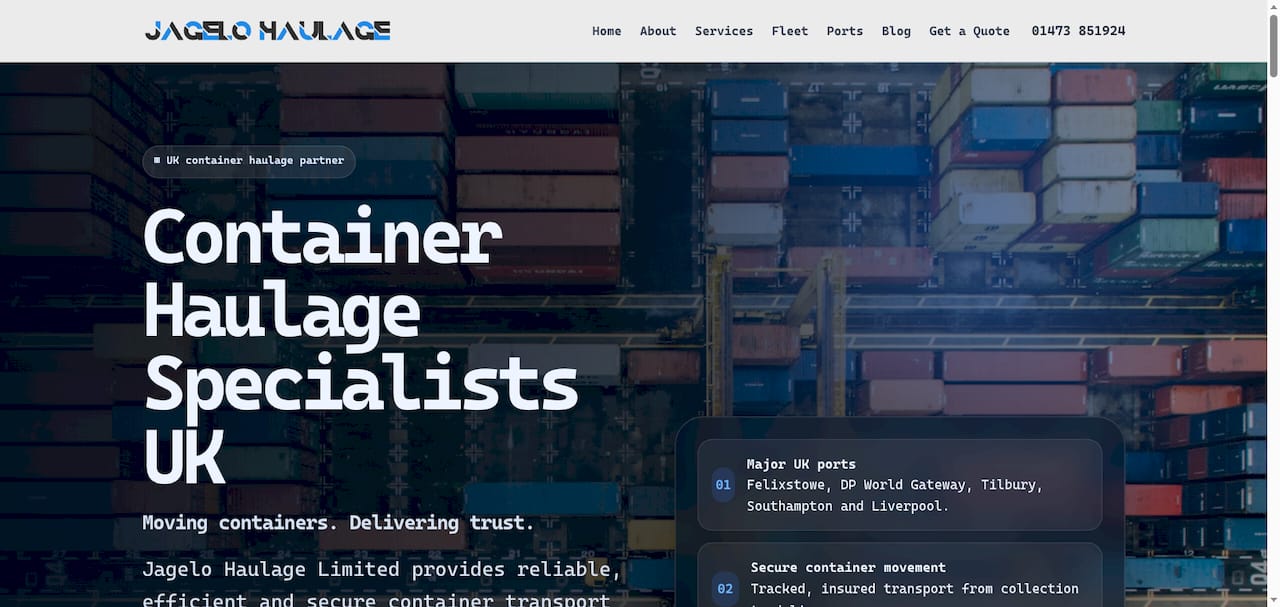
Jagelo Haulage Limited operates across Felixstowe, Tilbury, Southampton, and Liverpool with a fleet of over 40 GPS-tracked trucks and trailers, offering same-day port pickups, bonded handling, refrigerated transport, and full container load shipments under a single contracted service. There is no need to coordinate separate drayage, customs, and warehouse providers: Jhaulage manages the sequence from terminal release to warehouse receipt, with 24/7 support and real-time tracking throughout. For importers managing pallet distribution and last-mile consolidation alongside container movements, that single-provider accountability removes a significant layer of coordination overhead.
To discuss your port-to-warehouse requirements or request a quote, contact Jhaulage directly via jhaulage.co.uk and speak with a specialist about your port coverage, volume profile, and SLA requirements.
Useful sources and further reading
- HMRC: Check if you can store goods in a customs warehouse — Primary HMRC guidance on customs warehouse eligibility, bonded storage rules, and approved operator requirements for UK importers.
- Transport Geography: Port-centric logistics advantages — Academic overview of port-centric logistic zone benefits, covering container asset efficiency and drayage reduction.
- Peel Ports: Port-centric solutions — Operator-level explanation of value-added services, intermodal options, and emissions benefits from port-centric distribution.
- WareCRE: Last-mile delivery and warehouse location — Analysis of how warehouse proximity to demand zones affects last-mile cost, with cost-band examples.
- Knight-Swift Supply Chain: Port-to-door logistics — Practitioner perspective on integrated port-to-door workflows, demurrage mitigation, and the cost of fragmented handoffs.
- UNCTAD: Ports as logistics and distribution centres — Authoritative UN trade and development analysis of port integration into international logistics and value-added service provision.
- Jhaulage: Port-to-warehouse transport guide — UK-specific strategic guide to container logistics and port-to-warehouse delivery from Jagelo Haulage Limited.