What is port to door delivery? A UK guide
Port-to-door delivery is defined as the logistics process that moves goods from their port of arrival to the buyer’s final destination, encompassing port handling, customs clearance, inland transport, and last-mile delivery. Unlike port-to-port shipping, where the carrier’s responsibility ends at the destination port, port-to-door delivery coordinates the full inland journey under a single managed service. For UK logistics managers importing through Felixstowe, Tilbury, Southampton, or Liverpool, this distinction carries significant operational and financial weight. Understanding what port-to-door shipping involves, how it compares to alternatives, and how Incoterms govern responsibilities is the foundation of sound import planning.
What is port to door delivery and what does it include?
Port-to-door logistics manage shipments from port arrival to the customer’s location, covering port handling, customs clearance, inland transport, warehousing, and final delivery. This model is not a single transaction but a coordinated chain of services, each with its own documentation requirements, cost structures, and risk points. For a UK importer receiving a full container load (FCL) from Shanghai or Rotterdam, that chain typically begins the moment the vessel berths.
The five core components of a port-to-door service are:
- Port handling and container discharge: The logistics provider arranges collection of the container from the port’s container terminal, managing Vehicle Booking System (VBS) slots and port gate procedures. At Felixstowe, for example, missed or late VBS slots can trigger demurrage charges that accumulate daily.
- Customs clearance and documentation: Import declarations, commodity codes, and duty calculations must be submitted to HMRC before the container can leave the port. A competent port-to-door provider either holds an Authorised Economic Operator (AEO) status or works with a licensed customs broker.
- Inland transportation (drayage and onward haulage): The container moves from the port to either a deconsolidation warehouse or directly to the consignee’s premises. UK importers typically handle at least two trucking legs: drayage from the quay to a warehouse, then onward haulage to the final destination.
- Warehousing and distribution: Where the consignee cannot receive a full container directly, a cross-dock or bonded warehouse facility may be used for deconsolidation and palletisation before final despatch.
- Final delivery to the buyer’s premises: The goods arrive at the named address, whether a distribution centre, retail warehouse, or manufacturing facility.
Pro Tip: Always request a written scope of services from your port-to-door provider before signing a contract. Quotes frequently exclude detention costs, port storage fees, or customs examination charges, and these omissions can add hundreds of pounds per container to your landed cost.
How does port-to-door differ from port-to-port and door-to-door?
Understanding the distinctions between these three shipping models helps you select the arrangement that matches your operational capacity and risk tolerance. The differences are not merely semantic; they determine who bears cost, liability, and administrative burden at each stage of the journey.
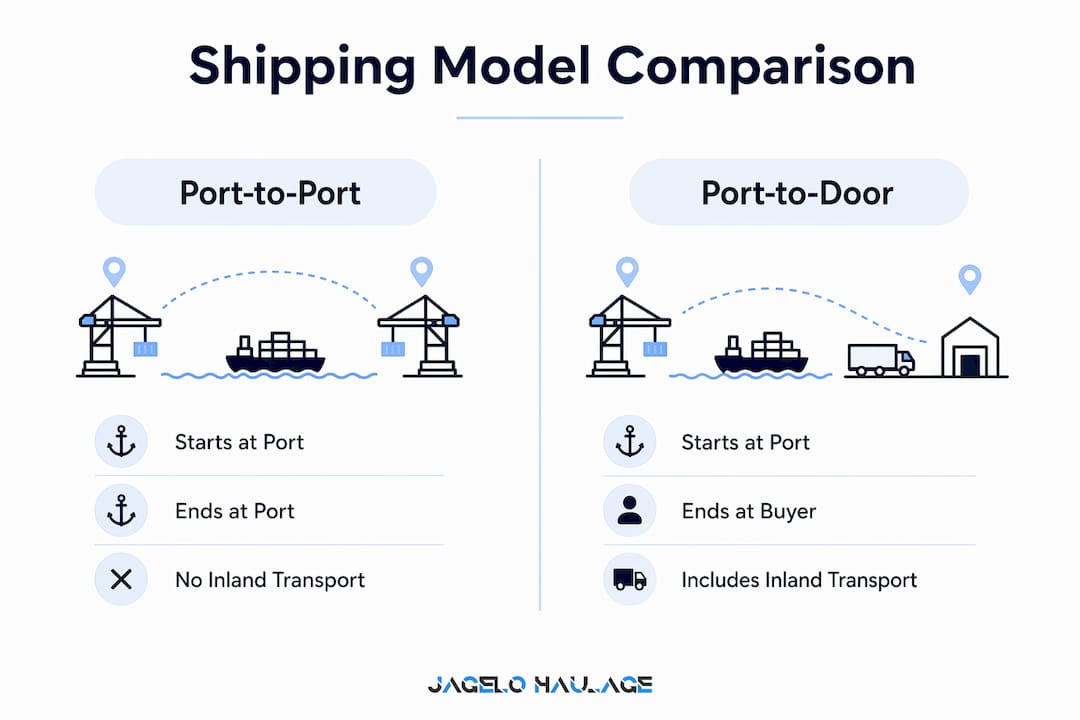
Port-to-port shipping is the most limited model. The carrier’s contractual responsibility ends at the destination port, and the consignee takes over all inland logistics. This suits large importers with their own haulage fleets or established relationships with drayage contractors, but it places the full burden of customs, transport booking, and delivery coordination on the buyer.
Door-to-door shipping, by contrast, is the most comprehensive model. Door-to-door ocean freight combines inland transport, ocean freight, customs clearance, and final delivery into one end-to-end service, covering the origin address through to the consignee’s door. This is the natural choice for importers who want maximum simplicity and are willing to pay a premium for it.
Port-to-door delivery sits between these two. It begins at the destination port rather than the origin address, making it the standard arrangement for most UK importers who source goods from overseas suppliers responsible for origin-side logistics.
| Shipping model | Starts at | Ends at | Customs included | Inland transport | Best suited for |
|---|---|---|---|---|---|
| Port-to-port | Origin port | Destination port | No | Buyer’s responsibility | Large importers with own haulage |
| Port-to-door | Destination port | Buyer’s premises | Usually yes | Provider managed | Most UK importers |
| Door-to-door | Origin address | Buyer’s premises | Yes | Fully managed | Importers prioritising simplicity |
Port-to-door reduces handoffs compared to port-to-port shipping, where carriers’ responsibility ends at the destination port and inland logistics falls to the consignee. Fewer handoffs mean fewer opportunities for delays, miscommunication, and cost overruns. For a logistics manager overseeing multiple container arrivals per week, this consolidation of responsibility is a material operational advantage.
Pro Tip: If your supplier quotes you on a CIF (Cost, Insurance, and Freight) basis, their responsibility ends at the UK port. You will need a separate port-to-door arrangement to cover the inland leg. Confirm this before the shipment departs.
What role do Incoterms play in port-to-door delivery agreements?
Incoterms 2020, published by the International Chamber of Commerce, define the precise point at which risk and cost transfer from seller to buyer. Three terms are directly relevant to port-to-door and door delivery arrangements: DAP, DPU, and DDP.
- DAP (Delivered at Place): Under DAP, the seller arranges and pays for carriage to the named destination, but the buyer is responsible for import clearance and import duties. For a UK importer, this means the overseas seller organises transport to your warehouse gate, but your business handles HMRC declarations and tariff payments. DAP is common in B2B trade where the importer has an established customs broker.
- DPU (Delivered at Place Unloaded): Under DPU, the seller must unload the goods at the named destination, but import clearance and duties remain the buyer’s responsibility. DPU is the only Incoterm that places unloading responsibility on the seller, making it operationally significant when the consignee’s site lacks unloading equipment. The chain-of-custody transfer occurs only after physical unloading is complete.
- DDP (Delivered Duty Paid): DAP and DDP differ primarily on who handles import clearance and duty payments, with DDP placing those responsibilities on the seller and changing the cost and risk profile entirely. Under DDP, the seller bears maximum liability and cost, which is why many overseas exporters decline to quote on DDP terms unless they have a UK customs agent or subsidiary.
Selecting the appropriate Incoterm is not a formality. It determines whether your business or your supplier absorbs import duty, VAT, and the administrative cost of customs compliance. A mismatch between the Incoterm in your purchase order and the actual service your logistics provider delivers is one of the most common sources of unexpected charges in UK import operations.
Selecting the right Incoterm such as DAP, DPU, or DDP directly impacts import duty management and delivery risk, and UK businesses benefit from understanding these nuances before contracts are signed. The practical implication is straightforward: align your Incoterm choice with your internal customs capability. If your team cannot process import declarations, avoid DAP and DPU unless you have a reliable customs broker on retainer.
How does effective port-to-door coordination improve UK shipping operations?
Coordinating port handling, customs, drayage, and final delivery under a single provider or tightly managed network is where port-to-door delivery generates its greatest operational value. The alternative, managing each leg independently, multiplies the number of communication points, increases the risk of container detention, and makes it harder to identify accountability when something goes wrong.
Supply-chain specialists recommend asking for an explicit scope to know what is included or excluded in port-to-door services. This advice reflects a common failure mode: a logistics manager assumes their port-to-door quote covers customs examination fees, only to receive an invoice for £300 per container after a Border Force physical inspection. Explicit service scopes prevent this.
Practical steps for improving port-to-door coordination include:
- Pre-advise your logistics provider of vessel ETA, container numbers, and commodity details at least 72 hours before arrival to allow VBS slot booking and customs pre-lodgement.
- Confirm customs broker arrangements in writing before the shipment departs origin. At ports like Southampton and Tilbury, customs holds caused by incomplete documentation are a leading cause of demurrage charges.
- Use GPS-tracked haulage for high-value or time-sensitive containers. Real-time visibility allows you to manage customer expectations and respond to delays before they escalate.
- Plan for port congestion at major UK hubs. Felixstowe, the UK’s largest container port, periodically experiences berth delays and yard congestion that affect free-time windows and detention cost exposure.
For UK businesses managing port-to-door logistics, selecting a provider with direct port relationships, a modern fleet, and in-house customs support reduces the coordination burden significantly. The value of an experienced partner is not simply convenience; it is measurable in avoided demurrage, faster customs release, and predictable delivery windows.
Pro Tip: Ask prospective port-to-door providers which specific UK ports they operate from directly. A provider with established VBS accounts and port relationships at Felixstowe or Tilbury will consistently outperform a general haulier booking ad hoc slots.
Key takeaways
Port-to-door delivery is the most practical import model for UK businesses, as it consolidates port handling, customs clearance, inland haulage, and final delivery under coordinated management, reducing demurrage exposure and administrative burden.
| Point | Details |
|---|---|
| Definition is precise | Port-to-door covers port arrival to buyer’s premises, not origin pickup. |
| Five core components | Port handling, customs, inland transport, warehousing, and final delivery are all included. |
| Incoterms govern liability | DAP, DPU, and DDP each assign customs and unloading responsibility differently. |
| Fewer handoffs reduce risk | Coordinated port-to-door management cuts delays and cost overruns versus port-to-port. |
| Scope clarity is non-negotiable | Always obtain a written service scope to avoid unexpected detention and examination charges. |
Why I think most UK importers underestimate port-to-door complexity
After years of working in and around UK container logistics, the pattern I see most consistently is this: businesses treat port-to-door delivery as a commodity purchase rather than a managed service. They compare quotes on headline price alone, without examining what each provider actually includes in their scope. The result is predictable. The cheapest quote wins the business, and then the invoices arrive with line items for customs examination, port storage, and failed delivery attempts that were never discussed.
The Incoterms issue compounds this. I have seen purchase orders written on DAP terms where the importer had no customs broker in place and no understanding that they were now responsible for HMRC declarations. The container sat in the port for four days while the situation was resolved, and the demurrage bill exceeded the saving made on the freight rate.
What actually works is treating your port-to-door provider as a supply chain partner rather than a transactional vendor. That means sharing shipment forecasts, aligning on customs procedures before the first container moves, and building a relationship with a provider who has direct port access at the terminals you use. For UK businesses importing through major UK ports, the difference between a provider with established VBS accounts and one without is measured in days, not hours.
The future of port-to-door logistics in the UK will be shaped by digital integration: customs pre-lodgement via HMRC’s Customs Declaration Service, real-time container tracking, and automated VBS booking. Providers investing in these capabilities now will deliver materially better service in 2026 and beyond. Choose accordingly.
— Vytautas
How Jhaulage supports your port-to-door operations
Jhaulage (Jagelo Haulage Limited) operates a fleet of over 40 GPS-tracked trucks and trailers across the UK’s major container ports, including Felixstowe, Tilbury, Southampton, and Liverpool. From container discharge and customs coordination through to final delivery at your premises, Jhaulage manages each stage of the port-to-door chain with 24/7 operational support. If you are a logistics manager or freight forwarder looking for a reliable container haulage partner with direct port relationships and proven inland transport capability, Jhaulage is built for exactly that requirement. Contact the team today to discuss your container movements and receive a detailed service scope.
FAQ
What is port to door delivery in simple terms?
Port-to-door delivery is a logistics service that collects your cargo from the destination port and delivers it to your specified address, managing customs clearance and inland transport along the way. It removes the need for you to arrange separate drayage, customs brokerage, and haulage contracts independently.
How does port-to-door differ from door-to-door shipping?
Port-to-door begins at the destination port, whereas door-to-door shipping covers the full journey from the origin address to the final destination, including origin-side collection and export customs. Door-to-door is more comprehensive but typically carries a higher freight cost.
Which Incoterms apply to port-to-door delivery?
DAP, DPU, and DDP are the Incoterms most relevant to port-to-door arrangements. DAP and DPU place import customs responsibility on the buyer, while DDP transfers it to the seller, making the choice of term a direct determinant of who pays UK import duties and VAT.
What causes unexpected costs in port-to-door shipping?
Unexpected charges typically arise from demurrage at the port, customs examination fees, port storage, and failed delivery attempts that were not included in the original quote. Requesting a written scope of services before booking eliminates most of these surprises.
How do I choose a reliable port-to-door provider in the UK?
Select a provider with direct VBS accounts at the ports you use, in-house or closely partnered customs brokerage, and GPS-tracked vehicles. A trusted port logistics company will provide a detailed written scope, transparent pricing, and named contacts for customs and transport queries.
Recommended
- UK Drayage Services: A Professional Guide to Port-to-Door Logistics | Jagelo Haulage
- How UK port infrastructure works: 2026 guide | Jagelo Haulage
- Haulage for Shipping Lines: A Comprehensive Guide to UK Port Logistics | Jagelo Haulage
- Road Haulage for Containers: A Professional Guide to UK Port Logistics | Jagelo Haulage