Why use a dedicated haulage provider for UK logistics

A dedicated haulage provider exclusively manages transportation for a specific client’s freight, delivering guaranteed capacity, tailored service protocols, and measurable operational efficiency across container movements. For UK logistics businesses handling containers through ports such as Felixstowe, Tilbury, Southampton, and Liverpool, the question of why use a dedicated haulage provider is not merely academic. It directly determines whether your supply chain operates with precision or absorbs costly, unpredictable disruption. Dedicated haulage, also referred to in the industry as dedicated contract carriage, converts transportation from a volatile variable cost into a controlled, budgeted operation with defined service levels and clear accountability.
What are the primary benefits of using a dedicated haulage provider?
Dedicated contract carriage is a strategic investment in cost predictability and risk management, not simply a cost-cutting measure. The distinction matters because businesses that approach dedicated haulage purely as a procurement exercise often undervalue what they are actually purchasing: a managed service with engineered reliability.
The benefits of dedicated haulage for distribution are most clearly visible in financial planning. Dedicated contracts guarantee capacity, which is critical when spot market availability tightens and rates spike unpredictably. Spot market haulage exposes your freight budget to rate volatility that can increase transport costs by double-digit percentages within a single quarter. Dedicated arrangements convert those variable expenses into predictable line items, giving finance teams accurate forecasting data and removing the budget surprises that disrupt procurement cycles.

Beyond cost, the operational risk reduction is substantial. Dedicated providers assume liability for driver recruiting, vehicle maintenance, safety compliance, and workers’ compensation, removing those management burdens from your internal team entirely. This is particularly relevant for container haulage, where compliance with Vehicle Booking System (VBS) requirements at major ports, driver hours regulations, and equipment certification demands constant administrative attention.
The benefits of dedicated haulage partnerships extend further into fleet quality. Providers operating dedicated fleets invest in modern, fuel-efficient vehicles because their contracts demand consistent performance standards. Fuel management programmes built into dedicated contracts reduce exposure to fuel price volatility through optimised routing and contract design, delivering long-term cost stability that spot market arrangements cannot replicate.
Key advantages at a glance:
- Guaranteed capacity during peak demand periods, including pre-Christmas retail surges and post-Chinese New Year container influxes at UK ports
- Outsourced compliance management covering driver CPC certification, tachograph monitoring, and DVSA roadworthiness obligations
- Branded equipment and service standards maintained without the capital expenditure of owning a private fleet
- Reduced demurrage and detention costs through reliable port collection scheduling and consistent driver availability
Pro Tip: When negotiating a dedicated haulage contract, specify KPI thresholds for on-time collection at port, damage rates, and driver continuity. Contracts without measurable service levels revert to informal arrangements that are difficult to enforce.
How does dedicated haulage compare with spot market and private fleet options?
Understanding the advantages of using haulage providers requires a clear-eyed comparison with the two principal alternatives: spot market haulage and private fleet ownership.
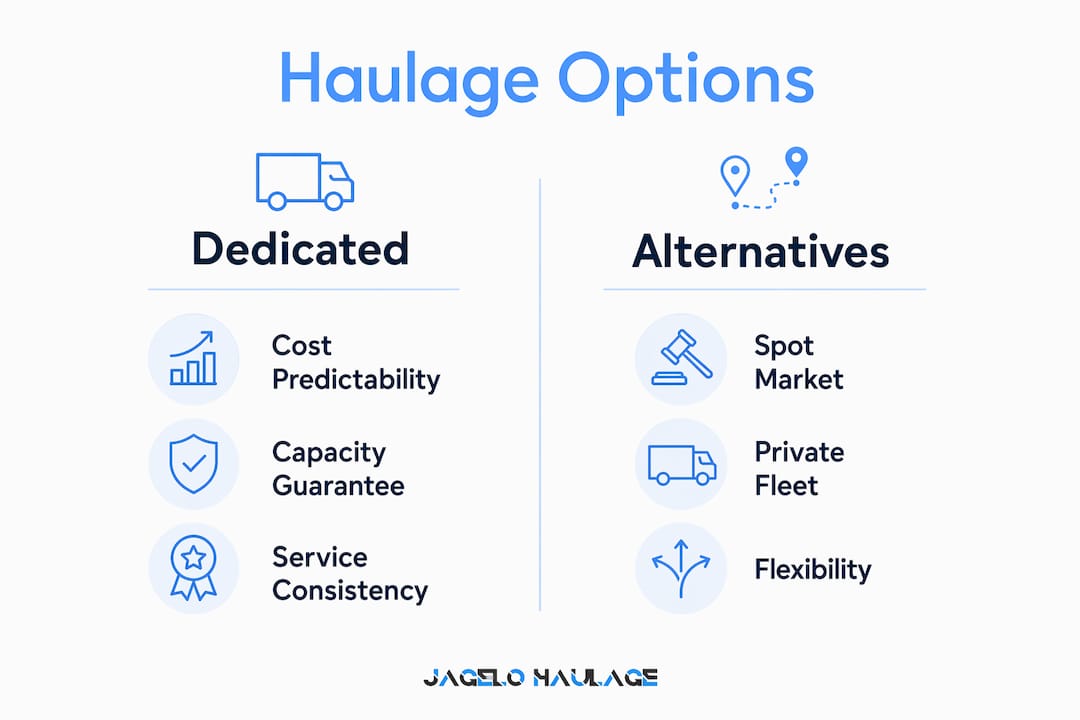
Spot market haulage is transactional. You post a load, a carrier accepts it, and the relationship ends on delivery. The model offers apparent flexibility but delivers inconsistent service quality, unpredictable pricing, and zero driver continuity. During periods of market tightening, as seen repeatedly in UK freight markets, spot availability evaporates precisely when your freight volumes peak. Private fleet ownership solves the consistency problem but introduces capital expenditure, driver employment obligations, vehicle depreciation, and the full weight of transport operator compliance onto your balance sheet.
Dedicated haulage occupies a distinct position. The dedicated model uses KPI-based management, escalation protocols, and continuous performance review to deliver engineered reliability rather than transactional convenience. This is not simply outsourcing a truck. It is outsourcing an entire transport operation with defined accountability structures.
A common misconception is that dedicated arrangements sacrifice flexibility. The reality is that dedicated fleets allow dynamic resizing through contractual mechanisms, accommodating seasonal volume changes without the shipper bearing the cost of idle assets during low periods.
| Model | Cost profile | Service reliability | Flexibility | Risk ownership |
|---|---|---|---|---|
| Spot market | Variable, volatile | Inconsistent | High but unreliable | Shipper bears capacity risk |
| Private fleet | High fixed capital | Consistent | Limited by owned assets | Shipper bears all risk |
| Dedicated haulage | Predictable contract | Engineered, KPI-driven | Dynamic via contract | Provider bears operational risk |
The highest-performing logistics organisations do not choose between dedicated and spot market in absolute terms. Combining dedicated fleet capacity with spot carriers allows dedicated fleets to handle base-load demand while spot market absorbs variability and peak surges. This hybrid model is the standard approach for sophisticated UK shippers managing container volumes across multiple ports.
What operational efficiencies do dedicated haulage providers deliver?
The operational efficiency gains from dedicated haulage are grounded in driver familiarity, technology deployment, and service consistency. These are not marginal improvements. They compound over time into measurable reductions in cost per container movement.
Driver continuity is the most underappreciated efficiency driver. Consistent drivers learn complex unloading protocols and paperwork requirements unique to each customer, reducing dwell times, errors, and damage claims. A driver who has collected containers from the same distribution centre forty times knows the gate procedure, the weighbridge sequence, and the loading bay preferences of the warehouse team. That institutional knowledge has measurable value in reduced delays and fewer exceptions.
Technology amplifies these gains significantly. Advanced dedicated fleets deploy AI-powered telematics and IoT sensor networks for condition-based vehicle maintenance, which lowers unplanned downtime and repair costs compared to calendar-based maintenance schedules. For container haulage, where a single vehicle breakdown can trigger demurrage charges at port, proactive maintenance is a direct cost-avoidance mechanism.
The following operational efficiencies are consistently delivered through dedicated haulage arrangements:
- Reduced on-site dwell time through driver familiarity with site-specific protocols, directly lowering detention costs
- Proactive delay management via real-time GPS tracking and dedicated account management, enabling early intervention before delays escalate
- Improved on-time delivery rates through route optimisation and pre-planned Vehicle Booking System slots at Felixstowe, Tilbury, and Southampton
- Lower damage claim rates as consistent drivers handle the same freight types and understand load-securing requirements for specific container configurations
- Supply chain visibility through continuous KPI tracking and clear escalation channels, giving you operational control without managing the fleet directly
Pro Tip: Request monthly KPI reports from your dedicated haulage provider covering on-time performance, damage incidents, and driver continuity rates. These metrics are your early warning system for service degradation before it affects your customers.
Outsourcing fleet management to a specialist provider also removes the internal overhead of managing tachograph analysis, driver licence checks, and vehicle inspection records, which represent significant hidden costs in private fleet operations.
When is dedicated haulage the right strategic choice for UK businesses?
Dedicated haulage delivers maximum value when your freight profile exhibits specific characteristics. Not every shipper benefits equally, and understanding when to choose dedicated transport is as important as understanding what it delivers.
The freight profiles most suited to dedicated haulage share three traits: high volume, predictable lanes, and frequent delivery cadence. A retailer moving full container loads (FCL) from Felixstowe to a regional distribution centre five days per week has a freight profile that dedicated haulage was designed to serve. A manufacturer shipping construction materials from Liverpool to multiple sites on a daily schedule similarly benefits from the service consistency and equipment specialisation that dedicated arrangements provide.
Industries that consistently extract the highest value from dedicated haulage include:
- Retail and FMCG distribution, where delivery windows are tight and stock-out consequences are severe
- Manufacturing and automotive, where just-in-time supply chains require precise, repeatable transport execution
- Construction, where specialised equipment such as flatbeds and moffetts improve site-specific handling and reliability
- Freight forwarding, where port-to-door container movements require consistent VBS slot management and port knowledge
| Freight characteristic | Dedicated haulage suitability |
|---|---|
| High volume, predictable lanes | Excellent |
| Frequent, regular delivery schedule | Excellent |
| Specialised equipment requirements | Excellent |
| Low volume, irregular shipments | Limited |
| One-off or seasonal-only freight | Spot market preferred |
The hybrid transport strategy is the practical answer for businesses with mixed freight profiles. Commit your base-load, predictable container movements to a dedicated provider, and retain spot market access for surge capacity and irregular lanes. This approach captures the cost predictability and service reliability of dedicated haulage without over-committing fixed capacity to freight that does not justify it.
Assessing your freight profile for dedicated suitability requires honest analysis of your annual lane data. If more than 60% of your container movements follow consistent origin-destination pairs with predictable frequency, dedicated haulage will almost certainly deliver a superior cost and service outcome compared to spot market dependence. For guidance on selecting the right haulier for your specific container profile, the evaluation criteria extend beyond price to include port coverage, fleet specification, and driver continuity policies.
Key takeaways
Dedicated haulage is the superior model for UK businesses with high-volume, predictable container lanes, delivering cost stability, operational risk transfer, and measurable service consistency that spot market arrangements cannot match.
| Point | Details |
|---|---|
| Cost predictability | Dedicated contracts convert volatile spot rates into fixed, budgetable transport costs. |
| Operational risk transfer | Providers assume liability for driver compliance, vehicle maintenance, and safety obligations. |
| Driver continuity advantage | Consistent drivers reduce dwell times, damage claims, and delivery errors through site familiarity. |
| Technology-driven efficiency | AI telematics and IoT maintenance reduce unplanned downtime and improve on-time port collections. |
| Hybrid model best practice | Combine dedicated capacity for base-load lanes with spot market access for surge and irregular freight. |
The case for dedicated haulage is stronger than most logistics teams realise
Having worked closely with UK container haulage operations across Felixstowe, Tilbury, and Southampton, I have observed a consistent pattern: businesses that switch to dedicated haulage from spot market dependence consistently underestimate how much the transition improves their operational control. The financial case is straightforward, but the less-discussed benefit is what I would call the management bandwidth recovery. When your transport provider owns the compliance, the driver recruitment, and the vehicle maintenance, your logistics team stops firefighting and starts planning.
The contractual design of dedicated arrangements deserves more attention than it typically receives. Contracts that specify driver continuity requirements, KPI escalation protocols, and fleet specification standards perform significantly better than those negotiated purely on rate. I have seen dedicated arrangements fail not because the model is flawed, but because the contract gave the provider no obligation to maintain service quality beyond a basic delivery confirmation.
The 2026 freight market context reinforces the case. Capacity tightening in UK road freight, combined with ongoing driver shortages, makes spot market reliability increasingly fragile. Businesses that locked in dedicated capacity through well-structured contracts are insulated from that volatility. Those still relying on transactional haulage are absorbing rate increases and service inconsistency that compound across every container movement. The long-term business case for dedicated haulage strengthens every time the spot market tightens.
— Vytautas
How Jhaulage supports UK businesses with dedicated container haulage
Jhaulage operates a modern fleet of over 40 trucks and trailers across major UK ports including Felixstowe, Tilbury, Southampton, and Liverpool, providing dedicated container haulage services built around driver continuity, GPS-tracked visibility, and 24/7 operational support.
For UK businesses seeking the cost predictability, capacity guarantee, and service consistency that dedicated haulage delivers, Jhaulage offers dedicated container haulage tailored to your freight profile and port requirements. Whether you need full container load movements, same-day port collections, or a managed port-to-door service, Jhaulage’s specialist team is ready to design a dedicated solution that fits your supply chain. Contact Jhaulage today to discuss your container haulage requirements.
FAQ
What is a dedicated haulage provider?
A dedicated haulage provider, also known as a dedicated contract carriage operator, exclusively manages transportation for a specific client’s freight under a contracted arrangement, delivering guaranteed capacity, defined service levels, and operational accountability rather than transactional load-by-load service.
Is dedicated haulage worth it for smaller UK businesses?
Dedicated haulage delivers the greatest value for businesses with high-volume, predictable container lanes. Smaller businesses with irregular or low-volume freight typically achieve better economics through spot market or groupage arrangements, though a hybrid approach can work where base-load volumes justify a dedicated commitment.
How does dedicated haulage reduce demurrage costs?
Dedicated providers manage Vehicle Booking System slots proactively and deploy consistent drivers familiar with port procedures, reducing the delays in container collection that trigger demurrage and detention charges at ports such as Felixstowe and Tilbury.
What should a dedicated haulage contract include?
A well-structured dedicated haulage contract specifies KPI thresholds for on-time performance, driver continuity requirements, fleet specification standards, escalation protocols for service failures, and mechanisms for dynamic volume adjustment to accommodate seasonal freight changes.
How does dedicated haulage differ from merchant haulage?
Merchant haulage is a shipping arrangement where the cargo owner organises inland container transport independently from the shipping line. Dedicated haulage is the operational model used to execute that transport, providing the contracted fleet, drivers, and service management that merchant haulage arrangements require.