Part of our guide to container haulage from Southampton
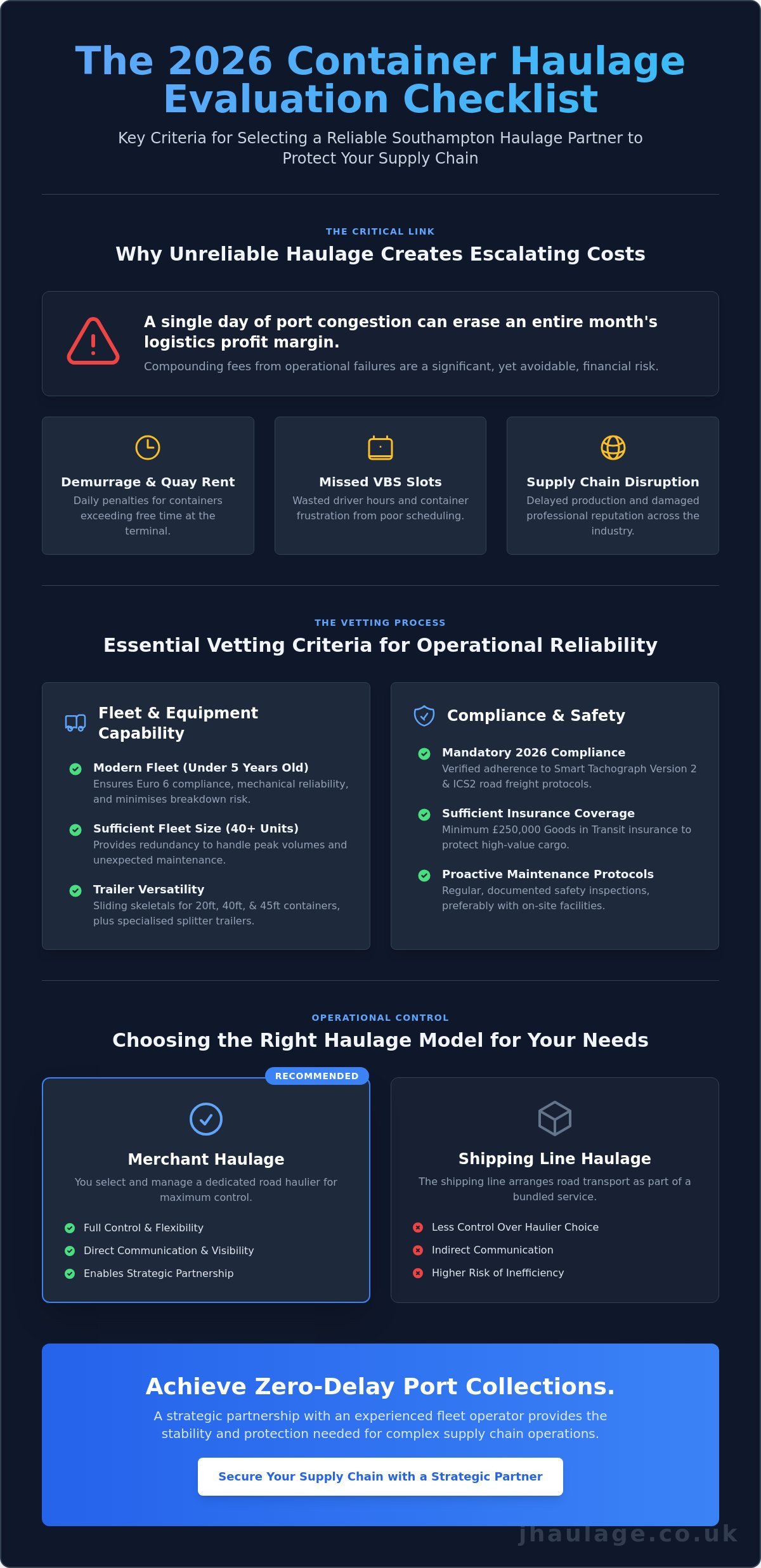
A single day of port congestion in 2026 can erase a month's logistics margin through compounding demurrage and detention fees. Securing reliable container haulage Southampton is no longer a simple procurement task; it is a critical risk management strategy for your supply chain. You likely recognise that inconsistent fleet availability and poor communication from hauliers often lead to missed delivery slots and escalating costs. These operational failures disrupt the flow of goods and damage professional reputations across the industry.
This evaluation checklist provides the technical criteria needed to identify a professional partner that prioritises operational discipline and functional reliability. We provide a comprehensive guide to the essential standards for 2026, including compliance with the Smart Tachograph Version 2 mandate and the mandatory ICS2 protocols for road freight. By following this structured assessment, you can ensure real-time visibility of container movements and establish a long-term strategic partnership. This approach focuses on achieving zero-delay port collections and protecting the efficiency of your broader logistics framework.
Key Takeaways
- Understand the critical link between maritime arrival and inland distribution to eliminate hidden costs like demurrage and quay rent.
- Learn how to verify fleet reliability and the availability of specialised equipment, such as sliding skeletals, to ensure secure container transport.
- Compare the flexibility of merchant haulage against shipping line models to determine which structure offers the best control for your specific cargo requirements.
- Evaluate the operational responsiveness and real-time tracking capabilities of your provider to maintain high-performance container haulage Southampton.
- Discover how a strategic partnership with an experienced fleet operator provides the stability and protection needed for complex supply chain operations.
Evaluating Port Logistics: Why Reliable Container Haulage is Critical
Container haulage Southampton serves as the critical bridge between maritime arrival and inland distribution. It's the final link in the complex chain of intermodal freight transport, where any lapse in performance immediately impacts the bottom line. Logistics managers often face the challenge of coordinating sensitive schedules across major UK hubs. When this link fails, the financial consequences are swift and severe. Professional haulage is not merely a commodity; it's a strategic asset that protects the integrity of the entire supply chain.
Unreliability introduces substantial hidden costs that far outweigh any initial savings on freight rates. Demurrage and quay rent fees accumulate daily when containers remain at the terminal beyond their allocated free time. These penalties, combined with disrupted supply chains and missed production deadlines, significantly increase the total logistics spend. Selecting a partner based solely on a "cheap" quote often results in higher operational expenses due to these compounding inefficiencies. A rigorous vetting process is essential to secure a provider that prioritises functional reliability over low-cost, high-risk models.
The Impact of Port Congestion and VBS Efficiency
Modern port operations rely heavily on the Vehicle Booking System (VBS). This digital framework regulates traffic flow and ensures that container collections occur within specific windows. A disciplined haulier manages these time slots with precision to avoid container frustration and wasted driver hours. Efficiency at the port requires a haulier with a significant presence at major national hubs. Providers like Jagelo Haulage maintain the operational reach necessary to navigate congestion whilst adhering to strict port protocols. This expertise ensures that your cargo moves out of the terminal before storage charges begin to accrue.
Defining Reliability in the 2026 Logistics Landscape
In 2026, reliability is a multi-dimensional metric. It's no longer just about moving a box from point A to point B. It requires a combination of modern fleet health, driver professionalism, and administrative accuracy. A professional haulier views transport as a managed operation rather than a simple delivery service. This involves maintaining vehicles to the highest standards and ensuring drivers are fully compliant with current safety regulations. Reliable container haulage is the consistent synchronisation of port data and physical assets. By focusing on these fundamentals, logistics managers can transform their transport requirements from a source of stress into a strategic operational advantage.
The Equipment and Compliance Checklist: Ensuring Secure Transport
Mechanical reliability is the foundation of a disciplined transport operation. When evaluating container haulage Southampton, you must scrutinise the physical assets of your provider. A haulier operating a modern fleet, typically consisting of over 40 tractor units, provides the necessary redundancy to handle peak volumes and unforeseen maintenance issues. Older vehicles increase the risk of roadside breakdowns, which lead to missed port slots and financial penalties. Ensuring your partner invests in fleet renewal is a primary step in protecting your cargo from preventable delays.
To assist in your vetting process, use the following checklist to verify a haulier's operational capability:
- Average Fleet Age: Confirm that the majority of tractor units are under five years old to ensure Euro 6 emissions compliance and mechanical efficiency.
- Trailer Versatility: Verify the availability of sliding skeletal trailers capable of handling 20ft, 40ft, and 45ft containers.
- Specialised Assets: Check for splitter trailers if your operations require the simultaneous movement of two 20ft units.
- Insurance Coverage: Confirm Goods in Transit insurance limits that reflect the value of your cargo, ideally a minimum of £250,000 per load.
- Maintenance Protocols: Enquire about the frequency of safety inspections and on-site maintenance facilities.
Fleet Capability and Trailer Versatility
Trailer versatility is non-negotiable for complex logistics requirements. Sliding skeletals allow for the correct weight distribution of varied container sizes, whilst splitter trailers enable the efficient transport of two 20ft units. This equipment flexibility supports urgent inland requirements and same-day delivery capabilities. A partner equipped with these specialised assets can adapt to changing cargo profiles without compromising safety. If you require a partner that maintains these high standards of mechanical and regulatory discipline, you can request a professional haulage quote to secure your 2026 capacity.
Compliance and Security Standards
Compliance serves as a verbal anchor for expertise in the haulage sector. Professional providers adhere strictly to container safety and compliance regulations, ensuring that every unit is examined and maintained according to UK law. Certifications such as FORS (Fleet Operator Recognition Scheme) signal a commitment to safety and driver training. These protocols protect the integrity of the supply chain and ensure transparency in merchant haulage operations. A disciplined haulier understands that safety standards are not merely administrative hurdles but are essential for delivering a protected and predictable outcome for the client.
Merchant vs Shipping Line Haulage: Selecting the Correct Model
Logistics managers must choose between merchant haulage and shipping line haulage to maintain supply chain stability. This decision fundamentally dictates the level of control an importer or freight forwarder has over their "port to door" movements. The economic importance of the UK logistics sector relies on these informed choices to keep national hubs functioning efficiently. Selecting the correct model for container haulage Southampton requires a thorough understanding of your operational priorities, volume, and the need for real-time visibility.
Merchant haulage involves the cargo owner or their agent arranging transport directly with a private haulier. In contrast, shipping line haulage, or carrier haulage, is managed by the shipping line that transported the container by sea. Whilst both models serve the same physical purpose, the administrative and operational outcomes differ significantly. Your choice will impact your ability to respond to port congestion and manage unexpected delays at the delivery point.
The Advantages of Merchant Haulage
Merchant haulage provides increased control over delivery scheduling and inland logistics. Dealing directly with the entity that owns the trucks ensures a level of accountability that is often missing from larger, more bureaucratic shipping line agents. This direct communication allows for rapid adjustments to delivery slots and immediate status updates. For a deeper analysis of these differences, you can review our guide on Merchant Haulage vs Shipping Line Haulage. This model is particularly beneficial for freight forwarders who require high levels of flexibility and the ability to prioritise specific containers based on customer demand.
When to Utilise Shipping Line Haulage
Shipping line haulage is often utilised for high-volume, low-complexity movements where a single point of contact for both sea and land transport is preferred. It offers a perceived simplicity that can be attractive for standard shipments. However, this convenience often comes at the cost of operational visibility. During periods of peak port congestion, shipping line haulage can suffer from lack of driver availability, as carriers don't always have dedicated local fleets. Logistics managers must evaluate the risk of "carrier haulage" delays against the potential administrative ease. For those managing time-critical container haulage Southampton, the merchant model typically provides the tactical responsiveness needed to navigate port disruptions without incurring excessive quay rent fees.
Operational Efficiency: A Checklist for Responsive Container Haulage Southampton
Operational efficiency is the measurable output of a disciplined logistics strategy. When you secure container haulage Southampton, the responsiveness of your provider determines the stability of your inland distribution. A professional operation translates technical capability into functional outcomes for the client. You can assess this efficiency through a structured evaluation of their administrative and operational protocols. Delayed responses during the initial booking phase often signal future failures in the physical transport chain.
To ensure your supply chain remains resilient in 2026, use the following steps to evaluate a haulier's operational responsiveness:
- Step 1: Initial Booking Speed. Monitor how quickly a haulier processes your enquiry. A professional firm typically confirms availability and provides a formal quote within a two-hour window to keep your planning on track.
- Step 2: Information Accuracy. Evaluate the precision of the data provided. Reliable hauliers use automated systems to ensure that container numbers, release codes, and delivery addresses are synchronised correctly from the outset.
- Step 3: Specialist Capability. Verify that the provider can handle non-standard loads. This includes out-of-gauge cargo or high-cube units that require specific weight distribution on sliding skeletal trailers.
- Step 4: Support Infrastructure. Confirm the presence of a dedicated customer service desk. Large-scale operations at major UK ports require constant monitoring by a professional team to manage the dynamic nature of port logistics.
Communication and Real-Time Reporting
Proactive communication is the hallmark of a reliable container haulage partner. It isn't enough to simply move the cargo; the haulier must provide real-time visibility through GPS tracking and status updates. This transparency allows logistics managers to anticipate arrivals and prepare warehouse staff accordingly. Immediate notification regarding port delays or Vehicle Booking System (VBS) slot changes is essential for avoiding wasted time and additional costs. Professional management of transport operations reduces your administrative burden by providing clear, concise data that integrates with your existing supply chain systems.
Handling Exceptions and Emergency Deliveries
A resilient supply chain requires a partner capable of providing same-day or emergency solutions when port conditions change. You should assess the problem-solving culture of the haulage company by enquiring about their protocols for handling vessel bunching or sudden terminal closures. A haulier that maintains a modern fleet of over 40 trucks has the operational redundancy to pivot resources when urgent inland requirements arise. Operational responsiveness is the primary differentiator amongst top-tier haulage firms. If you require this level of functional reliability, you can request a professional haulage quote to secure your 2026 capacity.
Strategic Partnership: Securing Your Supply Chain with Jagelo Haulage
Jagelo Haulage represents the logical conclusion for logistics managers seeking a disciplined and professional transport partner. The vetting process described in this checklist highlights the necessity of fleet reliability, administrative accuracy, and operational reach. With 15 years of industry experience and a modern fleet of over 40 trucks, Jagelo Haulage provides the mechanical and technical stability required to navigate the complexities of 2026 port logistics. Choosing a partner for container haulage Southampton is a strategic decision that directly impacts the safety and efficiency of your broader supply chain.
The company operates with a focus on functional reliability, ensuring that every container movement is protected from the hidden costs of delays. By maintaining a young fleet and investing in driver training, Jagelo Haulage delivers a service that mirrors the serious and corporate nature of the industrial sector. This disciplined approach allows fleet owners and freight forwarders to outsource their transport requirements with quiet confidence, knowing that protocols are followed strictly and punctuality is prioritised. A professional partnership with an established operator is the most effective way to eliminate the risks associated with inconsistent haulier performance.
For professionals managing corporate transitions alongside industrial logistics, it is helpful to see how elite relocation services handle complex long-distance routes; you can visit Southern Elite Van Lines to explore their comprehensive relocation guide.
Reliable Nationwide Coverage from a Professional Fleet
Operational reach is a fundamental requirement for modern logistics. Although Suffolk-based, Jagelo Haulage maintains a comprehensive national reach across all major UK maritime hubs. This includes consistent operations at Felixstowe, London Gateway, and Tilbury, alongside specialised container haulage Southampton. The value of a partner that supports both merchant and shipping line haulage requirements lies in their ability to adapt to diverse commercial models. This nationwide capability ensures that your cargo moves seamlessly from the quayside to its inland destination, regardless of the port of arrival or the complexity of the route. You can visit the Jagelo Haulage Homepage for specific service enquiries and detailed fleet specifications.
A Commitment to Consistent Operational Excellence
The Jagelo Haulage philosophy is built upon the pillars of punctuality, protocol, and protection. Every container movement is framed as a strategic outcome rather than a simple physical task. This solution-oriented signature is why freight forwarders trust the firm with their most critical loads. By adhering to rigorous safety standards and maintaining real-time visibility through advanced tracking systems, the company provides the stability required in a volatile global market. This commitment to excellence transforms a standard service into a long-term strategic partnership that supports your business growth. To secure your transport requirements for the coming year, you should contact Jagelo Haulage for a reliable port haulage quote.
Securing Your Logistical Future in 2026
Operational stability in the modern supply chain depends on the disciplined selection of your transport partners. You've identified the technical requirements for fleet compliance and the strategic benefits of merchant haulage models. By prioritising mechanical reliability and proactive communication, you protect your operations from the hidden costs of port congestion and administrative errors. Securing dependable container haulage Southampton is the final step in ensuring your cargo moves with precision from the terminal to the warehouse.
Jagelo Haulage provides the functional reliability needed to meet these high standards. With a modern fleet of over 40 trucks and more than 15 years of operational experience, we specialise in both merchant and shipping line haulage. Our team understands the high stakes of the UK supply chain and follows strict protocols to deliver protected outcomes for every client. You can Request a Professional Haulage Quote from Jagelo Haulage to begin a strategic partnership built on steadfast competence. We look forward to supporting your business goals with consistent and professional performance.
Frequently Asked Questions
What is the difference between merchant haulage and shipping line haulage?
Merchant haulage allows you to select your own transport provider, whilst shipping line haulage is managed by the maritime carrier. This distinction is critical for businesses requiring direct control over delivery windows and inland costs. Merchant haulage often provides greater flexibility for freight forwarders who need to prioritise specific containers during peak port congestion. It ensures a direct line of communication with the fleet operator rather than a third-party agent.
How much does it cost to transport a shipping container inland?
Inland transport costs are determined by several variables, including the distance from the port, current fuel surcharges, and specific equipment requirements. Weight also plays a role, as heavier containers may require specialised trailers to remain compliant with UK road regulations. Whilst we don't provide fixed price lists, a professional quote will account for these operational factors to ensure a transparent and accurate total logistics spend.
Can you provide same-day container delivery from major UK ports?
Same-day container delivery is achievable when fleet capacity and Vehicle Booking System (VBS) slots align. This service is typically reserved for urgent inland requirements where cargo must move immediately upon port release. Success depends on the haulier's ability to secure a collection window and coordinate with terminal operators. Proactive planning and immediate data sharing between the client and the transport office are essential for these time-critical movements.
What equipment is required for heavy or out-of-gauge container haulage?
Heavy or out-of-gauge containers require specialised sliding skeletal trailers or low-loader equipment to ensure safe and legal transport. These assets allow for correct weight distribution across the vehicle's axles, which is a mandatory requirement for UK road safety. For exceptionally wide or tall loads, additional permits and route planning are necessary. A disciplined haulier will verify these requirements during the booking phase to prevent delays or compliance failures. For projects involving complex industrial plant relocation, Silver Knight Haulage & Machineries Ltd provides the specialist expertise required for machinery moving and installation across the UK and internationally.
How do I avoid demurrage and detention charges at the port?
Avoiding demurrage and detention charges requires the prompt collection and return of containers within the shipping line's "free time" window. You should partner with a haulier that prioritises VBS efficiency and maintains real-time visibility of container movements. By synchronising port data with physical fleet assets, you can ensure containers are moved before daily storage penalties begin to accumulate. This disciplined approach is vital for maintaining healthy logistics margins.
Is your container haulage fleet fully insured and compliant?
A professional fleet must maintain comprehensive Goods in Transit and Public Liability insurance to protect high-value cargo. Compliance also involves adhering to the latest safety standards, including the Smart Tachograph Version 2 mandate effective from July 2026. Working with a FORS-accredited provider ensures that all drivers are trained in current protocols. This commitment to security and regulation is a non-negotiable aspect of reliable container haulage Southampton.
What ports do you serve for container collections and deliveries?
We provide comprehensive collection and delivery services across all major UK maritime hubs. This includes regular operations at the Port of Felixstowe, London Gateway, Tilbury, and the Port of Hull. This national reach ensures that your supply chain remains consistent regardless of the arrival point. Maintaining a presence at these key locations allows for the efficient management of container haulage Southampton and other critical inland routes.
How can I get an accurate quote for reliable container haulage?
To receive an accurate quote, you must provide the container size, weight, port of arrival, and the full delivery postcode. Mentioning any specific requirements, such as hazardous cargo (ADR) or the need for a splitter trailer, ensures the quote is technically sound. Accurate information allows the transport office to plan the most efficient route and allocate the correct equipment. This precision prevents unexpected surcharges and supports functional reliability.