Moving a shipping container is a strategic logistical operation, not just a simple delivery task. Many site managers realise too late that a standard flatbed cannot offload itself, or that restricted vehicle access can lead to costly aborted delivery fees. You likely understand that the success of your project depends on more than just moving a unit; it requires technical precision, the correct lifting equipment, and a deep understanding of UK port infrastructure.
This guide provides a professional breakdown of the complexities involved in modern container transport for 2026. We'll explain the critical differences between HIAB and flatbed haulage, outline the essential site preparation steps to prevent ground damage, and clarify the cost structures associated with major UK container ports and logistics hubs. Our objective at Jagelo Haulage is to equip you with a clear framework for managing your next delivery with absolute operational certainty and safety. By mastering these variables, you can avoid hidden port charges and ensure your cargo reaches its destination without incident.
Key Takeaways
- Distinguish between HIAB crane vehicles and standard haulage trailers to select the most cost-effective lifting solution for your specific site.
- Identify the essential site preparation steps required to accommodate heavy logistics vehicles and avoid expensive abortive delivery fees.
- Master the technical complexities of moving a shipping container by understanding the weight and safety implications of laden versus unladen transport.
- Navigate the 2026 booking process for UK port logistics, including the necessary protocols for securing slots at major hubs like DP World Gateway.
- Implement a professional safety framework that protects onsite personnel and infrastructure during the final stages of inland delivery.
The Logistics of Moving a Shipping Container in the UK
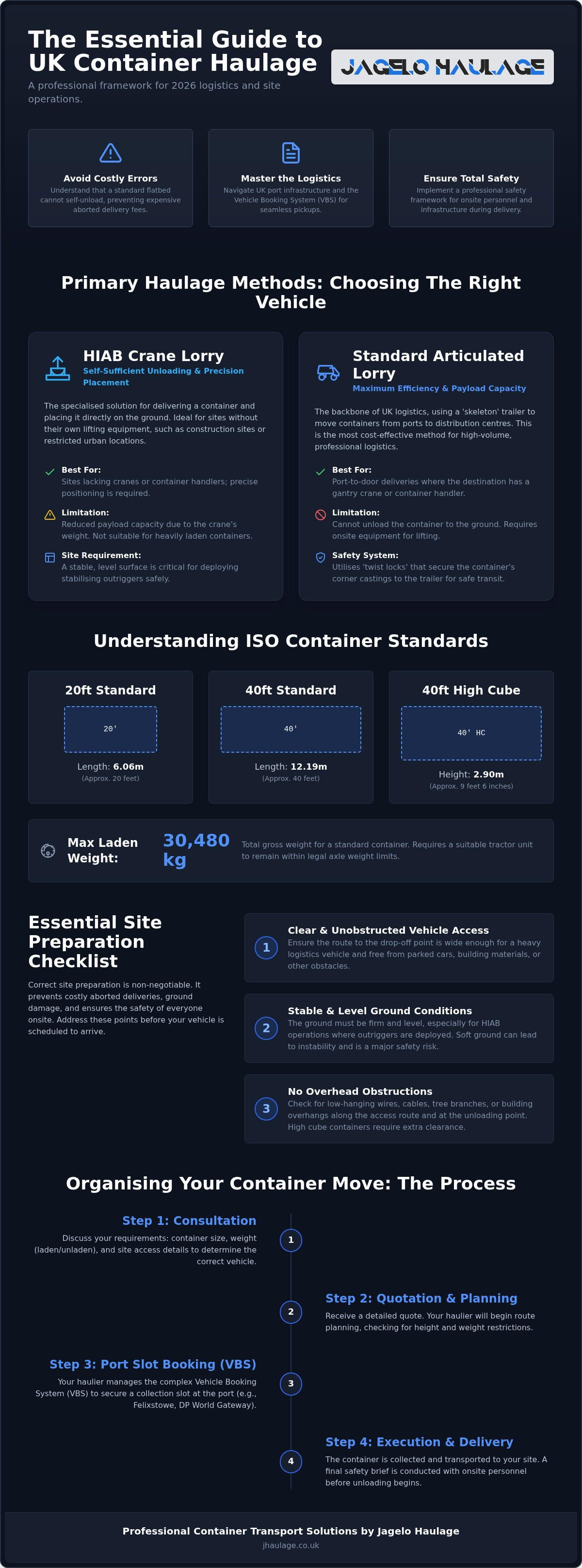
Container haulage is the disciplined, professional transport of standardised ISO units from UK ports to inland destinations. This process, often referred to as port-to-door logistics, forms the backbone of the national supply chain. When you're moving a shipping container, you're dealing with equipment designed for global maritime standards, which requires specific handling techniques and specialised vehicles.
Logistical planning differs significantly between laden and unladen moves. A laden container is a full unit that can weigh up to 30,480kg, requiring heavy-duty tractor units and skeletal trailers. Unladen moves involve empty containers, which are lighter but still present significant wind resistance and stability challenges during transit. Both categories require a methodical approach to ensure the structural integrity of the unit remains intact and the cargo is protected.
Why Professional Haulage Matters
Professional haulage provides a layer of security that unqualified transport providers cannot match. Most commercial insurance policies for goods in transit specifically require the use of certified hauliers who utilise specialised equipment. Standard ISO containers feature corner castings, which are reinforced points designed to be secured by twist locks on a dedicated trailer. Attempting to move these units without the correct locking mechanisms creates a severe safety risk and violates UK road safety regulations. Expert hauliers also manage the complex Vehicle Booking System (VBS) requirements at major logistics hubs like Felixstowe and DP World Gateway, ensuring that all weight and height restrictions are strictly followed.
Understanding ISO Container Standards
The most common units encountered in UK logistics are 20ft and 40ft ISO containers. A standard 20ft container is approximately 6.06m long, whilst a 40ft unit doubles that length. High cube variations add an extra foot of height, bringing the total to 9ft 6in, which necessitates careful route planning to avoid low bridges. The total weight of the unit dictates the choice of haulage vehicle. For example, a heavily laden 20ft container might require a three-axle tractor unit to stay within legal axle weight limits. Understanding these dimensions is the first step in moving a shipping container safely and efficiently within the UK's infrastructure.
Primary Methods for Transporting Containers: HIAB vs. Standard Haulage
Selecting the appropriate vehicle for moving a shipping container is a critical decision that impacts both the operational timeline and the final project cost. In the UK, haulage operations generally fall into two categories: standard articulated transport and self-loading crane deliveries. Each method serves a specific logistical purpose based on the site's infrastructure and the container's weight.
Standard Articulated Haulage (Skeleton Trailers)
Standard articulated haulage utilises skeleton trailers, which are the primary vehicles for high-volume merchant haulage from major ports. These trailers are stripped of unnecessary weight to maximise the legal payload capacity, allowing for the transport of fully laden 40ft units. This method is the most economical choice for port-to-warehouse logistics, provided the destination is equipped with a gantry crane or a heavy-duty container handler. This configuration is the foundation of the UK supply chain, prioritising speed and volume for professional distributors. Drivers operating these vehicles follow strict terminal protocols and Vehicle Booking System (VBS) slots to maintain a steady flow of goods. Without onsite lifting equipment, however, a skeleton trailer is restricted to deliveries where the container remains on the vehicle for unloading.
HIAB and Lorry Loader Cranes
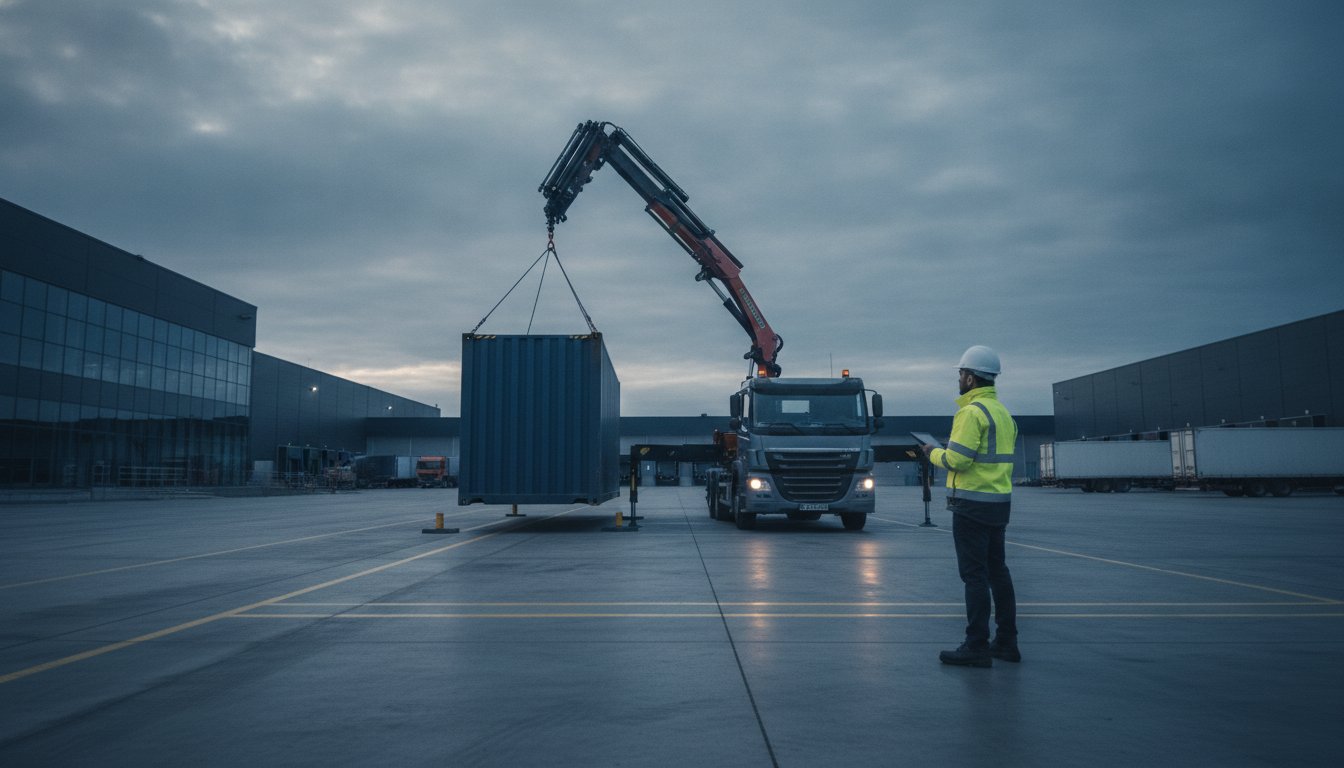
HIAB and lorry loader cranes offer a specialised solution for sites that require the container to be placed directly on the ground or stacked. These vehicles are equipped with hydraulic arms that can lift and position units with high precision, making them ideal for restricted urban environments or construction sites. Whilst this method provides unmatched flexibility, the crane's weight significantly reduces the available payload. A HIAB vehicle may not be suitable for moving a shipping container that is heavily laden, as the combined weight of the unit and the crane could exceed UK road limits. Additionally, the operation requires a stable, level surface to deploy the vehicle's stabilising outriggers safely. Safety remains the priority, as the reach of the crane is always limited by the weight of the container being lifted.
Professional logistics planning involves balancing these technical capabilities against the specific needs of the delivery site. You can obtain a professional haulage assessment to ensure your chosen method aligns with both safety protocols and budgetary requirements.
Essential Preparation: Site Access and Safety Protocols
Site access failure is the primary cause of aborted delivery fees in UK container logistics. Before moving a shipping container, you must verify that the physical environment can support the weight and dimensions of a heavy goods vehicle (HGV). A standard 40ft articulated lorry requires significantly more space than a domestic vehicle; it needs approximately 25 metres of straight approach and a wide turning circle to navigate safely. Preliminary surveys don't require professional surveying equipment. You can use a simple trundle wheel or a long tape measure to confirm that gate widths and approach roads meet the minimum requirements of 3.5 metres in width.
Weather and ground conditions play a decisive role in the success of the operation. A laden vehicle can reach a gross weight of 44 tonnes, which will easily sink into soft verges or unpaved tracks. If your site is not finished with concrete or heavy-duty hardcore, you must assess the ground bearing capacity. Heavy rainfall can quickly turn a viable site into a hazard, potentially leading to a vehicle becoming bogged down and requiring expensive recovery services.
The Access Checklist
Operational efficiency depends on a clear path from the public highway to the drop point. Use this checklist to identify potential fail-points:
- Turning Circles: Ensure there's sufficient clearance for the trailer to swing without striking perimeter fencing or parked vehicles.
- Overhead Obstructions: Identify low-hanging power lines, telephone cables, and overhanging tree branches. HGVs typically require a minimum vertical clearance of 4.5 metres.
- Building Eaves: Check that gutters and roof edges won't interfere with the crane arm if you've opted for a HIAB delivery.
- Ground Stability: Confirm that manhole covers and drainage pipes are rated for heavy axle loads to prevent structural collapse.
Safety and Risk Management
Establishing a Safe System of Work (SSOW) is a regulatory requirement for any lifting operation. During the drop, the driver must establish a strict exclusion zone. No personnel should enter this area whilst the container is in motion or held by the crane. This disciplined approach protects onsite staff and ensures the driver can focus entirely on the precision of the placement. Level ground is equally vital for the structural integrity of the ISO unit. If the container is placed on an uneven surface, the frame can twist slightly; this often results in the doors becoming difficult or impossible to operate correctly. Ensuring a level foundation of concrete pads or railway sleepers is a fundamental step in a professional relocation process.
Organising Your Container Move: The Booking Process
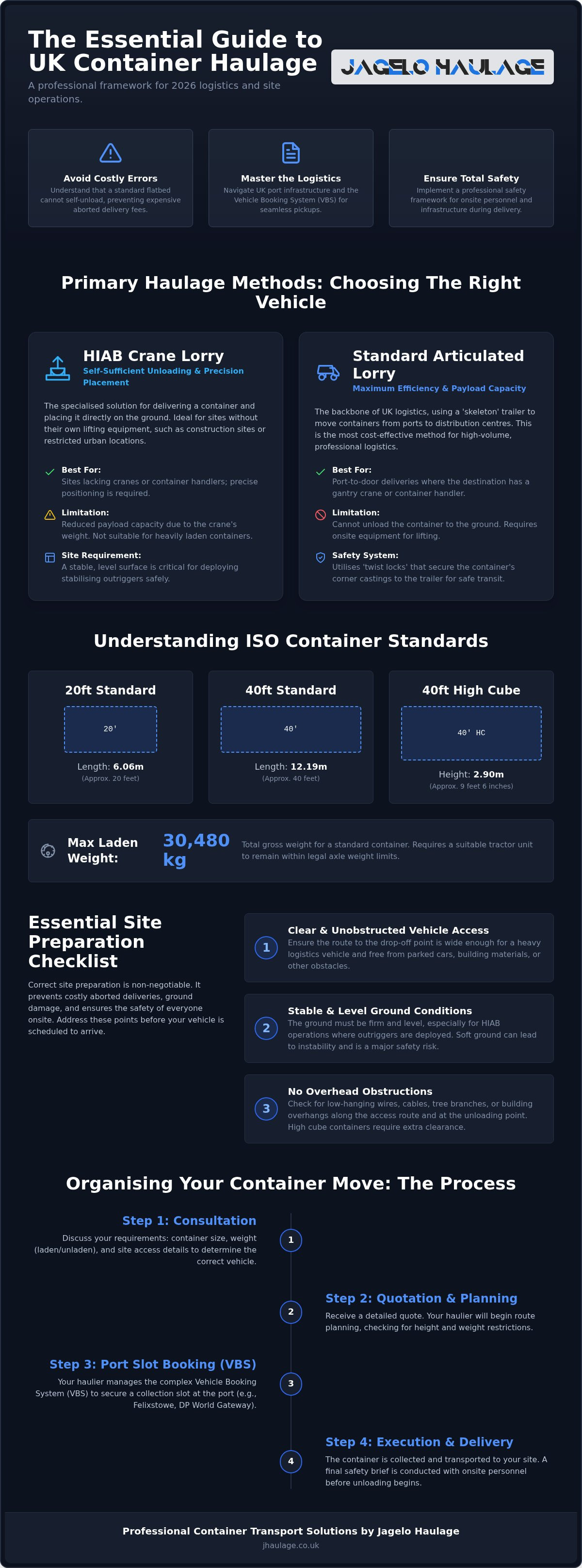
Securing a transport slot for moving a shipping container requires precise coordination between the client, the haulier, and the port terminal. This process isn't a casual booking; it's a timed operational entry governed by the Vehicle Booking System (VBS). In 2026, major UK hubs like Felixstowe and DP World Gateway operate under strict VBS protocols to manage gate congestion. Professional hauliers must secure these slots in advance, and any delay in providing documentation can result in the loss of a booking window, leading to project delays and potential storage charges at the port.
Providing accurate data at the point of booking is the most effective way to avoid 'abortive' fees. These fees occur when a vehicle arrives at a site but cannot complete the task due to incorrect information or lack of preparation. When you're moving a shipping container, the haulier's insurance and the vehicle's road legality depend entirely on the accuracy of your declaration. Discrepancies in weight or container type can lead to immediate safety stand-downs and financial penalties.
Information Your Haulier Needs
To ensure a seamless transition from the port to your site, you must provide a specific set of technical details. This information allows the haulier to assign the correct vehicle and trailer configuration for the task. Ensure you have the following data ready:
- Container Number and ISO Code: This unique 11-character identifier is essential for tracking the unit and confirming its dimensions (e.g., 20GP or 40HC).
- Accurate Weight Declarations: You must provide the Gross Mass to ensure compliance with UK axle loading regulations and to confirm the vehicle has sufficient lifting capacity.
- Site Contact Details: Provide a direct line for the onsite manager and specify precise delivery windows to align with the driver's tachograph requirements.
Merchant Haulage vs. Shipping Line Haulage
Choosing between merchant haulage and shipping line haulage is a strategic decision that affects your operational flexibility. Merchant haulage involves hiring an independent contractor to collect the unit, whereas shipping line haulage uses the carrier's own contracted fleet. Many professional operators prefer merchant haulage because it offers superior cost control and more direct communication with the driver. This independence allows for greater agility when site conditions change or when specific delivery sequences are required. For a deeper technical analysis, you can read our Merchant Haulage vs Shipping Line Haulage comparison.
A disciplined booking process protects your supply chain from unnecessary friction. You can request a professional transport consultation to secure your next delivery slot and ensure all regulatory requirements are met before the vehicle departs the terminal.
Jagelo Haulage: Professional Container Transport Solutions
Jagelo Haulage operates as a strategic partner for businesses requiring precision in their supply chain. Moving a shipping container requires more than just a vehicle; it demands a disciplined approach to logistics that prioritises safety and functional reliability. Our organisation positions itself as a master of the fundamentals, focusing on the core requirements of secure inland transport and terminal efficiency. We understand that in the industrial sector, quiet competence and dependable results are the most valuable assets a haulier can provide.
We maintain a modern fleet of over 40 trucks and trailers, specifically configured to handle the diverse requirements of UK container haulage. This operational capacity allows us to manage both high-volume merchant haulage contracts and specialised individual deliveries with consistent results. Our drivers are seasoned professionals who understand the high stakes of the supply chain. They follow strict protocols at every stage of the journey, from the initial gate entry at the terminal to the final placement at your site. This rigorous attention to detail ensures that your cargo remains protected and your timelines are respected.
Nationwide Reach from Key Strategic Hubs
Jagelo Haulage provides comprehensive operational capability across all major UK maritime gateways. We maintain a constant presence at hubs such as Felixstowe, DP World Gateway, and Southampton, ensuring that your cargo moves through the terminal without unnecessary delay. Our team provides responsive customer support for both scheduled logistics and urgent requirements, maintaining the same level of professional rigour regardless of the project's scale. By focusing on these strategic hubs, we provide a reliable bridge between international shipping lines and inland destinations. You can learn more about our container haulage services to see how our strategic hub presence can benefit your broader operational framework.
Experience and Reliability
With 15 years of industry experience, Jagelo Haulage has developed a deep understanding of the regulatory and physical challenges involved in moving a shipping container across the UK road network. We don't attempt to disrupt the industry with trendy jargon; instead, we focus on providing protected outcomes through punctual performance and strict adherence to safety standards. Our commitment to operational efficiency means that every route is planned with precision to minimise the risk of delays or site access issues. This steadfast professionalism is why corporate clients and operational managers trust us as their primary logistics partner. We invite you to request your container transport quote today to secure a dependable partner for your next nationwide move.
Executing a Seamless Container Relocation
Moving a shipping container in 2026 requires a disciplined approach to both terminal protocols and onsite safety. Success depends on selecting the correct vehicle configuration, whether that involves the high payload capacity of a skeleton trailer or the precise positioning of a HIAB crane. By conducting thorough site surveys and providing accurate declarations, you can ensure it's a seamless transition that eliminates the risk of abortive fees and maintains a predictable operational timeline.
Jagelo Haulage provides the technical expertise and modern infrastructure required to manage these complexities. With a modern fleet of 40+ vehicles and 15+ years of port logistics expertise, we ensure your cargo moves efficiently through major UK gateways. We provide nationwide coverage and a commitment to secure, professionally managed outcomes for every client.
You can secure your container transport quote from Jagelo Haulage to begin planning your next move with absolute confidence. Our team is ready to support your project with the reliability and precision your supply chain demands.
Frequently Asked Questions
How much does it cost to move a shipping container in the UK?
Costs vary based on the distance from the port, the type of vehicle required, and current fuel surcharges. A HIAB delivery, which includes onsite lifting, generally carries a higher rate than a standard skeleton trailer move. You should also account for potential port storage fees and Vehicle Booking System (VBS) charges. Providing the container's weight and specific site access details allows for a precise, fixed-price quote that avoids hidden logistical extras.
Can I move a shipping container myself with a trailer?
It's not recommended to move a shipping container using standard domestic trailers due to the extreme weights and specialised locking requirements. A standard 20ft container weighs approximately 2,300kg when empty, which exceeds the towing capacity of most passenger vehicles. Professional haulage utilises skeletal trailers equipped with ISO twist locks to secure the unit's corner castings. Attempting a DIY move without certified equipment creates significant safety risks and likely voids your transit insurance.
Do I need a HIAB or a standard flatbed for my container move?
The choice depends entirely on whether you have lifting equipment at the delivery site. If you have a gantry crane or a heavy-duty container handler, a standard skeleton trailer is the most cost-effective method for moving a shipping container. If the unit needs to be placed on the ground or stacked without onsite machinery, a HIAB crane vehicle is essential. These specialised trucks feature hydraulic arms capable of self-loading and unloading units with high precision.
What are the common access issues when moving a container?
The most frequent access challenges include restricted turning circles, low-hanging overhead cables, and insufficient ground stability. A 40ft articulated vehicle requires approximately 25 metres of straight approach and a wide swing area to navigate safely. You must also check for overhanging tree branches or building eaves that could obstruct the crane arm during a HIAB lift. Ignoring these variables often leads to aborted delivery fees and project delays that disrupt your supply chain.
How long does it take to load and unload a container?
A standard port collection or site drop typically takes between 30 and 60 minutes, provided the site is fully prepared. This window includes the time required for the driver to position the vehicle, deploy stabiliser legs for HIAB moves, and secure or release the twist locks. Delays often occur if the ground is uneven or if personnel aren't ready to supervise the exclusion zone. Maintaining a disciplined schedule helps avoid additional hourly demurrage charges from the haulier.
Do I need planning permission to move a container onto my land?
In many cases, shipping containers are classified as temporary structures and don't require formal planning permission. However, this depends on the duration of the placement, the intended use, and the specific regulations of your Local Planning Authority. If the container is positioned in a visible area or a conservation zone, you should consult with your local council before the delivery. Professional hauliers focus on the transport logistics rather than land-use legalities or local council approvals.
What is the maximum weight a standard UK haulier can carry?
The maximum gross vehicle weight for a six-axle articulated lorry in the UK is 44 tonnes. This limit includes the weight of the tractor unit, the trailer, and the container itself. For a standard 40ft unit, the maximum cargo weight usually falls around 26 to 28 tonnes to remain compliant with road safety regulations. Exceeding these limits is illegal and can lead to immediate vehicle seizure and heavy fines at Driver and Vehicle Standards Agency (DVSA) checkpoints.
How do I prepare the ground before the container arrives?
Ground preparation is essential to prevent the container from sinking or the doors from jamming. You should ensure the surface is level and capable of supporting the concentrated load at the four corner castings. Concrete pads, paving slabs, or heavy-duty railway sleepers are effective solutions for unpaved sites. Avoid placing units directly on soft grass or loose soil, as the weight of the steel will cause the structure to settle unevenly over time, compromising its structural integrity.