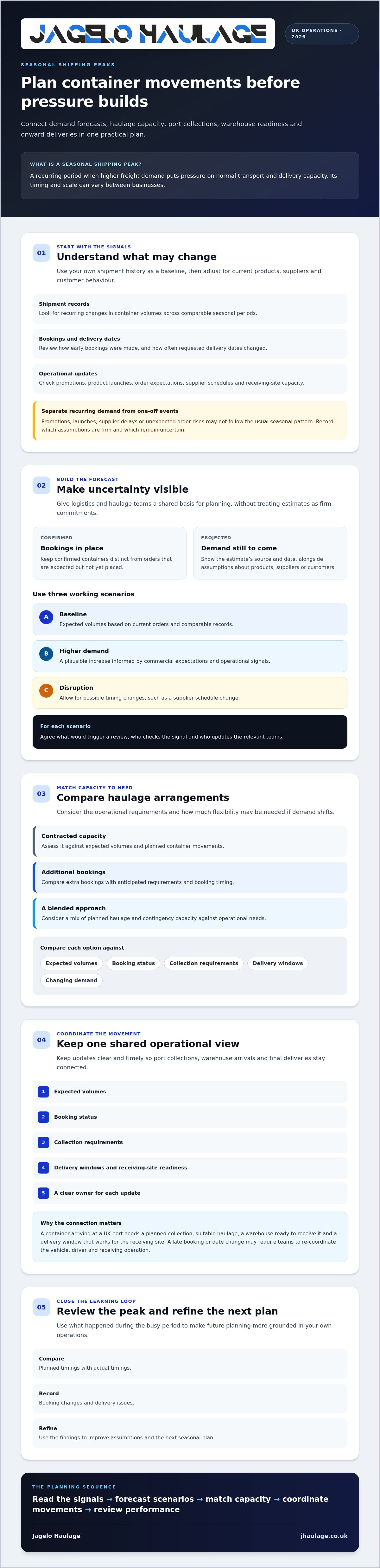
A seasonal shipping peak is rarely controlled by a single booking. It depends on how well demand forecasts, port collections, warehouse readiness and onward deliveries fit together. For UK operators, managing seasonal shipping peaks in 2026 means planning container movements before uncertainty creates last-minute pressure.
Uncertain volumes make it harder to plan the right transport capacity. Port, warehouse and delivery schedules can fall out of step, while late changes and limited visibility add pressure to operational teams. Relying on one haulage arrangement may also leave too little flexibility when demand shifts.
This guide explains how to prepare: forecast demand using operational signals, choose a suitable mix of planned haulage and contingency capacity, and keep container movements visible as schedules change. It also covers how clear, timely communication helps teams coordinate port collections, warehouse arrivals and final deliveries during busy periods.
Key Takeaways
- Use historical shipment records as a baseline, then adjust for changes in products and customer behaviour.
- Set demand scenarios and review their assumptions before peak volumes rise.
- When managing seasonal shipping peaks, compare contracted capacity, additional bookings and a blended approach against your operational needs.
- Keep expected volumes, booking status, collection requirements and delivery windows in one shared view, with clear owners for updates.
- After the peak, compare planned and actual timings, record booking changes and delivery issues, then use the findings to refine your next plan.
Managing seasonal shipping peaks starts with understanding demand
A seasonal shipping peak is a predictable period when freight demand rises enough to put pressure on normal operating capacity. It may follow a recurring pattern, such as a seasonal sales cycle, but its timing and scale can vary between businesses.
Container movements depend on connected schedules. A container arriving at a UK port needs a planned collection, suitable haulage, a warehouse ready to receive it and a delivery window that works for the receiving site. This coordination is part of broader supply chain management. If one stage changes, other plans may need to change too.
Separate recurring seasonal demand from one-off events. A promotion, product launch, supplier delay or unexpected rise in orders can create a temporary surge that historical patterns won’t fully explain. When managing seasonal shipping peaks, start with your own shipment history, then adjust the forecast for known changes. Generic industry forecasts can add context, but they can’t replace knowledge of your products, suppliers and customers.
Which seasonal demand signals should logistics teams monitor?
Compare similar periods rather than relying on one busy week. Review previous shipment volumes, booking lead times and changes to requested delivery dates. Then check what may be different this time. Ask commercial teams about planned promotions, product launches and customer order expectations, and confirm supplier schedules and receiving-site capacity.
- Shipment records: Look for recurring increases and changes in container volumes.
- Bookings and delivery dates: Note how early bookings were made and how often dates changed.
- Operational updates: Check sales plans, supplier timing and receiving constraints with the relevant teams.
How does a shipping peak affect container haulage?
Featured snippet definition: A seasonal shipping peak is a recurring period when higher freight demand puts pressure on normal transport and delivery capacity.
When more containers arrive within a concentrated period, collection and delivery plans need to account for available haulage capacity and receiving slots. A late change to a booking or delivery date can mean re-coordinating the vehicle, driver and receiving operation. Record which assumptions are firm and which are uncertain. This helps teams see where they need earlier updates or more flexible planning, rather than treating every increase in demand as part of the usual seasonal pattern.
Build a seasonal shipping forecast before demand rises
A useful forecast turns demand signals into practical planning assumptions. Start with shipment records, compare equivalent trading periods, consult the teams closest to orders and supply, then build scenarios and review them as information changes. This gives logistics and haulage teams a shared basis for discussing expected container volumes without treating an estimate as a firm commitment.
Separate confirmed bookings from projected demand. For example, record containers with confirmed bookings separately from orders that are expected but not yet placed. Show the source and date of each estimate, along with assumptions about product mix, supplier timing or customer demand. This makes uncertainty visible and helps teams distinguish known requirements from possible changes.
How can previous shipping data improve the forecast?
Compare equivalent trading periods, such as the same seasonal window in previous years, rather than assuming every peak follows the same pattern. Review container volumes alongside booking timing, delivery windows and cancellations. A rise in volume may be manageable if bookings arrive earlier, but harder to plan for if requirements are confirmed late or delivery dates change frequently.
Flag periods affected by unusual conditions, such as a one-off promotion, product launch or supplier delay. These records can provide useful context, but may not represent normal seasonal demand. Note changes in products and customer behaviour too. A new product range or different ordering pattern can make older shipment records a less reliable guide.
How should teams plan for different demand scenarios?
Build three working views using internal estimates: a baseline based on the most likely demand, a higher-demand scenario and a disruption scenario that accounts for possible timing changes. For each, identify what would prompt a review, such as bookings exceeding the baseline or a supplier schedule changing. Agree who checks those signals and who tells the relevant teams when plans need to be reviewed.
- Baseline: Expected volumes based on current orders and comparable records.
- Higher demand: A plausible increase informed by commercial expectations.
- Disruption: A planning case for changed supply or delivery timing.
Forecasts need regular updates because bookings, supply schedules and customer requirements can change. Record each revision, its reason and the information behind it. This creates a clear trail for planning decisions and helps teams refine assumptions after the peak, without suggesting the forecast will be exact. If you’re considering container haulage for planned or additional capacity, you can discuss your expected haulage requirements with a specialist provider.
Compare capacity options for managing seasonal shipping peaks
Once the forecast shows where demand is firm and where it may change, compare how each capacity arrangement would support the operation. Contracted capacity, additional bookings and a blended approach can each suit different levels of volume certainty, flexibility and delivery constraint. Don’t treat any arrangement as available until the provider has confirmed the details for the relevant period.
Assess each option against the same operational questions:
- Volume certainty: How much expected container demand is supported by confirmed bookings?
- Flexibility: How easily can planned movements change if volumes or dates shift?
- Communication: Who confirms bookings, shares changes and coordinates collection and delivery details?
- Delivery windows: Can the arrangement work with port collection timing and receiving-site availability?
This comparison keeps the decision focused on container movements, not capacity in isolation. An arrangement may look suitable by volume but still create pressure if it cannot accommodate the required delivery windows or if changes are difficult to communicate.
When is planned haulage capacity the better fit?
Planned capacity can suit operations with reasonably clear volumes and shipment timing. Sharing expected container numbers, collection requirements and delivery windows early gives the haulage provider useful information for discussing vehicle and delivery scheduling. It also helps the shipper identify which movements are confirmed and which remain provisional. Agree the scope, timing and operational commitments directly with the provider, and confirm availability rather than relying on a previous season’s arrangement.
When should a business use flexible or contingency capacity?
Additional bookings may be worth considering when demand is variable, late orders are possible or existing plans leave little room for change. A blended approach can combine planned capacity for more certain movements with additional bookings for demand that becomes clearer later. This can add flexibility, but it requires clear ownership of booking updates and delivery coordination.
Using multiple providers may give you more options to discuss, but it can also mean more contacts, handovers and status updates to manage. A single-provider arrangement may simplify communication, but don’t assume it will cover every requirement or change. Compare both approaches against your team’s ability to coordinate providers, the importance of consistent updates and the constraints at each receiving site.
For movements involving UK ports, include collection arrangements and onward delivery needs in the capacity discussion. Specialist container haulage can be considered for planned or additional transport requirements, with the specific service and availability confirmed directly with the provider.
Coordinate bookings, collection and delivery during the peak
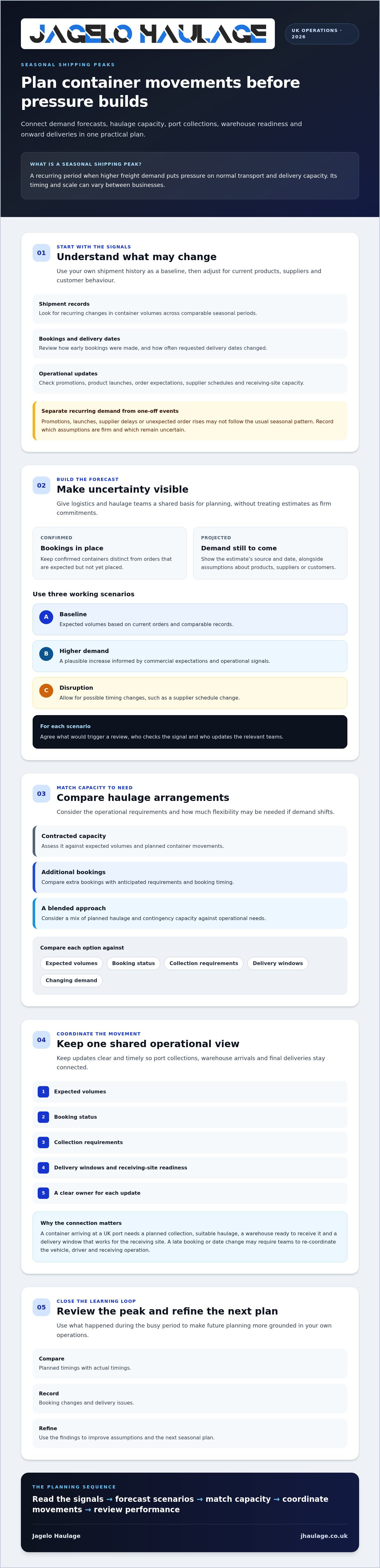
A forecast only helps operations if teams can act on current information. During a busy period, keep one shared view of expected volumes, booking status, collection requirements and delivery windows. This could be a planning document or system, provided the shipper, haulage provider and receiving operation can identify the latest confirmed details.
Give each update a clear owner. For example, the shipper can confirm booking changes, the haulage provider can report collection or timing updates, and the receiving operation can confirm whether a delivery window remains suitable. Define how updates will be shared and who will notify other parties when a plan changes. This reduces the risk of teams working from different versions of a container movement plan.
What information should teams share with haulage providers?
Provide the container details, expected availability, collection instructions and confirmed delivery requirements needed to discuss each movement. Mark provisional information clearly, such as an estimated arrival or a delivery window awaiting confirmation. If a booking changes, communicate it promptly and specify what has changed, what remains valid and whether the change affects collection or delivery arrangements.
Agree how parties will report delays, revised timings and other operational exceptions. A simple status structure can help: confirmed, awaiting information, changed or requiring action. For guidance on coordinating timings, refer to your container delivery scheduling process and make sure everyone uses the same update route.
How can teams protect delivery plans when disruption occurs?
Not every update needs an alert. Set exception alerts for changes that affect a confirmed collection, delivery window or receiving plan. Routine status updates can stay in the shared view, while exceptions should identify the affected container, the change, the next action and who owns it. This keeps attention on issues that need a decision.
If disruption affects several movements, prioritise them using agreed criteria: customer commitments, available receiving capacity and operational importance. Keep possible alternative delivery windows visible, but treat them as options to confirm with the receiving operation and haulage provider, not as guaranteed slots. A broader port-to-door view can also help teams understand how a change at one stage affects later movements.
Consistent updates support better coordination, but depend on clear responsibilities and accurate movement details. For support with container haulage and inland deliveries during a busy period, discuss your container haulage requirements with Jagelo Haulage.
Review peak performance and plan the next shipping season
A peak review turns operational experience into a better starting point for the next planning cycle. Compare the forecast with what happened, record exceptions, gather feedback from the teams involved and revise assumptions that no longer fit. Keep the review practical: identify what changed, how it affected container movements and what action could improve coordination next time.
Which measures help improve the next peak plan?
Use internal records to examine forecast accuracy, planned versus actual collection and delivery timings, booking changes and unresolved delivery issues. Review communication handovers too. For example, check whether a revised delivery window reached the haulage provider and receiving operation promptly, and whether each party knew who was responsible for the next update.
Separate process issues your organisation can address from external disruption. A late internal booking update may point to a clearer approval or communication process. A supplier schedule change may be outside the team’s control, but its effect on haulage and receiving plans can still inform future contingency planning. Avoid judging results against generic benchmarks. Establish a baseline from your own records, then compare future seasons against it.
- Compare: Forecast volumes and timings with actual movements.
- Record: Booking changes, exceptions and outstanding delivery issues.
- Review: Feedback from commercial, logistics, receiving and haulage teams.
- Revise: Assumptions and action points for the next seasonal plan.
How can a haulage partner support seasonal planning?
Discuss expected container volumes, collection requirements and delivery windows with a haulage provider early enough to assess the operational options. Share which movements are confirmed and where timing or demand remains uncertain. This gives both parties a clearer basis for discussing planned and changing requirements, while actual availability and arrangements still need to be confirmed directly.
Jagelo Haulage provides container haulage and inland container deliveries across the UK, including haulage from UK ports, merchant haulage and shipping line haulage. A specialist provider can contribute to planning discussions and help coordinate information about container movements, without implying that capacity is guaranteed. Review findings can help your team approach those discussions with clearer requirements for managing seasonal shipping peaks.
Once you’ve defined expected volumes and delivery needs, request a container haulage quote to discuss your requirements with Jagelo Haulage.
Put your seasonal plan into operation
Managing seasonal shipping peaks is more controlled when decisions are based on your own demand signals, clear capacity arrangements and current movement information. Use the forecast to separate confirmed requirements from estimates, agree how changes will be shared, and review what happened after the busy period to strengthen the next plan.
Jagelo Haulage provides container haulage and inland delivery services for operators nationwide. Its modern fleet of over 40 trucks and trailers, supported by more than 15 years of industry experience, can be part of a discussion about planned or changing transport requirements. Confirm availability and arrangements against your specific needs.
Once you’ve defined your expected volumes, collection requirements and delivery windows, request a container haulage quote to discuss your requirements with Jagelo Haulage. With a clear plan and the right operational conversations in place, your team can approach the next peak with greater confidence.
Frequently Asked Questions
How do you prepare for seasonal shipping peaks?
Prepare by setting a demand forecast, checking container booking and delivery requirements, then discussing transport capacity with providers. Managing seasonal shipping peaks also means agreeing how teams will report changes and who owns each update. Keep confirmed bookings distinct from estimates, and make sure port collection plans align with warehouse and receiving-site capacity. After the busy period, review changes and delays so the next plan reflects actual operating experience.
When should a business start planning for a shipping peak?
Start as soon as you can identify the likely seasonal demand window, supplier schedules and commercial activity that may affect volumes. There’s no single lead time that suits every operation, since booking patterns, container volumes and provider availability differ. Early discussion gives your team more time to test assumptions and confirm operational options. Revisit the plan as orders firm up, rather than waiting until every shipment is confirmed before starting capacity discussions.
How can a company forecast seasonal container volumes?
Use shipment records from comparable trading periods as a baseline, then check whether products, suppliers or customer ordering patterns have changed. Review container volumes alongside booking timing, delivery-date changes and cancellations, since volume alone may not reveal planning pressure. Ask commercial and supplier teams about upcoming promotions, launches and schedule changes. Label confirmed bookings separately from estimates, document assumptions and update the forecast as new information becomes available.
What happens if shipping demand exceeds planned haulage capacity?
If demand exceeds the plan, identify which movements need immediate attention and contact haulage providers to discuss options. Prioritise containers using customer commitments, receiving-site capacity and operational importance. Check whether bookings can be adjusted or additional capacity is available, but confirm arrangements directly rather than assuming availability. Update warehouses and receiving teams promptly, and record revised delivery windows as proposals until the relevant parties have agreed them.
How can businesses reduce delays during peak shipping periods?
Reduce avoidable delays by keeping booking status, container availability, collection instructions and delivery windows current in one shared view. Assign responsibility for updates and make sure changes reach the haulage provider and receiving operation promptly. Alert the relevant teams to exceptions that affect confirmed plans, such as a revised collection date, rather than obscuring important changes with routine messages. Check receiving capacity before confirming adjusted delivery arrangements.
Should businesses use one haulage provider or several during peak season?
The right choice depends on volume certainty, flexibility needs and the team’s ability to coordinate transport arrangements. One provider may simplify communication, while several may offer additional options to assess when demand varies. Multiple providers can also mean more handovers and status updates, so set clear ownership for each movement. Compare arrangements against delivery windows and collection requirements, and confirm each provider’s availability for the specific period.
Which information should businesses share with a container haulage provider?
Share the container details, expected availability, collection instructions and confirmed delivery requirements. Identify provisional dates or other uncertain information clearly, so estimates aren’t mistaken for agreed arrangements. Communicate booking changes promptly and state which details have changed. Agree who will report delays, revised timings and operational exceptions, and how updates should reach the receiving operation. Clear information supports practical coordination, but specific service arrangements and availability must be confirmed with the provider.