Manage container haulage fleet maintenance: 2026 guide

Effective fleet maintenance management in container haulage is defined as a structured programme combining vehicle-specific preventive schedules, mandatory daily inspections, and digital compliance tracking to maximise uptime and reduce unplanned costs. The industry term is preventive maintenance management, though fleet operators increasingly use predictive maintenance to describe data-driven approaches that anticipate failures before they occur. To manage container haulage fleet maintenance well, you must treat your fleet not as a collection of individual vehicles but as an integrated system of assets, including prime movers, chassis, container handlers, spreaders, and twistlocks, each requiring its own service regime. Regulatory bodies such as the DVSA and safety standards including OSHA 29 CFR 1910.178 set the compliance floor; operational efficiency demands you go further.
What are the essential preventive maintenance schedules for container haulage fleets?
Distinct maintenance schedules aligned to real operating parameters lower maintenance costs and increase reliability compared to generic schedules. This is the single most overlooked principle in container haulage fleet maintenance: one schedule does not fit all assets.
Class 8 tractor service intervals
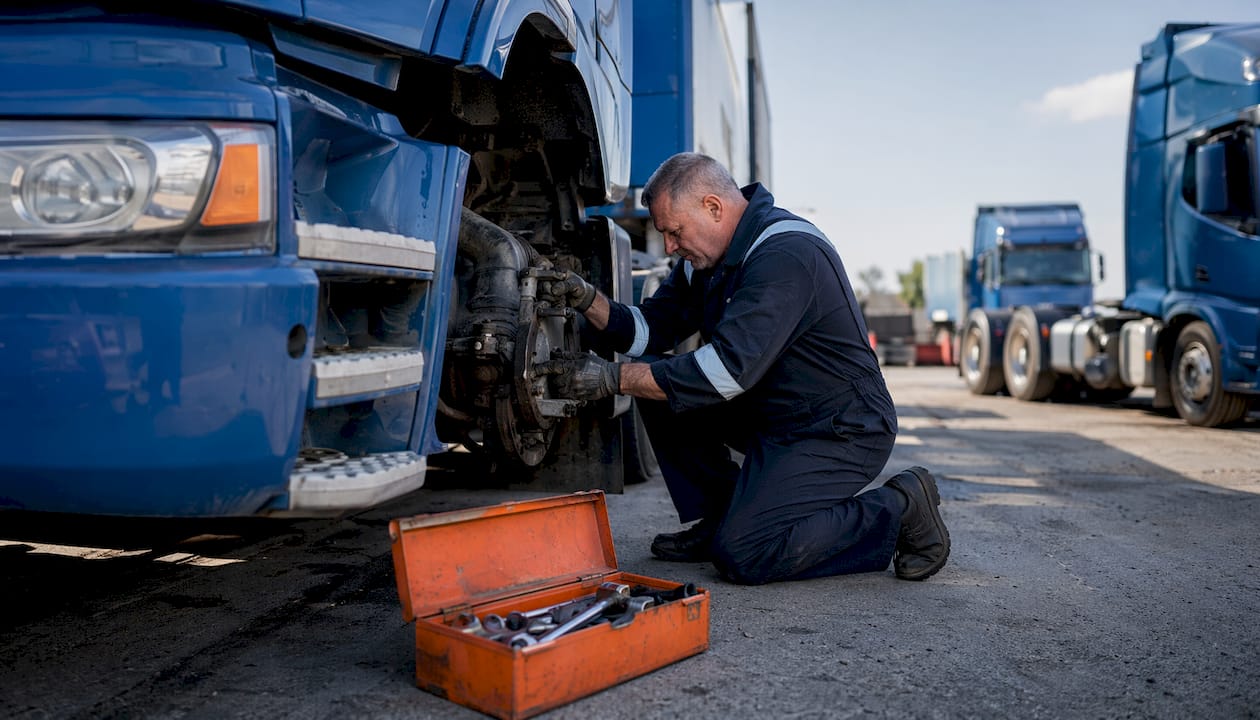
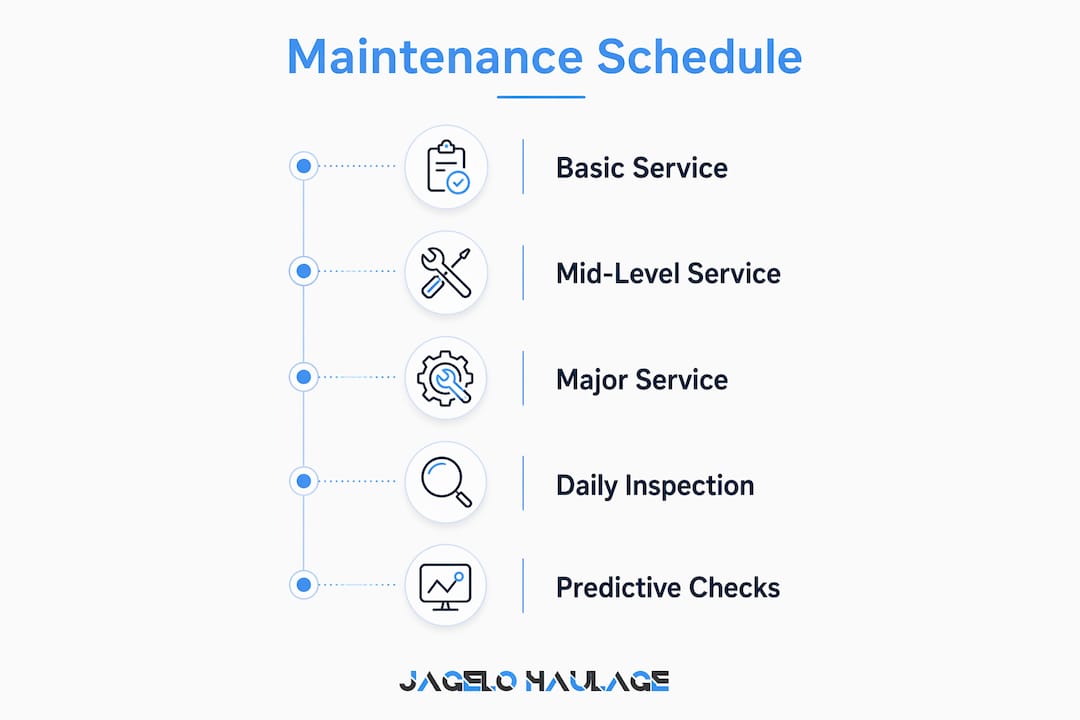
Heavy-duty tractors follow a tiered mileage-based programme. The structure below reflects the three service levels that keep Class 8 tractors compliant and reliable:
| Service level | Trigger interval | Scope of work |
|---|---|---|
| Basic service | Every 15,000 miles | Engine oil, oil filter, fuel filter, visual checks |
| Mid-level service | Every 30,000 miles | All basic items plus coolant, belts, brakes, tyres |
| Major service | Every 60,000 miles | Transmission fluid, DPF inspection, full electrical check |
A tiered mileage programme prevents the common error of performing major work too early or deferring it too late. Both errors increase cost and risk.
Vocational equipment and container handlers
Container handlers and reach stackers operate on engine hours, not road miles. The standard basic service interval for vocational equipment is every 250 engine hours, covering oil, filters, and hydraulic fluid levels. The critical 500-hour service addresses the engine and drivetrain in depth, but the highest-risk components are the spreader, twistlocks, and mast chains. These components bear the full load of every container lift and degrade faster than any powertrain part.
Specialised trailers and reefer units
Refrigerated (reefer) trailers require additional service layers beyond standard trailer checks. The refrigeration unit itself runs on its own engine hours and demands separate tracking. Chassis used in intermodal operations accumulate wear differently from over-the-road trailers because of the repeated coupling and decoupling cycles at port facilities such as Felixstowe and Tilbury. Mixing all fleet assets into one maintenance template is a primary source of fleet inefficiency and should be avoided entirely.
Pro Tip: Build a separate asset register for each vehicle category. Assign a maintenance template to each category rather than each individual unit. This reduces administrative effort and prevents schedule drift when new vehicles join the fleet.
How to implement daily inspections and digital compliance tracking
Container lifting equipment requires mandatory daily pre-shift inspections, including a full walkaround and a functional key-on test, before any operational use. This is not optional. OSHA 29 CFR 1910.178 sets the legal standard for powered industrial truck inspections, and the DVSA applies equivalent expectations to HGV operators under the operator licence framework.
A thorough daily inspection for a container handler covers the following areas:
- Tyres and wheels: Check for cuts, bulges, and correct inflation pressure.
- Hydraulic system: Inspect for fluid seepage around rams, hoses, and fittings.
- Spreader and twistlocks: Confirm twistlock indicators show green; amber indication is a safety-critical defect requiring immediate withdrawal from service.
- Mast and chains: Check chain lubrication and look for elongation or cracking.
- Lights and alarms: Verify all warning lights, reversing alarms, and beacon functions.
- Cab and controls: Test horn, brakes, and steering response before moving the machine.
The spreader and twistlock system is the critical failure point on container handlers. A dropped container incident carries severe financial and legal consequences, making twistlock inspection the non-negotiable first step of every pre-shift check.
Digital inspection platforms transform this process from a paper-based formality into an auditable record. Platforms that capture photographic evidence at each inspection point create a timestamped audit trail that satisfies both DVSA operator licence requirements and insurance claims processes. You can also review insurance compliance guidance to understand how inspection records directly affect your liability exposure.
Pro Tip: Require drivers and operators to photograph any defect at the point of discovery, not after the shift. A photo taken at 06:15 AM carries far more evidential weight than a written note completed at the end of a 10-hour shift.
What role does predictive maintenance play in container haulage fleet uptime?
Reactive maintenance is defined as repairing equipment after it fails. Predictive maintenance is defined as using operational data to identify deterioration before failure occurs. The distinction matters because reactive maintenance causes bottlenecks in container terminals; a single handler out of service can halt an entire yard sequence.
The data inputs that drive predictive maintenance in container haulage include:
- Engine hours logged per shift: Deviations from baseline indicate abnormal load or mechanical drag.
- Recurring defect patterns: A twistlock flagged three times in two weeks signals imminent failure, not operator error.
- Telematics alerts from GPS-equipped prime movers: Sudden changes in fuel consumption or idle time indicate developing faults.
- Hydraulic pressure readings: Gradual pressure loss in a handler’s lift circuit precedes catastrophic seal failure by days, not hours.
Treating container haulage as a mobile inventory challenge means tracking all assets, including chassis, spreaders, containers, and prime movers, as a unified system. This unified view enables predictive scheduling rather than reactive firefighting.
The operational gains from this approach are substantial. Optimising yard equipment maintenance and logistics flow reduces unproductive container movements by 74% and improves energy efficiency by 26%. Those figures represent the difference between a terminal that flows and one that stalls.
Managing container fleets as continuous operational flows rather than discrete routes improves scheduling and reduces idle equipment time. This principle applies equally to port-side handlers and the prime movers running between Felixstowe, Southampton, and inland distribution centres.
How to organise and digitise maintenance scheduling and compliance management
A centralised digital dashboard is the operational backbone of effective container haulage fleet maintenance. Missing administrative compliance deadlines such as MOT, Driver Qualification Card (DQC), and insurance renewals risks financial penalties and operator licence jeopardy. A dashboard that surfaces these deadlines automatically removes the human error that causes most compliance failures.
The table below compares two approaches to maintenance scheduling organisation:
| Approach | Trigger method | Compliance visibility | Risk level |
|---|---|---|---|
| Calendar-based scheduling | Fixed dates, regardless of use | Low; deadlines tracked manually | High; misses actual wear patterns |
| Operations-based scheduling | Engine hours, mileage, and calendar combined | High; automated alerts and audit trails | Low; reflects real asset condition |
Scheduling preventive maintenance around shift changes based on actual operating hours maintains uptime in 24/7 terminal environments. A handler that runs three shifts per day accumulates 250 engine hours in under three weeks. A calendar-based monthly service interval would miss that trigger entirely.
Effective digital scheduling systems automate the following functions:
- MOT, tax, and insurance expiry alerts, sent 28 days and 7 days before deadline.
- Mileage-based service triggers for prime movers, fired automatically from telematics data.
- Engine-hour triggers for vocational equipment, updated daily from onsite logs.
- Document storage for service records, inspection reports, and driver compliance certificates.
Driver compliance records sit alongside vehicle records in a well-organised system. Separating them creates gaps that auditors find quickly. You should also review commercial vehicle operation risks to understand how maintenance gaps translate directly into operator licence risk.
Pro Tip: In 24/7 operations, schedule major services to begin at the start of the quietest shift, typically the early hours of Sunday morning. This maximises the maintenance window without disrupting peak operational periods.
For a full view of UK regulatory obligations relevant to your fleet, the container transport compliance checklist published by Jhaulage covers MOT, operator licence, and driver documentation requirements in detail.
Key takeaways
Effective container haulage fleet maintenance requires vehicle-specific preventive schedules, daily digital inspections, and operations-based compliance tracking to prevent downtime and protect operator licences.
| Point | Details |
|---|---|
| Use tiered maintenance schedules | Apply separate service intervals for Class 8 tractors, vocational handlers, and specialised trailers. |
| Prioritise spreader and twistlock inspection | These are the highest-risk components on container handlers; inspect them at every pre-shift check. |
| Replace calendar scheduling with operations-based triggers | Fire service intervals from actual engine hours and mileage, not fixed dates. |
| Centralise compliance tracking digitally | Automate MOT, DQC, and insurance alerts to eliminate missed deadlines and licence risk. |
| Adopt predictive maintenance using telematics data | Monitor recurring defects and operational metrics to prevent failures before they occur. |
Why I stopped trusting calendar-based maintenance in container haulage
The most expensive lesson I have seen fleet operators learn is that a calendar is not a maintenance tool. A prime mover sitting on a port gate queue for four hours accumulates zero wear on its drivetrain. A container handler running three shifts a day accumulates wear at a rate that makes monthly calendar servicing dangerously inadequate.
The second pitfall I observe consistently is treating the spreader as a secondary concern. Operators focus on engines and tyres because those are the components they understand from road transport experience. The spreader and twistlock system is a precision mechanical assembly under constant shock loading. A twistlock showing amber is not a minor fault to note and monitor. It is a withdrawal-from-service event.
Digital inspection platforms changed my view of what compliance actually means. Before photo-evidenced inspections became standard, a pre-shift check was only as reliable as the operator’s attention and honesty. A timestamped photograph of a hydraulic seep at 05:45 AM is evidence. A tick in a paper box is not.
The operators who achieve the best uptime figures treat their container fleet as a unified asset system, not a list of vehicles. They track chassis, spreaders, and prime movers together. They review recurring defect patterns weekly, not monthly. And they schedule maintenance around operational reality, not the calendar on the workshop wall. That discipline is what separates a fleet that flows from one that stalls at the worst possible moment.
— Vytautas
How Jhaulage supports container haulage fleet operations
Jhaulage operates a fleet of over 40 GPS-tracked trucks and trailers serving major UK ports including Felixstowe, Tilbury, Southampton, and Liverpool. Every vehicle in the Jhaulage fleet operates under a structured preventive maintenance programme aligned to the principles covered in this guide.
Fleet operators and logistics managers who need a reliable container haulage partner, one whose vehicles arrive on time and in full compliance, can review Jhaulage’s full range of container haulage services for port-to-door movements across the UK. Jhaulage also publishes practical guidance on fleet management best practices for operators building their own maintenance frameworks.
FAQ
What is the correct service interval for a Class 8 haulage tractor?
Heavy-duty tractors follow a tiered programme: basic service every 15,000 miles, mid-level every 30,000 miles, and major service every 60,000 miles covering transmission, DPF, and full electrical systems.
How often should container handlers be inspected?
Container handlers require a mandatory daily pre-shift inspection including a full walkaround and functional test before every operational use, as required under OSHA 29 CFR 1910.178 and DVSA operator licence standards.
What is the difference between preventive and predictive maintenance?
Preventive maintenance follows fixed intervals based on mileage or engine hours. Predictive maintenance uses real-time operational data, such as recurring defect patterns and telematics readings, to anticipate failures before they occur.
Why is twistlock inspection so critical on container handlers?
The spreader and twistlock system is the highest-risk failure point on a container handler. A twistlock indicating amber or showing hydraulic seepage is a safety-critical defect requiring immediate withdrawal from service to prevent dropped-container incidents.
How does a digital compliance dashboard reduce fleet risk?
A centralised dashboard automates alerts for MOT, DQC, and insurance deadlines, removing the manual tracking that causes most compliance failures and protecting the operator licence from financial penalties.
Recommended
- Logistics fleet management best practices: 2026 guide | Jagelo Haulage
- Heavy Container Haulage: A Strategic Reference Guide for UK Logistics 2026 | Jagelo Haulage
- The Modern Container Transport Fleet: A Strategic Guide to UK Port Logistics | Jagelo Haulage
- The Professional Guide to Cost-Effective Container Haulage in 2026 | Jagelo Haulage