Why haulage reliability matters for UK business

Haulage reliability is defined as the consistent, predictable delivery of freight within agreed timeframes, forming the operational backbone of any UK business that depends on physical goods movement. In the context of supply chain management, the importance of haulage reliability extends far beyond punctuality. It governs cost control, customer retention, regulatory compliance, and production continuity. For logistics managers, procurement directors, and supply chain operators across the UK, understanding why haulage reliability matters for business is the difference between a supply chain that performs under pressure and one that collapses when conditions change.
Why does haulage reliability matter for business?
Haulage reliability is the single most consequential variable in supply chain performance, not price, not route distance, and not fleet size. 85% of UK supply chain resilience depends on reliable road transport, and a single missed delivery can trigger production stoppages that cost far more than the freight rate itself. That figure reflects a structural truth: road haulage is not a peripheral service but the connective tissue of British commerce.
The financial consequences of unreliable haulage are direct and measurable. Businesses operating just-in-time (JIT) production models, common in automotive, food manufacturing, and pharmaceutical sectors, face idle labour costs, missed production slots, and contractual penalties when deliveries fail. These downstream costs rarely appear on a freight invoice, yet they dwarf the original transport spend.
Customer relationships suffer equally. A retailer whose shelves run empty due to a missed delivery does not absorb that loss quietly. Repeat failures erode trust, and in competitive markets, a single logistics breakdown can accelerate a client’s decision to switch supplier. Reliable carriers build trust and earn stronger pricing discipline from clients, precisely because dependability is treated as a product in its own right.
The benefits of reliable haulage also extend to inventory management. When delivery windows are predictable, businesses can reduce safety stock levels, freeing working capital that would otherwise sit in warehouses. The role of haulage in supply chain efficiency is therefore both operational and financial, touching balance sheets as directly as any procurement decision.
Pro Tip: Track your haulier’s on-time delivery rate monthly. If it falls below 90%, calculate the downstream cost of delays including idle labour, expedited freight, and customer credits. The total will almost always exceed any saving made on the base freight rate.
Key business impacts of reliable haulage include:
- Cost containment: Fewer penalties, reduced rework, and lower expedited freight spend.
- Production continuity: Consistent inbound supply prevents costly manufacturing stoppages.
- Customer retention: Predictable outbound delivery protects client relationships and contract renewals.
- Inventory efficiency: Reliable lead times allow leaner stock holding and reduced warehousing costs.
- Operational focus: Logistics teams spend less time firefighting and more time on strategic planning.
Reliability vs. price: which delivers better value?
The instinct to select the lowest-cost haulage provider is understandable, particularly under procurement pressure. The problem is that base freight rates capture only a fraction of the true cost of a logistics decision. Procurement teams now prioritise total cost of ownership over spot rates, calculating the financial impact of delays, detention charges, appointment failures, and internal rework hours. This shift in procurement strategy reflects hard experience, not theory.
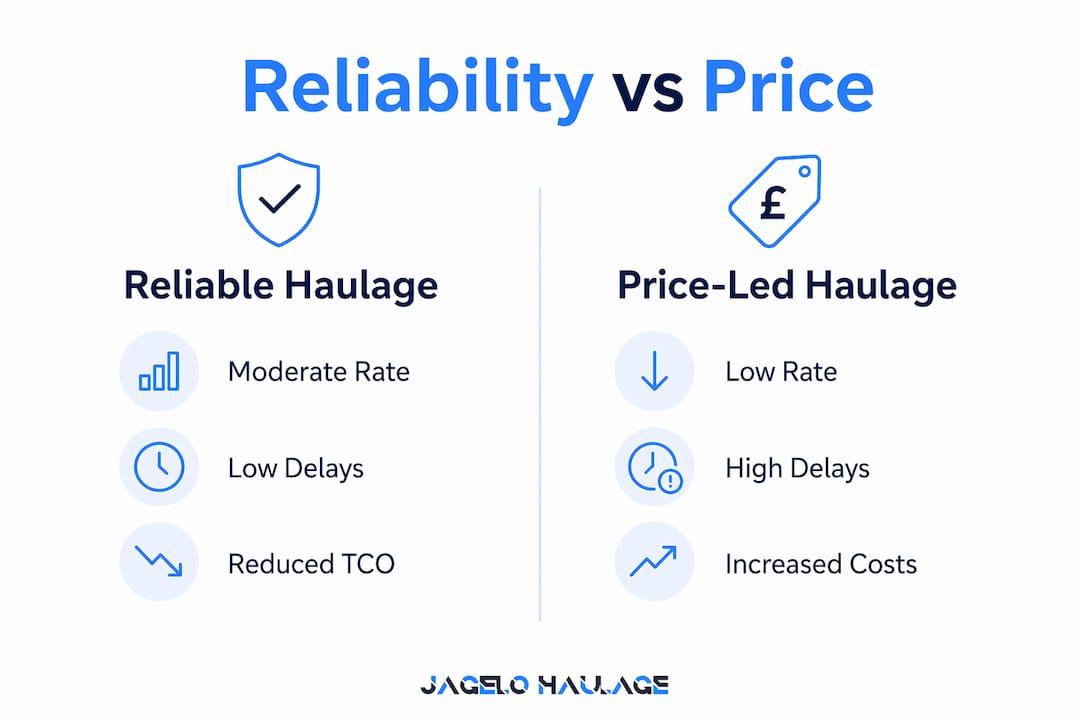
Total cost of ownership (TCO) in haulage means quantifying every downstream impact of a logistics decision. Calculating TCO entails accounting for labour disruption, expedited shipment costs, demurrage fees, and customer compensation, not just the line-item freight rate. A provider quoting 15% below market rate may generate costs three times that saving through chronic lateness.
The table below illustrates the cost components that differentiate reliable haulage from price-led alternatives:
| Cost Component | Reliable Haulage Provider | Price-Led Provider |
|---|---|---|
| Base freight rate | Moderate to premium | Low |
| Detention and demurrage | Minimal (predictable scheduling) | Frequent (poor slot management) |
| Expedited freight spend | Low (disruptions rare) | High (regular recovery shipments) |
| Idle labour costs | Negligible | Significant during delays |
| Customer penalty clauses | Rarely triggered | Regularly triggered |
| Internal rework hours | Low | High |
| Total cost of ownership | Lower overall | Higher overall |
The pattern is consistent across sectors. A food manufacturer relying on a cheap haulier that misses a 06:00 delivery slot at a major retailer’s distribution centre faces a rejected load, a re-delivery charge, and a potential delisting fine. None of those costs appear on the original freight quote. Haulage service dependability, when measured against TCO rather than spot rate, is almost always the more economical choice.
Pro Tip: When evaluating haulage tenders, ask each provider for their detention rate, appointment failure rate, and average delay duration over the past 12 months. These three metrics reveal true reliability more accurately than any reference call.
How do UK regulations affect haulage reliability in 2026?
Regulatory compliance is now a direct determinant of haulage reliability for UK businesses. The expansion of Clean Air Zones (CAZs) across cities including London, Birmingham, and Manchester means that non-compliant hauliers face daily financial penalties and operational disruption risks that cascade directly into your supply chain. A haulier operating older, non-compliant vehicles through a CAZ either absorbs those fines or reroutes, adding time and cost to every affected delivery.
The practical implications for logistics managers are significant. Choosing a haulier whose fleet does not meet Euro VI emission standards in 2026 introduces a compliance risk that sits entirely outside your control. If that provider is fined, delayed, or prohibited from entering a delivery zone, your cargo is affected regardless of your own compliance record.
Key regulatory factors that influence haulier selection in 2026 include:
- Clean Air Zone compliance: Hauliers must operate Euro VI or equivalent vehicles to avoid daily CAZ charges in London (Ultra Low Emission Zone), Birmingham, Manchester, and Bristol.
- Operator licence conditions: A haulier’s operator licence (O-licence) status directly affects their legal right to operate. Licence suspension grounds all their vehicles immediately.
- Driver hours regulations: Compliance with EU-derived drivers’ hours rules (retained in UK law post-Brexit) prevents fatigue-related delays and legal liability.
- Vehicle roadworthiness: Preventative maintenance programmes reduce breakdown frequency. Effective haulage includes preventative maintenance and driver safety training as standard operational disciplines.
- Goods Vehicle Operator Licensing: Businesses using third-party hauliers should verify that providers hold a valid Standard National or Standard International O-licence, confirming legal compliance.
Accredited fleets with modern vehicles and documented maintenance schedules carry materially lower breakdown risk. For businesses moving containers through ports such as Felixstowe, Tilbury, Southampton, or Liverpool, where Vehicle Booking System (VBS) slots are time-critical, a breakdown caused by a poorly maintained vehicle is not an inconvenience. It is a demurrage event with a measurable cost.
What operational practices strengthen haulage reliability?
Structured operational practices are what separate consistently reliable haulage from providers that perform well only in favourable conditions. Structured haulage strategies improved on-time delivery from 82% to 95% and reduced empty miles from 22% to 11%, with fuel consumption falling 14% as a direct result. These are not marginal gains. They represent the difference between a logistics operation that absorbs disruption and one that amplifies it.
The following practices define operationally reliable haulage at scale:
- Scheduled trunking and route optimisation: Fixed lane schedules reduce variability. Route optimisation software, such as that used by providers operating across multiple UK port corridors, minimises transit time and fuel exposure simultaneously.
- Real-time tracking and exception reporting: Technology enables real-time shipment tracking integrated with supply chain systems, reducing manual input and improving decision-making when exceptions occur.
- Active contingency planning: True haulage reliability requires contingency plans including rerouting protocols and equipment substitution, enabling predictable recovery from disruptions rather than reactive crisis management.
- Integrated single-provider logistics: Supply chain fragmentation increases operational risk and blurs accountability. A single integrated provider coordinates all movements under one operational framework, reducing the handoff failures that cause most logistics breakdowns.
- Demand forecasting analytics: Providers using demand data to anticipate volume fluctuations can pre-position equipment and drivers, preventing capacity shortfalls during peak periods.
The table below shows the key performance indicators (KPIs) that logistics managers should use to measure haulage reliability:
| KPI | Definition | Target Benchmark |
|---|---|---|
| On-time delivery rate | Percentage of deliveries arriving within agreed window | 95% or above |
| Detention rate | Frequency of vehicle detention beyond agreed dwell time | Below 5% of movements |
| Appointment failure rate | Percentage of missed booking slots at ports or DCs | Below 3% |
| Empty miles ratio | Proportion of total mileage run without cargo | Below 12% |
| Breakdown frequency | Vehicle breakdowns per 100,000 kilometres | Below 2 incidents |
Businesses that assess haulage company reliability using these KPIs before awarding contracts consistently report fewer supply chain disruptions than those selecting on price alone. The data is the due diligence.
Key takeaways
Haulage reliability is the foundation of supply chain performance, and businesses that measure it rigorously and procure it strategically will consistently outperform those that treat transport as a commodity.
| Point | Details |
|---|---|
| Reliability drives total cost reduction | Reliable haulage lowers TCO by eliminating detention, rework, and penalty costs that cheap providers generate. |
| JIT operations are most exposed | Just-in-time businesses face the highest financial risk from unreliable haulage, including idle labour and production stoppages. |
| Regulatory compliance is non-negotiable | Hauliers operating non-compliant vehicles in UK Clean Air Zones introduce direct disruption risk into your supply chain. |
| Technology separates reliable providers | Real-time tracking, exception reporting, and contingency planning are the operational markers of a genuinely dependable haulier. |
| Single-provider integration reduces risk | Fragmented logistics vendors blur accountability; integrated providers deliver measurably higher reliability across complex supply chains. |
The case for treating reliability as a strategic asset
From my experience working within UK logistics, the most persistent mistake I see businesses make is treating haulage as a cost line rather than a performance variable. The procurement conversation almost always starts with rate cards. It rarely starts with on-time delivery data, detention history, or contingency protocols. That ordering of priorities is precisely backwards.
The businesses I have seen manage their supply chains most effectively share one characteristic: they treat their haulage provider as a strategic partner, not a commodity vendor. They share forecasts. They conduct quarterly performance reviews against agreed KPIs. They negotiate service level agreements that include financial consequences for delivery failures, not just rate escalation clauses. This is not sophisticated. It is disciplined procurement applied to a function that most organisations still manage informally.
The UK logistics market in 2026 is under structural pressure from driver shortages, fuel cost volatility, and expanding regulatory requirements. In that environment, the providers who invest in fleet modernisation, driver training, and technology integration will be the ones who deliver consistently. The ones who compete solely on price will cut corners that eventually show up in your supply chain as delays, demurrage, and damaged client relationships.
My advice is direct: audit your current haulage provider against the KPIs in this article. If their on-time delivery rate sits below 90%, calculate the full downstream cost of that underperformance. The number will almost certainly justify switching to a provider who charges more per movement but costs less per quarter.
— Vytautas
How Jhaulage supports UK businesses with dependable container haulage
For UK businesses that need container haulage they can build a supply chain around, Jhaulage operates a modern fleet of over 40 GPS-tracked trucks and trailers across major ports including Felixstowe, Tilbury, Southampton, and Liverpool. Every movement is monitored in real time, with 24/7 support available to manage exceptions before they become disruptions.
Jhaulage’s fleet meets current emission standards, removing Clean Air Zone compliance risk from your logistics operation entirely. From full container load shipments to same-day port collections, the service is built around the on-time delivery rates and VBS slot discipline that logistics managers and freight forwarders require. If you are evaluating container haulage specialists for your UK supply chain, Jhaulage offers the operational depth and port coverage to support consistent, measurable performance.
FAQ
What is haulage reliability and why does it matter?
Haulage reliability is the consistent delivery of freight within agreed timeframes, forming the foundation of supply chain performance. It matters because a single missed delivery can trigger production stoppages, customer penalties, and detention costs that far exceed the original freight spend.
How does unreliable haulage affect business costs?
Unreliable haulage generates costs beyond the base freight rate, including demurrage fees, idle labour, expedited shipment charges, and customer penalty clauses. Procurement teams calculate total cost of ownership to capture these downstream impacts when evaluating haulage providers.
What kpis should i use to measure haulage reliability?
The most effective KPIs are on-time delivery rate (target: 95% or above), detention rate (below 5%), appointment failure rate (below 3%), and breakdown frequency (below 2 incidents per 100,000 kilometres). These metrics reveal operational performance more accurately than reference calls or rate comparisons.
How do UK clean air zones affect haulage reliability?
Clean Air Zones in London, Birmingham, and Manchester require hauliers to operate Euro VI compliant vehicles. Non-compliant providers face daily financial penalties and rerouting delays that directly disrupt your delivery schedules and increase your supply chain risk.
Is it better to use one haulage provider or multiple vendors?
A single integrated provider delivers higher reliability than fragmented multi-vendor arrangements. Integrated logistics approaches reduce complexity and improve coordination, eliminating the handoff failures and accountability gaps that cause most logistics breakdowns in complex supply chains.