How to assess haulage company reliability UK

Choosing the wrong haulage provider is not merely inconvenient — it directly costs your business money. Late container deliveries trigger demurrage charges at ports like Felixstowe and Tilbury, missed consignments disrupt production schedules, and unreliable carriers erode the trust you have built with your own clients. When you need to assess haulage company reliability UK, the challenge is that most providers present a polished surface: professional websites, competitive rates, and confident sales pitches. This guide cuts through that surface and gives you a structured, criteria-driven method to evaluate logistics company UK providers with precision and confidence.
Table of Contents
- Assessing haulage company reliability: what it actually means
- Preparing to assess haulage providers: what you need to know
- Step-by-step guide to evaluating haulage company reliability
- Common pitfalls and how to avoid unreliable haulage partners
- Interpreting your haulage reliability assessment and making informed decisions
- Why conventional reliability checks often miss critical risks in haulage selection
- Trusted container haulage specialists UK: Jagelo Haulage Limited
- Frequently asked questions
Key Takeaways
| Point | Details |
|---|---|
| Reliability defined | Reliable haulage means consistent uptime, compliance with regulations, and professional operations. |
| Key assessment criteria | Check maintenance intervals, telematics use, SLAs, and breakdown support when vetting hauliers. |
| Verify compliance | Use Traffic Commissioner records to uncover past driver hours or maintenance violations. |
| Look beyond revenue | Operational capabilities and site density near hubs predict better service consistency than size alone. |
| Avoid common pitfalls | Don’t rely solely on marketing claims; insist on transparency for insurance and maintenance practices. |
Assessing haulage company reliability: what it actually means
Many logistics managers treat reliability as synonymous with “on-time delivery percentage.” That figure matters, but it is only one output of a far more complex operational machine. True reliability, in the context of UK container haulage, hinges on three foundational pillars: vehicle uptime, driver professionalism, and regulatory compliance.
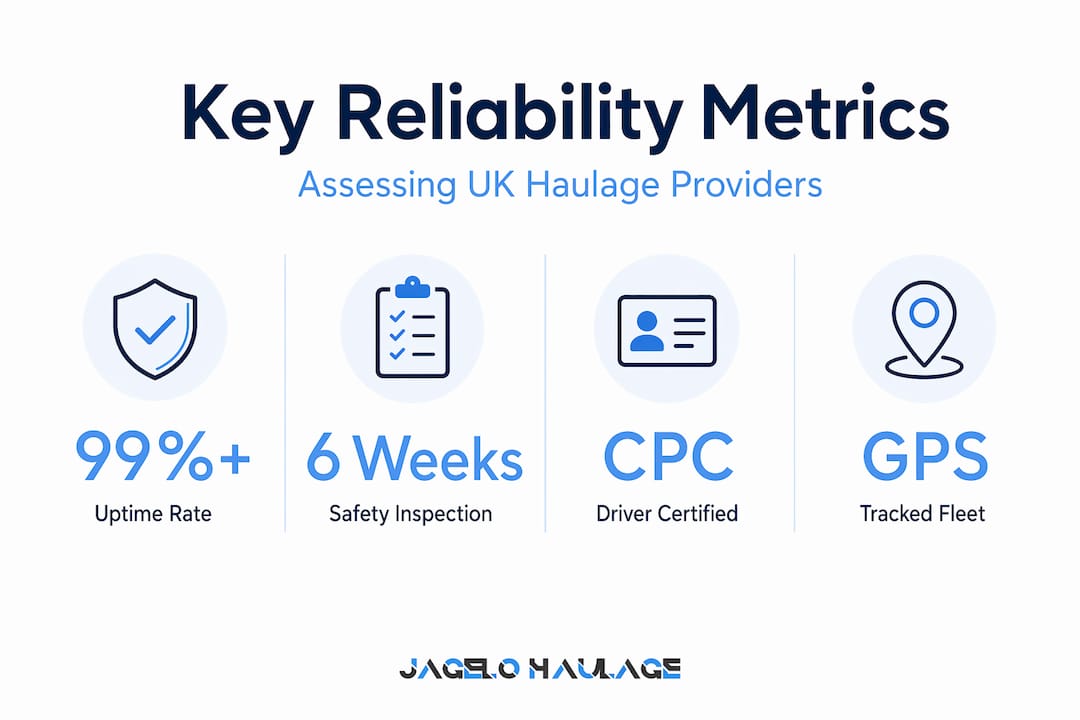
Vehicle uptime is arguably the most revealing metric. Industry-leading HGV traction services maintain uptime rates of 99% or higher, which means their fleet is operational and available for planned movements with minimal unscheduled downtime. A provider operating at 94% uptime sounds reasonable until you realise that equates to roughly 21 days per year when vehicles are off the road. For a logistics manager running time-sensitive port-to-door container movements, that gap matters enormously.
Driver professionalism encompasses far more than a valid Certificate of Professional Competence (CPC). It includes adherence to Working Time Directive rules, proper documentation handling at port gates, and conduct during Vehicle Booking System (VBS) slot management at major terminals. A driver who misses a VBS slot at Southampton or Liverpool due to poor planning can set off a chain of detention costs and re-booking fees that far exceed the transport invoice itself.

Regulatory compliance is non-negotiable. A provider holding a valid Operator’s Licence issued by the Traffic Commissioner, with no outstanding prohibitions from the Driver and Vehicle Standards Agency (DVSA), signals that it is operating within the legal framework. You can read more about haulage reliability factors and how they intersect with compliance on our resource hub.
Key capability signals to look for include:
- A maintained, documented fleet with traceable service histories
- Named transport managers holding a valid Certificate of Professional Competence in Transport Management (CPC TM)
- Established relationships with major UK port authorities
- Telematics or GPS tracking fitted to all vehicles in the active fleet
- Clear procedures for driver hours monitoring under the EU Tachograph Regulation
Preparing to assess haulage providers: what you need to know
Before you send a single request for quotation, you should assemble an information checklist that will allow you to compare providers on equal footing. This preparation phase is where many logistics managers save considerable time later.
Follow these steps before opening any formal assessment:
- Define your specific delivery corridors. Port-to-door container movements from Felixstowe to the Midlands differ operationally from those out of Tilbury into Greater London. Fleet routing, driver familiarity with port access roads, and VBS slot booking experience vary by corridor.
- Identify your volume and frequency requirements. Whether you move five containers per week or fifty shapes the provider tier you should be approaching.
- Prepare a list of compliance questions. Ask specifically about vehicle safety inspection frequency, maintenance intervals, and whether telematics data is available to clients in real time.
- Request evidence of 24/7 breakdown recovery partnerships. Maintenance intervals of 4 to 6 weeks minimum and active breakdown support networks are critical markers of genuine operational reliability.
- Obtain draft Service Level Agreements (SLAs). A credible provider will offer SLAs detailing uptime commitments, claims procedures, and insurance coverage thresholds before you have even signed a contract.
Pro Tip: Ask each provider to share their last three DVSA roadworthiness inspection outcomes. These are a matter of public record and reveal far more about day-to-day maintenance discipline than any brochure ever will.
Use the following table to track the information you gather during your preparation phase:
| Assessment criterion | Information requested | Provider A | Provider B |
|---|---|---|---|
| Vehicle safety inspection interval | Documented schedule (weeks) | ||
| Telematics coverage | Percentage of active fleet | ||
| Breakdown recovery SLA | Response time in hours | ||
| Operator’s Licence status | Current or conditional | ||
| Insurance coverage limit | Cargo value per movement |
Visit our assessing haulage providers resources for additional guidance on framing these preparation questions effectively.
Step-by-step guide to evaluating haulage company reliability
With your checklist prepared, you can now conduct a structured evaluation. The goal is to cross-reference what providers claim against verifiable evidence.
- Run a Traffic Commissioner records check. The Traffic Commissioner’s public regulatory decisions are searchable on gov.uk. Verify regulatory compliance and look specifically for any history of licence revocations, curtailments, or formal warnings. Even a single curtailment in the past three years warrants a direct conversation.
- Request uptime and breakdown response metrics. A credible provider tracks these internally and will share them. Anything below 98% uptime over the preceding 12 months should prompt further scrutiny.
- Review client testimonials with scepticism. Haulage service reviews UK on provider websites are curated. Instead, ask for two or three named referees from clients with similar delivery corridors and volumes. Speak to those referees directly.
- Examine claims rates and insurance records. A high frequency of cargo claims signals either poor vehicle maintenance or inadequate driver training. Ask providers to share their claims ratio (claims paid out as a proportion of total consignments) for the last two years.
- Compare fleet composition and technology capability. A provider running a modern fleet with GPS tracking on every vehicle, regular tyre checks, and documented preventive maintenance is operationally different from one relying on older units with reactive maintenance only.
Pro Tip: When you check freight company credentials through Traffic Commissioner records, note the number of vehicles authorised on the licence versus the number currently operated. A significant gap between authorised and active vehicles can indicate financial strain or fleet contraction.
Use this comparison table when ranking shortlisted providers:
| Performance indicator | Minimum acceptable | Strong performer |
|---|---|---|
| Vehicle uptime rate | 97% | 99%+ |
| Safety inspection interval | Every 8 weeks | Every 4 to 6 weeks |
| Breakdown response time | Within 4 hours | Within 2 hours |
| Claims ratio | Below 2% | Below 0.5% |
| Telematics fleet coverage | 75% | 100% |
Common pitfalls and how to avoid unreliable haulage partners
Even experienced logistics managers fall into predictable traps when selecting transport providers. Knowing these pitfalls in advance significantly reduces your risk exposure.
The most damaging errors include:
- Prioritising price over capability. A rate that is 15% below the market average almost always signals a trade-off. That trade-off is usually in maintenance spending, driver pay, or insurance coverage.
- Accepting marketing materials as evidence. Terms like “reliable,” “trusted,” and “industry-leading” are unverifiable without documentation to support them. When you evaluate logistics company UK providers, demand figures, not adjectives.
- Overlooking maintenance inspection intervals. Skipping this check is the single most common mistake. Operators with poor maintenance records consistently exhibit higher vehicle failure rates and compliance issues, both of which translate directly into failed or delayed deliveries.
- Ignoring the absence of breakdown recovery agreements. A provider without a named breakdown recovery partner is one vehicle failure away from leaving your container stranded on the M6.
- Failing to clarify insurance coverage scope. Some providers carry liability only for their own negligence. You need to understand whether their policy covers cargo in transit, third-party claims, and whether it applies during port dwell time.
“The absence of a clear breakdown recovery protocol is not a minor administrative oversight. It is a structural gap that will manifest as a disruption to your supply chain at the least convenient moment.”
Look for warning signs of unreliable haulage proactively rather than waiting for a failure to surface. Red flags include vague responses to compliance questions, reluctance to share DVSA records, and SLAs that contain excessive liability exclusions.
Interpreting your haulage reliability assessment and making informed decisions
Once you have gathered and scored your data across multiple providers, the interpretation phase requires balancing quantitative scores against qualitative judgement.
Follow this sequence to reach a confident decision:
- Cross-reference capabilities against your specific corridors. A provider with strong Felixstowe coverage but limited experience at Liverpool may not suit a business importing via multiple northern ports.
- Weight operational continuity evidence heavily. Capability signals such as site density and demonstrated service continuity during labour shortages are more predictive of long-term reliability than revenue figures alone.
- Consider scalability against your growth projections. A provider operating 15 vehicles may perform excellently today but lack the capacity to absorb a 30% volume increase in 12 months.
Qualitative factors to weigh alongside your scored data:
- Responsiveness during the assessment process itself (slow responses to quotation requests often mirror operational behaviour)
- Clarity and transparency of their SLA documentation
- Evidence of ongoing driver training programmes
- Client retention rates and length of key account relationships
| Decision factor | Weight (%) | Minimum score |
|---|---|---|
| Vehicle uptime and maintenance | 30 | 8 out of 10 |
| Regulatory compliance record | 25 | 9 out of 10 |
| Claims ratio and insurance clarity | 20 | 7 out of 10 |
| Telematics and tracking capability | 15 | 7 out of 10 |
| Responsiveness and SLA quality | 10 | 8 out of 10 |
Visit interpreting haulage assessment results on our blog for worked examples of this scoring framework applied to real provider selection decisions.
Why conventional reliability checks often miss critical risks in haulage selection
Most logistics managers conducting a UK haulage performance assessment begin and end with two questions: “What is your rate?” and “Can you show me some testimonials?” Both questions are useful but insufficient. The deeper truth, one we have observed consistently across the container haulage sector, is that revenue-based rankings and curated case studies are poor proxies for operational reliability.
A large provider with impressive annual turnover can still operate a neglected fleet and an overstretched driver pool. Revenue growth, particularly rapid growth, frequently outpaces maintenance investment and training capacity. The providers that consistently perform well under pressure — during port congestion events, during HGV driver shortages, or during infrastructure disruptions on key arterial routes — are those with strong internal discipline, not necessarily the largest balance sheets.
Capability signals are more predictive of service outcomes than revenue-based rankings alone. Those signals include documented preventive maintenance schedules, named transport managers with genuine day-to-day oversight, and multi-port operational experience built over years rather than months. When you read about deep haulage reliability insights across the industry, this pattern emerges repeatedly.
Our view is that logistics managers should invest as much rigour in assessing a haulage provider as they would in auditing a tier-one supplier. The container arriving safely and on time at its destination is not a commodity outcome — it is the product of operational discipline applied consistently at every stage of the movement.
Trusted container haulage specialists UK: Jagelo Haulage Limited
Applying the assessment criteria in this guide to your provider search is the right approach. It is also worth understanding that some providers have already built their operations around the exact standards this framework identifies.
Jagelo Haulage Limited operates a fleet of over 40 GPS-tracked trucks and trailers across major UK container ports including Felixstowe, Tilbury, Southampton, and Liverpool. Every vehicle undergoes inspections within a 4 to 6 week cycle, telematics coverage is 100% across the active fleet, and 24/7 breakdown recovery support is embedded within our operational model rather than treated as an optional add-on. Our SLAs are transparent, our insurance coverage is clearly defined, and our Traffic Commissioner compliance record is clean.
If you are ready to select a reliable UK haulage partner whose operational standards match the criteria outlined here, we welcome the conversation. You can also review our terms of service and cookie policy for full transparency on how we operate and manage your data.
Frequently asked questions
What uptime percentage should I expect from a reliable haulage company?
Top UK haulage companies maintain uptime rates of 99% or higher, ensuring that the vast majority of planned movements proceed without vehicle-related disruption.
How can I check the compliance history of a haulage provider in the UK?
You can verify a haulier’s regulatory history by searching the Traffic Commissioner’s public regulatory decisions on gov.uk, which records licence conditions, curtailments, and formal warnings.
What maintenance schedule is indicative of a reliable haulage company?
Reliable providers conduct vehicle safety inspections every 4 to 6 weeks alongside continuous telematics monitoring, giving them early warning of mechanical issues before they cause operational failures.
Are quick pickup times a sign of haulage reliability for urgent shipments?
Yes, genuinely capable providers in the UK typically offer pickup within 60 to 120 minutes of booking confirmation and maintain consistently high on-time delivery rates across their active fleet.