What is door to port haulage: a UK guide

Door to port haulage is defined as a logistics service in which a haulier collects cargo from the shipper’s premises and transports it to the departure port, after which the exporter takes full responsibility for international freight, customs clearance, and onward delivery. The industry term for this arrangement is “door to port” or “D2P,” and it sits at the export end of the incoterms spectrum. Understanding door to port shipping is critical for any logistics professional managing container exports from UK ports such as Felixstowe, Tilbury, Southampton, or Liverpool. This guide covers the operational scope, cost trade-offs, risks, and practical steps for getting the most from this model.
What does door to port haulage cover?
Door to port haulage is defined by its service coverage, not by the mode of transport, which can be road, rail, or multimodal. That distinction matters because many logistics professionals assume the label describes a single truck journey. In practice, it describes a chain of operational milestones, each with its own handoff point and accountability.
The standard service sequence runs as follows:
- Cargo collection. The haulier arrives at the shipper’s facility, whether a factory, warehouse, or distribution centre, and loads the container or cargo unit.
- Inland transportation. The container moves by road or intermodal rail to the departure port. For UK exporters, this leg typically terminates at a port terminal such as Felixstowe or Southampton.
- Export documentation. The shipper or their freight forwarder prepares the commercial invoice, packing list, and bill of lading. The haulier delivers the container within the port’s Vehicle Booking System (VBS) slot.
- Container booking and loading. The shipping line or freight forwarder confirms the vessel booking. The container is loaded onto the vessel at the terminal.
- Export clearance. HMRC export declarations are submitted, and the cargo is released for departure. This step sits with the exporter or their customs agent, not the haulier.
Door to port haulage bridges the logistics gap between the producer’s facility and the carrier’s terminal. What it does not cover is equally important: international ocean or air freight, import customs clearance at the destination country, and final mile delivery to the consignee. Those responsibilities transfer to the exporter or the overseas buyer at the port gate.
Pro Tip: Book your VBS slot at least 48 hours before the vessel’s closing date. Late arrivals at port terminals generate missed-slot fees and, in the worst cases, a rolled shipment to the next available vessel.

How does door to port differ from door to door and port to door?
The three principal shipping models divide responsibility at different points in the supply chain. Choosing the wrong model for your cargo type or business structure creates cost overruns and liability gaps.
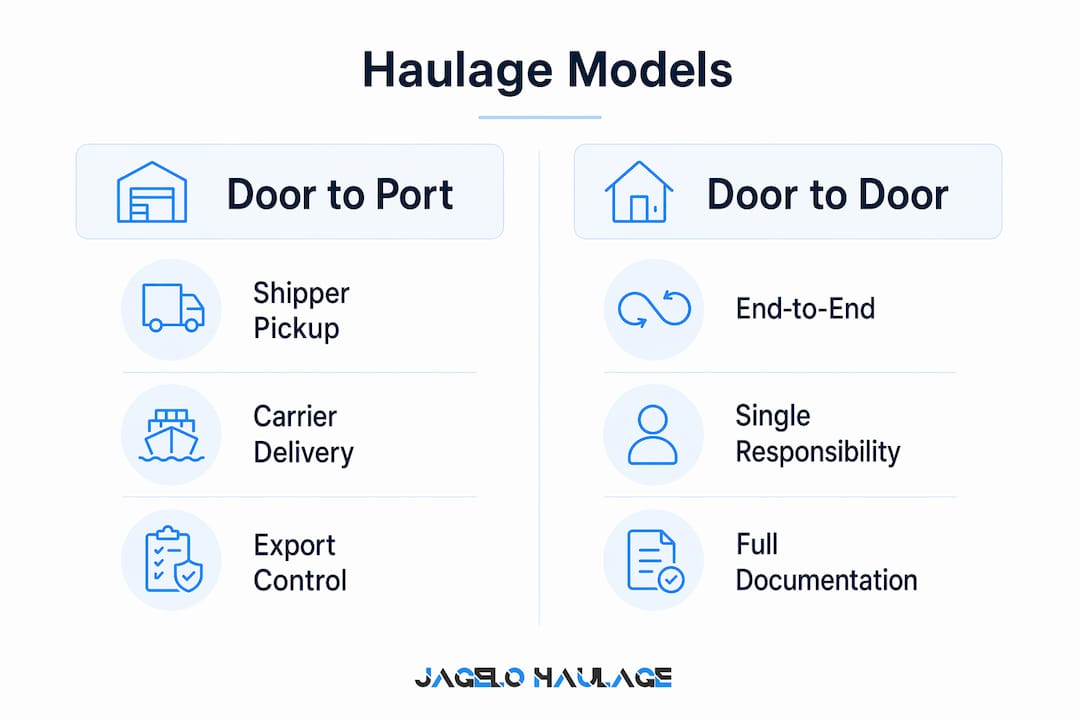
The table below compares service scope across the three models:
| Service element | Door to port | Door to door | Port to door |
|---|---|---|---|
| Cargo collection from shipper | Yes | Yes | No |
| Inland transport to departure port | Yes | Yes | No |
| International freight | Exporter arranges | Provider arranges | Provider arranges |
| Import customs clearance | Exporter arranges | Provider arranges | Provider arranges |
| Final mile delivery to consignee | Exporter arranges | Provider arranges | Yes |
The key differences come down to control and cost:
- Door to door transfers all responsibility to a single provider. You pay a premium for that convenience, but you also lose direct control over carrier selection and customs agent choice at the destination.
- Door to port gives you full control over the international leg. You select your own ocean carrier, negotiate freight rates, and appoint your own customs broker at the destination port.
- Port to door is the mirror image of door to port. It covers the import side: collection from the arrival port and delivery to the consignee’s premises. Jhaulage specialises in port to door delivery as well as the export equivalent.
Door to port haulage is recommended when the shipper has strong local contacts at the destination or expertise in customs clearance. It offers cost savings over door to door, but those savings only materialise when the exporter actively manages the international leg. Businesses without established overseas networks often find that the apparent saving disappears once they factor in agent fees, delays, and coordination time.
What operational risks come with door to port haulage?
Door to port haulage is not a single responsibility chain. It is multiple operational legs requiring readiness and coordination at each stage. That structure creates specific risk categories that logistics professionals must plan for before committing to this model.
The most common operational risks are:
- Segmented liability. A single insurance policy may not cover all segments of the journey when responsibility is split between the haulier, the shipping line, and the overseas agent. You need separate cargo insurance for each leg, or a marine open cover policy that explicitly includes the inland haulage segment.
- Documentation errors. The shipper remains accountable for cargo readiness, packaging, and documentation compliance. An incorrect commodity code on the export declaration, or a mismatch between the packing list and the actual cargo weight, can trigger a customs hold at the port.
- Demurrage and detention. Late documentation or missed appointments lead to demurrage charges at the terminal and detention fees on the container unit. These costs erode the cost advantage of door to port very quickly. A single day of demurrage at a major UK terminal can cost more than the saving achieved by choosing D2P over a full door to door service.
- Destination-side gaps. If you lack a reliable customs agent or inland haulier at the destination, the cargo sits at the arrival port while you scramble to arrange clearance. That delay compounds into storage fees and potential cargo damage.
Pro Tip: Appoint your destination customs agent before the vessel departs, not after. Confirm their contact details, tariff classification agreement, and fee schedule in writing. This single step prevents the majority of destination-side delays.
Effective risk management in door to port logistics requires treating each operational leg as a separate project with its own deadline, responsible party, and contingency plan. Businesses that treat it as a single task consistently underestimate the coordination burden.
How can logistics professionals optimise door to port haulage?
Getting the most from door to port transportation requires deliberate planning across four areas: provider selection, documentation management, export clearance timing, and cost control.
- Select a haulier with port-specific experience. A haulier familiar with the VBS system at Felixstowe or the gate procedures at Tilbury will avoid the delays that cost inexperienced operators dearly. Jhaulage operates a fleet of over 40 GPS-tracked trucks and trailers across all major UK ports, providing real-time visibility on every container movement. Review the full scope of UK container haulage options before committing to a provider.
- Centralise export documentation. Assign one person or team as the single point of contact for all export paperwork. Fragmented document ownership is the leading cause of missed vessel closings. Use a shared document management system so that the freight forwarder, customs agent, and haulier all work from the same version of the commercial invoice and packing list.
- Plan export clearance timelines backwards from the vessel closing date. HMRC export declarations must be submitted and accepted before the container arrives at the terminal. Build in a minimum of 24 hours between declaration acceptance and the VBS slot. For controlled goods or dual-use items, allow significantly more time for export licence processing.
- Appoint an international freight forwarder early. Professionals select door to port haulage to maintain control over final customs clearance and inland delivery. A freight forwarder with destination-country expertise helps you select the right ocean carrier, negotiate competitive freight rates, and pre-appoint a customs broker. Coordinating an international shipping workflow across all parties from the outset reduces the risk of cost escalation.
- Negotiate contract terms that cap ancillary charges. Agree waiting time allowances, failed collection fees, and out-of-hours surcharges in writing before the first shipment moves. Hidden costs in door to port contracts depend on how well shippers manage split responsibilities. A well-drafted haulage contract protects you from unexpected charges when port congestion or vessel delays extend dwell times.
For a detailed breakdown of how to structure haulage pricing, the professional guide to securing an accurate haulage quote covers the key variables and negotiation points.
Key takeaways
Door to port haulage delivers genuine cost and control advantages, but only when exporters actively manage documentation, destination agents, and each operational handoff with the same discipline they apply to the inland leg.
| Point | Details |
|---|---|
| Service scope, not transport mode | Door to port defines responsibility boundaries, not the vehicle or route used. |
| Exporter retains international control | The shipper manages ocean freight, customs clearance, and final delivery beyond the port gate. |
| Documentation accuracy is critical | Errors in export declarations or packing lists cause port holds, demurrage, and rolled shipments. |
| Insurance must cover each leg | A single policy rarely covers all segments; obtain marine open cover or separate per-leg insurance. |
| Destination contacts determine success | Pre-appointing a customs agent and inland haulier at the destination prevents costly arrival-side delays. |
Why door to port haulage rewards discipline more than budget
I have worked with exporters across a range of sectors, and the pattern is consistent: businesses that choose door to port haulage for the right reasons do well, while those that choose it purely to reduce the invoice total often spend more in the end.
The model genuinely suits exporters who have built reliable networks at their destination markets. If you have a trusted customs broker in Hamburg or a proven inland haulier in Rotterdam, door to port gives you the control to use them and the cost saving that comes from bypassing a middleman’s margin. That is a legitimate and repeatable advantage.
Where I see it go wrong is when businesses treat the destination side as someone else’s problem. The moment the container leaves the UK port, the exporter’s operational responsibility does not diminish. It shifts. You are now coordinating across time zones, regulatory systems, and carriers you may not have used before. Without established local contacts, that coordination cost can exceed the saving you achieved on the inland leg.
My view is that door to port haulage is a model for disciplined exporters, not a cost-cutting shortcut. The businesses that extract the most value from it invest in destination-side relationships before they need them, not after a shipment goes wrong. If you are building those relationships now, door to port is worth serious consideration. If you are not, a full door to door arrangement with a reputable freight forwarder will serve you better until those networks are in place.
— Vytautas
Jhaulage: UK door to port haulage you can rely on
Jhaulage provides specialist container haulage services across all major UK ports, including Felixstowe, Tilbury, Southampton, and Liverpool. Every vehicle in the Jhaulage fleet carries GPS tracking, giving you real-time visibility on your container from collection to port gate. The team operates 24/7, so your shipment moves on schedule regardless of vessel closing times or out-of-hours requirements.
Whether you need a single container collected or a regular export programme managed, Jhaulage offers tailored door to port solutions built around your cargo type, port of departure, and documentation requirements. Contact Jhaulage for a quote and speak directly with a specialist who understands UK port logistics from the ground up.
FAQ
What is door to port haulage in simple terms?
Door to port haulage is a service where a haulier collects cargo from the shipper’s premises and delivers it to the departure port. The exporter then manages international freight, customs clearance, and onward delivery independently.
What is the difference between door to port and door to door?
Door to door covers the entire journey from shipper to consignee under one provider’s responsibility. Door to port ends at the departure port, leaving the exporter to arrange the international leg and destination-side handling.
What is freight haulage and how does it relate to door to port?
Freight haulage is the inland movement of goods by road or rail. Door to port haulage is a specific application of freight haulage where the destination is a port terminal rather than a warehouse or distribution centre.
Who is responsible for export customs clearance in a door to port arrangement?
The exporter or their appointed customs agent is responsible for submitting HMRC export declarations and obtaining clearance. The haulier’s responsibility ends at the port terminal gate.
What are the main costs to watch in door to port logistics?
The primary cost risks are demurrage at the terminal, detention charges on the container unit, and destination-side agent fees. Accurate documentation and pre-booked VBS slots are the most effective controls against these charges.