Role of port authority UK: functions and responsibilities

A UK port authority is a statutory body responsible for regulating and managing port and harbour operations to ensure safety, security, and efficiency in maritime trade and transport. These bodies are not simply administrative offices. They hold enforceable legal powers over navigation, environmental protection, and port security within their defined jurisdictions. Members of the British Ports Association collectively facilitate 86% of the UK’s seaborne trade, which makes the governance and performance of port authorities a matter of national economic significance. For logistics professionals, industry analysts, and policymakers, understanding how these bodies operate is fundamental to planning freight movements, forecasting costs, and managing supply chain risk.
What is the role of port authority UK operations?
The role of port authority UK bodies covers a broad spectrum of statutory duties, all anchored in maritime safety law. At their core, port authorities are responsible for safe navigation management within their jurisdiction. This includes maintaining navigational channels through dredging, operating Vessel Traffic Services (VTS), and administering compulsory pilotage schemes where required by law.
The Port of London Authority (PLA) is the most prominent example. The PLA manages a 95-mile stretch of tidal Thames, enforcing regulations, maintaining navigation channels, and providing VTS around the clock. That scale of operational responsibility illustrates why port authorities require dedicated statutory powers rather than relying on general commercial management.
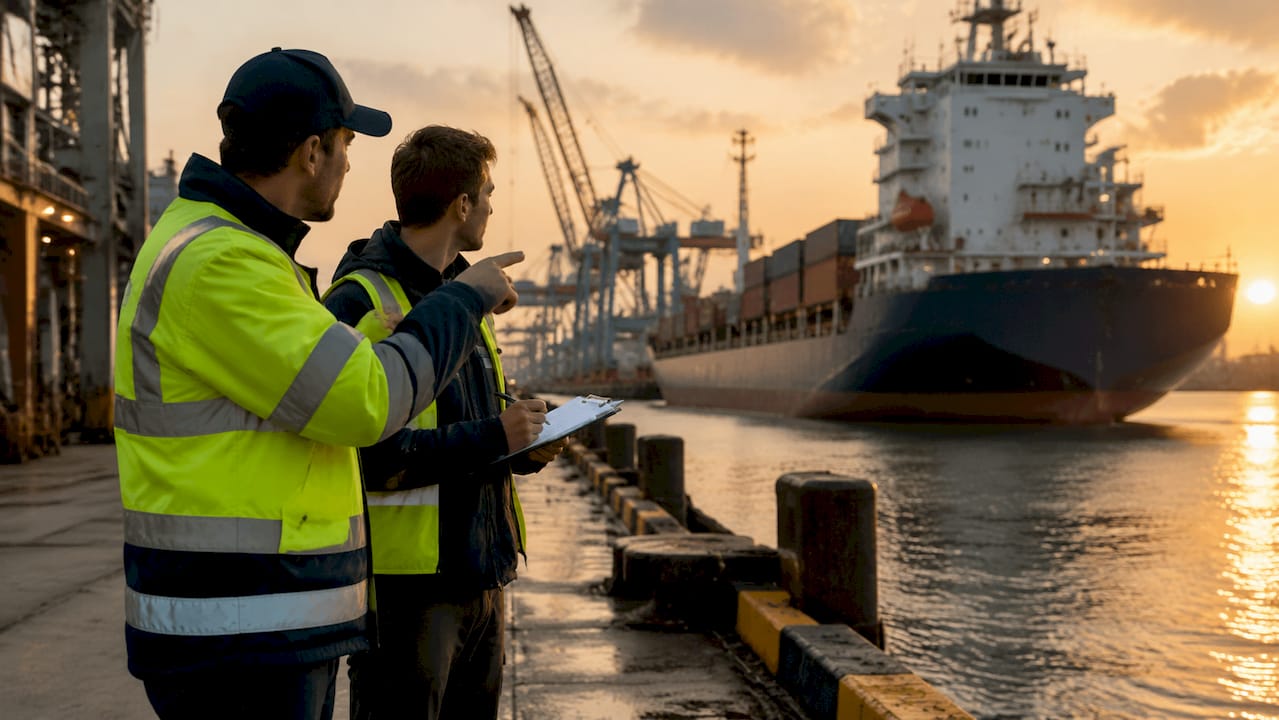
Port security is another core function. Harbour Masters hold statutory enforcement roles that extend well beyond administrative duties, encompassing port security oversight, marine incident investigation, and resilience planning. The Harbour Master is the principal point of compliance contact for vessels entering a port, and their authority is backed by legislation.
Key statutory duties performed by UK port authorities include:
- Safe navigation: Pilotage administration, channel maintenance, and VTS operation to manage vessel movements safely.
- Port security: Enforcement of the International Ship and Port Facility Security (ISPS) Code and coordination with Border Force and the Maritime and Coastguard Agency.
- Emergency planning: Resilience frameworks covering oil spills, vessel groundings, and major incidents, updated regularly.
- Environmental protection: Pollution control, habitat management, and compliance with the Marine and Coastal Access Act 2009.
- Traffic regulation: River and harbour traffic management, including speed limits, anchorage designations, and vessel scheduling.
The Ports and Marine Facilities Safety Code (PMSC) sets mandatory operational standards across these areas. One requirement that logistics professionals often overlook is the appointment of an independent ‘Designated Person’, who provides objective assurance to the Duty Holder that the safety management system is functioning correctly. This role exists precisely because port authorities cannot self-certify compliance on matters of public safety.
Pro Tip: When planning port calls or haulage schedules, request the port’s current VTS operating hours and pilotage requirements in advance. Delays caused by pilotage unavailability are a common source of demurrage costs that are entirely avoidable with early planning.
How are UK port authorities governed?
UK port governance follows three distinct models, each with different accountability structures and financial arrangements.
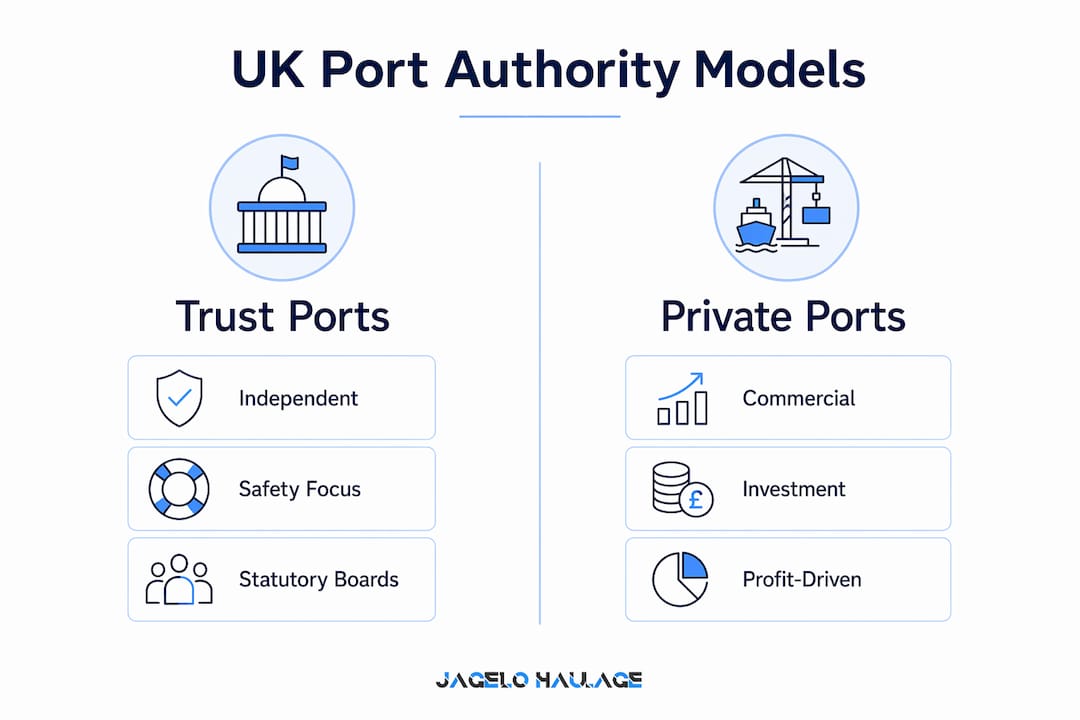
| Port type | Ownership and control | Financial model |
|---|---|---|
| Trust ports | Independent statutory boards, no shareholders | Surpluses reinvested into port and surrounding area |
| Private ports | Commercial companies or investors | Profit-driven, subject to shareholder returns |
| Municipal ports | Local authorities | Publicly funded, accountable to elected councils |
Trust ports represent the most distinctive model. Trust ports operate as regulatory and safety management bodies rather than cargo operators. They typically do not own docks or cargo handling equipment. The PLA exemplifies this: it reinvests all financial surplus back into the tidal Thames region, funding environmental improvements and infrastructure maintenance without distributing profits to shareholders. That model creates a direct alignment between port performance and public benefit.
Private ports, by contrast, operate under commercial imperatives. They may invest heavily in terminal infrastructure, but their governance prioritises shareholder value. This distinction matters for logistics professionals negotiating access terms, because the commercial flexibility and fee structures differ significantly between port types.
UK ports policy is fully devolved in Scotland and Northern Ireland and partly devolved in Wales. This means that port governance frameworks, planning consents, and administrative oversight vary by region. A port authority operating in Scotland answers to different regulatory bodies than one in England, which creates complexity for operators running national distribution networks. Understanding these regional variations is not optional for policymakers or freight planners working across multiple UK ports.
How do port authorities affect trade, logistics, and regional economies?
Port authorities are the foundational infrastructure layer beneath every container movement, bulk cargo shipment, and passenger ferry crossing in the UK. Their decisions on channel depth, VTS capacity, and security protocols directly determine what vessels can call at a port and how efficiently cargo flows through it.
Port authorities fund navigational maintenance through Harbour Conservancy Charges, also known as Harbour Dues, levied on vessels regardless of their commercial cargo status. These charges cover dredging programmes and continuous VTS monitoring. For logistics professionals, these charges form a predictable cost component within port disbursement accounts, distinct from terminal handling fees or stevedoring costs.
The economic reach of port authorities extends well beyond the quayside. Their influence on regional development includes:
- Infrastructure investment: Port authorities commission channel deepening, berth upgrades, and road and rail connectivity improvements that benefit inland freight networks.
- Workforce development: Many port authorities fund skills programmes and apprenticeships, supporting the transport career growth that the sector depends on.
- Supply chain coordination: Port authorities liaise with shipping lines, hauliers, and freight forwarders to align vessel scheduling with inland transport capacity, reducing congestion and dwell times.
- Decarbonisation investment: Port authorities advocate for energy transition and net-zero goals, investing in shore power, hydrogen infrastructure, and green land use to attract future-ready shipping services.
The connectivity between port authority decisions and UK port logistics best practices is direct. When a port authority upgrades its VTS technology or deepens a navigation channel, the practical result is faster vessel turnaround, reduced waiting time for hauliers at the gate, and lower demurrage exposure for cargo owners. These are not abstract policy outcomes. They translate into measurable cost differences for every container movement.
What challenges and future trends shape UK port authority roles?
The responsibilities of UK port authorities are expanding, driven by environmental targets, technological change, and the complexity of post-Brexit trade policy.
-
Net-zero transition. Port authorities are now active participants in the UK’s decarbonisation agenda. Many are investing in shore power connections, electric vehicle charging infrastructure, and renewable energy generation on port land. This is no longer a voluntary commitment. The British Ports Association has positioned port authorities as central to the UK’s energy transition, and planning decisions increasingly reflect this.
-
Digitalisation of VTS and port operations. Vessel Traffic Services are evolving from radio-based communication systems to integrated digital platforms that combine radar, AIS (Automatic Identification System), and predictive analytics. Port authorities investing in these systems improve safety outcomes and reduce the administrative burden on Harbour Masters.
-
Regional governance complexity. The devolved nature of UK ports policy creates genuine administrative friction. UK port regulation is highly decentralised, with devolved governments managing ports differently and producing regional variation in governance approaches. For logistics operators running intermodal networks across England, Scotland, and Wales, this means navigating different planning regimes and regulatory contacts for each port.
-
Global supply chain pressures. Trade policy changes, including adjustments to customs procedures and border controls following the UK’s departure from the European Union, have added new compliance layers to port operations. Port authorities have had to expand their coordination with HMRC, Border Force, and the Animal and Plant Health Agency.
-
Independent safety oversight. The ‘Designated Person’ role under the PMSC is becoming more visible as port authorities face greater scrutiny from the Maritime and Coastguard Agency. Ports that treat this appointment as a box-ticking exercise rather than a genuine assurance function face enforcement risk.
Pro Tip: Logistics professionals tendering for port-side contracts should request sight of a port authority’s most recent PMSC audit summary. A well-maintained safety management system is a reliable proxy for operational discipline across the whole port.
Understanding how UK port infrastructure works in the context of these evolving responsibilities helps freight operators anticipate disruption, plan contingency routes, and engage constructively with port authority consultations on infrastructure investment.
Key takeaways
UK port authorities are statutory bodies whose governance model, safety obligations, and investment decisions directly determine the cost, speed, and reliability of every container movement through a UK port.
| Point | Details |
|---|---|
| Statutory safety duties | Port authorities manage pilotage, VTS, dredging, and emergency planning under mandatory legal frameworks. |
| Three governance models | Trust, private, and municipal ports operate under distinct financial and accountability structures. |
| Trade facilitation | BPA members facilitate 86% of UK seaborne trade, making port authority performance a national economic issue. |
| Devolved complexity | Ports policy varies across Scotland, Wales, and Northern Ireland, creating regional compliance differences. |
| Sustainability shift | Port authorities are now active investors in net-zero infrastructure, reshaping port planning and logistics costs. |
The case for taking port authority governance seriously
Working closely with logistics operators across Felixstowe, Tilbury, Southampton, and Liverpool, I have seen how often port authority governance is treated as background noise rather than a live operational variable. That is a costly mistake.
The distinction between trust ports and private ports, for example, is not academic. A trust port reinvests its surplus into the navigation infrastructure you depend on. A private port may prioritise terminal expansion over channel maintenance. Those decisions affect vessel access, turnaround times, and ultimately the demurrage exposure of every container you are moving. Knowing which model governs your port of call changes how you negotiate and plan.
The shift toward sustainability is the area I find most underestimated. Port authorities are now making infrastructure decisions, shore power investment, hydrogen bunkering feasibility studies, green land use designations, that will determine which shipping services call at which ports over the next decade. Logistics professionals who engage with port authority consultations now will have a clearer picture of where capacity and connectivity are heading. Those who ignore them will be reacting to changes rather than anticipating them.
The Designated Person requirement under the PMSC is another area where I see a gap between formal compliance and genuine assurance. The role exists to provide independent oversight of safety management systems. When it functions properly, it catches systemic risks before they become incidents. When it is treated as a formality, it provides false confidence. For anyone planning operations at a UK port, understanding whether that assurance function is genuinely independent is worth the conversation.
— Vytautas
Jhaulage: container haulage built around UK port operations
Understanding the functions of UK port authorities is only part of the picture. The other part is having a haulage partner who translates that knowledge into reliable, cost-controlled container movements.
Jhaulage operates a fleet of over 40 GPS-tracked trucks and trailers, providing container haulage across major UK ports including Felixstowe, Tilbury, Southampton, and Liverpool. With 24/7 operational support and deep familiarity with port authority scheduling, VTS requirements, and gate procedures, Jhaulage reduces dwell time and demurrage exposure for shipping lines, freight forwarders, and logistics operators. For specialist container haulage services built around the realities of UK port authority operations, Jhaulage is the dependable choice.
FAQ
What is a UK port authority?
A UK port authority is a statutory body with legal powers to regulate navigation, enforce safety standards, and manage port operations within a defined jurisdiction. Port authorities are classified as trust ports, private ports, or municipal ports.
What does a Harbour Master do?
A Harbour Master holds statutory enforcement powers covering port security, marine incident investigation, and emergency resilience planning. The Harbour Master is the principal compliance contact for all vessels entering a port.
How are UK port authority charges calculated?
Port authorities levy Harbour Conservancy Charges or Harbour Dues on vessels to fund dredging, VTS operation, and navigational maintenance. These charges apply regardless of whether a vessel is carrying commercial cargo.
How does devolution affect UK port governance?
Ports policy is fully devolved in Scotland and Northern Ireland and partly devolved in Wales, meaning governance frameworks, planning consents, and regulatory oversight differ by region across the UK.
What is the Designated Person role under the PMSC?
The Ports and Marine Facilities Safety Code requires port authorities to appoint an independent Designated Person who provides objective assurance that the port’s safety management system is functioning correctly and meeting its legal obligations.