How container haulage networks expand in 2026

Container haulage network expansion is the process of strategically broadening inland and intermodal transport corridors, terminals, and service capabilities to create more resilient, integrated, and efficient freight movement systems. The shift from isolated, point-to-point trucking to unified multimodal operations, combining road, rail, sea, and air freight with customs clearance and warehousing, defines how the sector grows today. Operators including Rhenus, Maersk, and cargo-partner have each demonstrated that scaling a container haulage network requires deliberate corridor development, phased capacity increases, and technology-led planning rather than simply adding trucks to existing routes.
What key strategies drive the expansion of container haulage networks?
Container haulage networks expand through four primary mechanisms: multimodal corridor integration, hub-and-spoke terminal development, increased service frequency on established lanes, and embedded customs execution. Each mechanism addresses a distinct constraint in freight flow, and the most effective expansions combine all four rather than pursuing any single lever in isolation.
Multimodal inland connectivity is the foundation of modern network growth. Rhenus has scaled Asia-Pacific road freight through cross-border trucking corridors integrated with air and ocean services, demonstrating that road capacity alone cannot sustain network growth at scale. Connecting road legs to rail and sea modes reduces total transit time, distributes risk across transport types, and opens corridors that pure trucking cannot serve economically.

Hub-and-spoke models anchor expansion by creating inland terminals that consolidate container flows before onward distribution. Geodis opened a multiservice hub at Le Havre integrating port, road transport, and logistics functions, which allowed the operator to increase container throughput without proportional increases in linehaul capacity. This model is particularly effective at major port gateways where landside congestion is the primary bottleneck.
The third lever, increasing corridor frequency, is often underestimated as a growth tool. Raising departure frequency on an existing lane improves asset utilisation, reduces shipper dwell time, and makes the corridor commercially attractive to a broader customer base. Customs and border clearance integration completes the picture. Building clearance capability directly into corridor design, rather than treating it as an external dependency, prevents execution delays that would otherwise erode the commercial case for expansion.
- Prioritise multimodal integration over pure road capacity additions
- Develop inland hub terminals at port gateways to consolidate container flows
- Increase departure frequency on proven lanes before opening new corridors
- Embed customs and clearance functions within corridor design from the outset
- Sequence expansion: resolve throughput bottlenecks first, then increase frequency, then extend geography
Pro Tip: When planning corridor expansion, map your current landside throughput constraints, including driver availability, terminal dwell times, and rail slot scheduling, before committing capital to new routes. Resolving existing bottlenecks typically delivers faster capacity gains than opening new lanes.
How do technology and network optimisation support container haulage expansion?
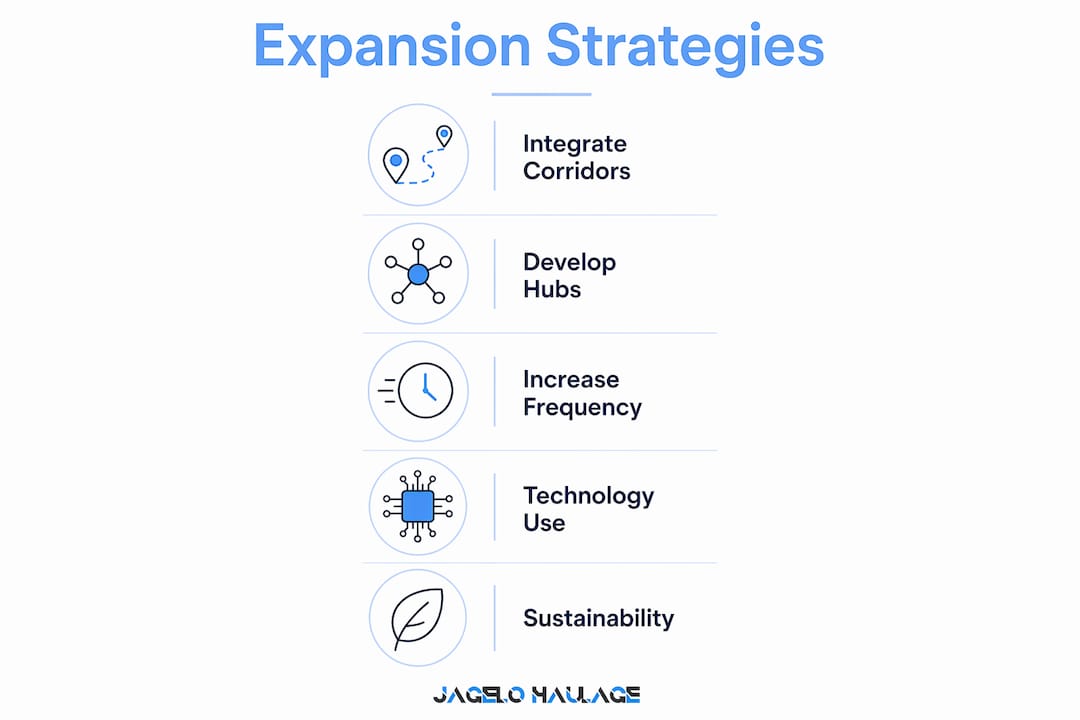
Data-driven network optimisation is the critical enabler that separates sustainable expansion from overextension. The core principle is straightforward: treat network scaling as an optimisation problem, not an asset procurement exercise. Effective network plans employ 12 or more months of origin-destination transport data with scenario testing of node additions, mode shifts, and carrier allocation to optimise cost, transit time, and capacity simultaneously.
The practical sequence for technology-led expansion follows a clear logic:
- Collect baseline data. Gather at minimum 12 months of origin-destination flows, lane utilisation rates, and dwell time records across all current corridors.
- Model demand scenarios. Build multiple demand projections, including base case, high growth, and disruption scenarios, to stress-test proposed network changes before committing resources.
- Test node and mode additions. Simulate the effect of adding inland terminals, shifting volume between road and rail, or reallocating carrier capacity across lanes.
- Evaluate total landed cost. Assess each scenario against full cost, including linehaul, terminal handling, customs, and detention, rather than linehaul rates alone.
- Pilot before scaling. Run capacity pilots on priority lanes under live demand conditions before committing to full corridor rollout.
Artificial intelligence takes this process further by evaluating permutations that human planners cannot process manually. Amazon’s middle-mile network design uses graph attention networks and Monte Carlo simulations to evaluate hundreds of candidate network configurations under uncertainty. This approach prevents overinvestment in fixed assets during volatile demand periods and maintains flexibility when freight rates shift rapidly.
“Risk-aware network design using AI-driven scenario testing underpins sustainable haulage network scaling. The goal is not the perfect network today but the most adaptable network across multiple future states.”
Pro Tip: If you do not yet have AI-based modelling capability in-house, efficient container delivery scheduling tools and third-party network consultants can apply scenario-based analysis to your existing origin-destination data at a fraction of the cost of building proprietary systems.
How do recent expansions illustrate these growth strategies in practice?
The most instructive examples of container haulage network expansion in recent years share a common architecture: multimodal integration, phased corridor development, and embedded service capabilities. The following table summarises five significant expansions and the specific strategies each operator deployed.
| Operator | Expansion action | Key strategy applied |
|---|---|---|
| Rhenus | Asia-Pacific cross-border trucking corridors with customs border office at Bukit Kayu Hitam | Multimodal integration with embedded customs execution |
| Maersk | Middle East landbridge moving ~5,000 containers per week via 1,200 km road and rail corridors | Disruption-driven alternative routing with phased throughput scaling |
| cargo-partner | Up to five weekly Italy-CEE departures with integrated customs and consolidation services | Frequency increase on established corridor with bundled service integration |
| CargoBeamer | Calais to Perpignan round trips increased from 4 to 6 per week | Intermodal rail frequency increase to expand corridor capacity |
| Geodis | Multiservice hub at Le Havre integrating port, road, and logistics functions | Hub-and-spoke inland terminal development at port gateway |
Maersk’s Middle East landbridge is particularly instructive for logistics professionals assessing disruption-driven expansion. The operation deployed approximately 1,200 trucks and trains across a 1,200-kilometre corridor, circumventing maritime chokepoints that had disrupted ocean freight flows. The phased approach, securing road and rail route capacity and throughput before extending network geography, is a model that applies equally to UK port corridors facing congestion at Felixstowe or Southampton.
Rhenus demonstrates a different but equally important principle: customs integration as a structural component of network design rather than an afterthought. The dedicated border office at Bukit Kayu Hitam with full customs capabilities is not a supplementary service. It is the operational mechanism that makes the cross-border trucking corridor commercially viable. Without it, container dwell times at the border would erode the transit time advantage that justifies the corridor’s existence.
cargo-partner’s European expansion illustrates how frequency increases on established lanes generate network value without requiring new infrastructure. Offering up to five weekly departures on the Italy to Central and Eastern Europe corridor transforms a periodic service into a reliable supply chain tool, which attracts higher-value cargo and justifies the bundled customs and consolidation services that generate additional margin.
What challenges and considerations shape container haulage network expansion?
Network expansion does not proceed in a straight line. Infrastructure readiness, freight rate volatility, regulatory complexity, and the economics of lane viability each impose constraints that operators must address before committing to corridor growth.
The most immediate constraint is infrastructure capacity at terminal and port level. Landside throughput, encompassing driver availability, rail slot scheduling, and terminal dwell times, determines whether a new corridor can actually deliver the transit times it promises. Opening a new lane without resolving upstream terminal congestion transfers the bottleneck rather than eliminating it.
Freight rate volatility adds a further layer of complexity. Global container volumes rose 4.3% year-on-year in April 2026, with spot rates increasing sharply in response to capacity pressure. This dynamic means that lane economics can shift materially within the planning horizon of a corridor expansion, making early capacity pilots and flexible contract structures more valuable than long-term fixed-cost commitments.
Key considerations for managing expansion risk include:
- Assess total landed cost across linehaul, terminal handling, customs, and detention rather than evaluating linehaul rates in isolation
- Build flexibility into corridor contracts to accommodate freight rate swings without locking in overcapacity
- Pilot new lanes under live demand conditions before full rollout to validate transit time and cost assumptions
- Integrate regulatory and customs expertise into corridor design from the planning stage, not the execution stage
- Evaluate infrastructure readiness at both origin and destination terminals before committing to frequency increases
Sustainability considerations are also entering expansion planning in a meaningful way. Fleet choices, routing decisions, and CO₂ tracking are increasingly integral to network growth strategies, particularly for operators serving European markets where carbon reporting obligations are tightening. Operators who embed sustainability metrics into corridor design now will avoid costly retrofitting later.
Key takeaways
Container haulage networks expand most effectively through phased multimodal integration, hub-based terminal development, and AI-driven scenario planning rather than through asset accumulation alone.
| Point | Details |
|---|---|
| Multimodal integration is the foundation | Combining road, rail, sea, and air freight within a single corridor design is the primary driver of sustainable network growth. |
| Phased corridor sequencing reduces risk | Resolve throughput bottlenecks first, then increase frequency, then extend geography to avoid transferring constraints to new lanes. |
| Customs integration is operationally critical | Embedding clearance functions within corridor design prevents border delays that undermine transit time advantages. |
| AI-driven scenario testing prevents overinvestment | Monte Carlo simulations and graph-based models evaluate hundreds of network permutations under demand uncertainty before capital is committed. |
| Lane economics must account for total landed cost | Evaluating linehaul rates alone misses terminal handling, detention, and customs costs that determine true corridor viability. |
Why integrated thinking matters more than infrastructure spend
The instinct in this industry is to equate network expansion with asset acquisition: more trucks, more trailers, more terminal space. After years of working in and around container haulage, I find that instinct is usually wrong. The operators who scale most effectively are not the ones with the largest fleets. They are the ones who have built the tightest integration between transport modes, customs execution, and data systems.
Maersk’s Middle East landbridge is a case in point. The operation did not succeed because Maersk deployed 1,200 trucks. It succeeded because those trucks operated within a corridor that had been designed around throughput sequencing, border clearance capability, and phased geographic extension. The infrastructure was in service of the system, not the other way around.
The same logic applies to UK port corridors. Felixstowe, Tilbury, Southampton, and Liverpool each present distinct landside throughput profiles, and the operators who understand those profiles at a granular level, including dwell time patterns, rail slot availability, and customs processing times, are the ones who can expand their UK port haulage operations without creating new bottlenecks downstream.
Technology adoption is not optional in this context. Scenario-based network modelling, even without enterprise-grade AI systems, gives planners the ability to stress-test corridor assumptions before committing capital. The operators who treat this as a planning discipline rather than a technology project will make better expansion decisions consistently.
Sustainability is the variable I expect to reshape expansion planning most significantly over the next three to five years. CO₂ tracking, alternative fuel routing, and carbon reporting are moving from voluntary commitments to contractual requirements in European freight markets. Operators who integrate these considerations into corridor design now will have a structural advantage when those requirements tighten.
— Vytautas
How Jhaulage supports your container haulage network
Jhaulage operates as a specialist container haulage provider across the UK’s principal port corridors, including Felixstowe, Tilbury, Southampton, and Liverpool. With a fleet of over 40 GPS-tracked trucks and trailers, Jhaulage delivers the terminal integration, scheduling precision, and corridor reliability that network expansion demands. Whether you are scaling intermodal connections, managing full container load shipments, or requiring same-day port-to-door delivery, Jhaulage provides the operational capability to support your growth without adding complexity to your supply chain. Contact the team at Jhaulage container haulage specialists to discuss how we can support your UK corridor requirements.
FAQ
What does container haulage network expansion mean?
Container haulage network expansion is the process of broadening inland and intermodal transport corridors, terminals, and service capabilities to create more integrated and resilient freight movement systems. It moves beyond adding trucks to encompass multimodal connectivity, hub terminal development, and embedded customs execution.
How do logistics companies grow their haulage networks?
Logistics companies grow haulage networks by integrating road, rail, and ocean freight within shared corridors, increasing departure frequency on established lanes, developing inland hub terminals, and embedding customs clearance into corridor design. Operators such as Maersk, Rhenus, and cargo-partner each demonstrate this phased, multimodal approach.
What role does technology play in expanding freight networks?
Technology enables operators to evaluate network expansion scenarios using 12 or more months of origin-destination data, AI-based simulations, and Monte Carlo modelling before committing capital. This approach, applied by operators including Amazon in middle-mile design, prevents overcapacity and maintains flexibility under demand volatility.
What are the main challenges in container haulage network expansion?
The primary challenges are infrastructure capacity at terminal level, freight rate volatility affecting lane economics, regulatory and customs complexity, and the risk of transferring bottlenecks to new corridors without resolving existing throughput constraints. Total landed cost evaluation and early capacity pilots are the standard tools for managing these risks.
How does frequency increase help expand a haulage network?
Increasing departure frequency on an established corridor, as CargoBeamer did by raising Calais to Perpignan round trips from four to six per week, improves asset utilisation, reduces shipper dwell time, and makes the lane commercially viable for a broader range of cargo types without requiring new infrastructure investment.