Fedship.com alternatives: UK port-to-door shortlist

For UK logistics operators, the most practical alternatives to fedship.com fall into three categories: asset-based hauliers (owned fleets, direct port access), digital freight forwarders (brokered capacity, visibility dashboards), and integrated 3PLs (software-led, multi-modal). For port-to-door container moves at Felixstowe, Tilbury, Southampton, or Liverpool, Jagelo Haulage Limited is the recommended starting point.
One clarification worth making upfront: fedship.com is the domain for Federal Shipping & Forwarding Agency Sdn. Bhd., a Malaysian logistics company based at Port Klang, Selangor. Its services cover freight forwarding, container haulage, and depot operations within Malaysia and the surrounding region. UK operators searching for “fedship.com alternatives” are typically not seeking a like-for-like Malaysian replacement; they are searching for a capable UK container-haulage partner. The domain match is a regional coincidence, not a service equivalence.
With that distinction clear, the shortlist for UK operators:
- Asset-based haulier (owned fleet, GPS-tracked, ADR-capable, same-day port collection): Jagelo Haulage Limited
- Digital freight forwarder (brokered capacity, integrated booking and visibility, global ocean schedules): platforms such as Zencargo or Flexport
- Integrated 3PL (combined freight network and software, multi-modal): providers such as Wincanton or Eddie Stobart (Stobart Logistics)
Table of Contents
- How do fedship.com alternatives compare for UK container haulage?
- How to choose the right UK container haulage alternative
- Asset-based hauliers versus digital forwarders: which model fits port-to-door work?
- What does UK port-to-door container haulage actually cost?
- What compliance documents should you confirm before contracting?
- Why Jagelo Haulage is the recommended option for UK port-to-door moves
- Key takeaways
- The part of port work that most operators underestimate
- Jagelo Haulage: direct port access, no intermediary risk
- Authority sources and suggested next steps
How do fedship.com alternatives compare for UK container haulage?
The table below maps each service category against the dimensions that matter most for UK port-to-door container moves. Competitor names are omitted from the category rows; Jagelo Haulage is positioned within the asset-based column as the publisher’s recommended option.
| Dimension | Asset-based haulier (e.g. Jagelo Haulage) | Digital forwarder (e.g. Zencargo, Flexport) | Integrated 3PL (e.g. Wincanton, Eddie Stobart) |
|---|---|---|---|
| UK port coverage | Felixstowe, Tilbury, Southampton, Liverpool | Port-agnostic booking; relies on sub-contracted hauliers | Major ports via owned or contracted network |
| Asset model | Owned/operated fleet | Brokered capacity | Mix of owned assets and brokered freight |
| Real-time tracking | GPS on every unit; live alerts | Visibility dashboard (carrier-dependent data feeds) | TMS-based tracking; varies by contract tier |
| Service types | FCL, same-day, refrigerated, ADR/hazardous, oversized | FCL/LCL, ocean/air bookings, freight consolidation | Full-service 3PL, warehousing, distribution |
| Pricing model | Per-move fixed rate or contracted rate | Spot and contracted; platform fee may apply | Contracted; volume-based; accessorials vary |
| SLA and availability | 24/7 support; gate cut-off adherence | Business-hours support typical; portal self-service | Account manager model; SLA by contract |
| Onboarding and IT | Direct account setup; API/EDI available | API-first; EDI integrations standard | EDI/API; longer onboarding for enterprise contracts |
| Compliance | O-licence, ADR, driver CPC, cargo insurance | Freight broker licence; cargo insurance via carriers | Full compliance suite; ISO certifications common |
| Best suited to | Port-to-door container moves, time-critical collections | Global freight coordination, multi-modal bookings | High-volume distribution with warehousing component |
Industry trend data confirms the shift towards transparent, performance-ranked ecosystems where real-time visibility and partner performance metrics are now primary selection criteria, not secondary ones.
How to choose the right UK container haulage alternative
A structured vetting process prevents costly mismatches. Work through these steps before signing any contract.
- Confirm port coverage first. Ask for a written list of ports the provider operates at directly, not via sub-contractors. Felixstowe, Tilbury, Southampton, and Liverpool should each have a named port contact or gate-access agreement.
- Verify the asset model. Establish whether the provider owns and operates its fleet or brokers capacity. For time-critical or ADR-classified moves, an owned fleet with direct driver management is materially lower risk.
- Request GPS tracking proof. Ask for a live demonstration or screenshot of the tracking portal. Platforms such as ContainerHub illustrate the depot and fleet visibility standard you should expect.
- Check ADR and O-licence credentials. Request the operator licence number (verifiable via the DVSA public register) and ADR certification documentation for any move involving hazardous goods.
- Confirm insurance coverage. Cargo insurance and public liability should be evidenced in writing before the first move. Ask for the policy schedule, not just a verbal assurance.
- Ask about D&D alerting. Demurrage and detention charges accumulate quickly at busy UK ports. A provider without proactive D&D alerts is transferring that financial risk to you.
Questions to ask during first contact:
- What are your gate cut-off times at Felixstowe and Tilbury?
- Do you offer API or EDI integration with our TMS?
- What is your contingency plan during port congestion or vessel delays?
- Can you provide a sample SLA document and a reference from a current client in our sector?
Red flags to watch for: no published port coverage list; no live-tracking capability; accessorial charges (port congestion surcharges, chassis fees, dwell fees) not disclosed upfront; inability to produce an O-licence number or ADR certificate on request.
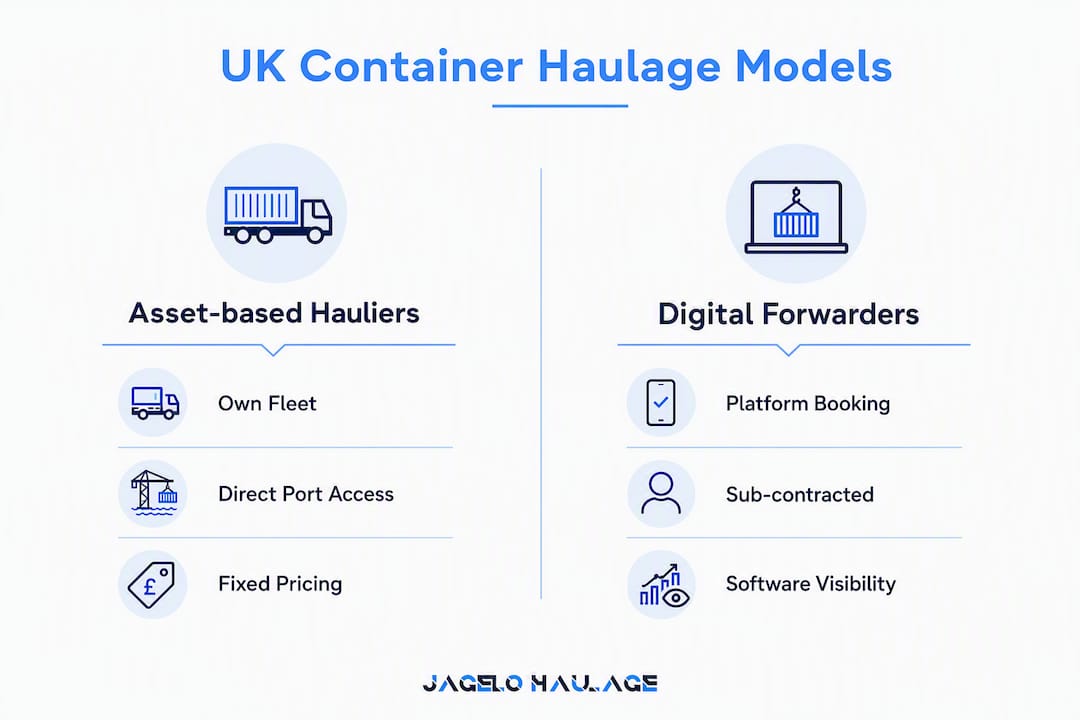
Asset-based hauliers versus digital forwarders: which model fits port-to-door work?
The distinction between these two models has direct operational consequences for UK container moves.

An asset-based haulier operates its own fleet of trucks and trailers, employs its own drivers, and holds direct port access agreements. This means the provider controls the entire collection-to-delivery chain: gate-in timing, driver briefing, chassis management, and depot handover. For same-day collections, ADR-classified cargo, or refrigerated containers, this control is not optional — it is the mechanism that prevents costly delays. Jagelo Haulage’s fleet of numerous GPS-tracked trucks exemplifies this model.
A digital freight forwarder, by contrast, manages bookings and visibility through a software platform while sub-contracting the physical haulage. Platforms such as Shifl and Zencargo offer API connectivity and integrated booking workflows, which suits operators managing global multi-modal freight who need a single visibility layer across carriers. The limitation for UK port-to-door work is that the forwarder’s control over gate timing and driver behaviour is indirect. During port congestion, that indirect control can translate directly into demurrage exposure.
Integrated 3PLs such as Wincanton and Eddie Stobart (Stobart Logistics) occupy a middle position: they combine owned or contracted haulage assets with warehouse and distribution capability, making them well-suited to high-volume importers who need storage alongside container collection. The trade-off is typically longer onboarding, volume-based pricing thresholds, and less flexibility for ad-hoc or same-day moves.
The operational implication is straightforward: for port-to-door container moves where D&D exposure, gate cut-offs, and ADR compliance are live concerns, an asset-based haulier with direct port access reduces failure points. For global freight coordination and multi-modal consolidation, a digital forwarder adds genuine value.
What does UK port-to-door container haulage actually cost?
Pricing for container haulage in the UK is rarely a single line item. Understanding the full cost structure prevents budget surprises.
Common pricing shapes:
- Per-move fixed rate: a single agreed price covering base haulage for a defined origin-destination pair; most transparent for budgeting.
- Contracted rate: volume-committed pricing negotiated for a defined period; typically lower per-move cost in exchange for volume commitment.
- Spot rate: market-rate pricing for ad-hoc moves; useful for overflow but exposed to demand surges.
- Accessorials: additional charges applied on top of the base rate for specific conditions.
| Cost component | Description | Typical range (indicative) |
|---|---|---|
| Base haulage (FCL) | Port collection to delivery address | Published on request; varies by distance |
| Chassis/trailer fee | Where a specific trailer type is required | Included or itemised depending on provider |
| Port congestion surcharge | Applied during high-demand periods at major ports | Variable; confirm with provider |
| Dwell/storage fee | Container held beyond free-time allowance at depot | Per-day charge; confirm free-time window |
| D&D exposure | Demurrage (at port) and detention (on equipment) | Can escalate rapidly; proactive alerts reduce risk |
| Fuel surcharge | Indexed to fuel price movements | Percentage of base rate; confirm adjustment frequency |
Timeline for a typical port-to-door move:
- Booking lead time: 24–48 hours for standard moves; same-day available with asset-based providers.
- Gate-in/collection window: confirm cut-off times per port (Felixstowe and Tilbury have specific VBS slot requirements).
- Transit to delivery: typically same-day to next-day for UK mainland destinations.
- Contingency allowance: build in 24 hours for vessel delays, port congestion, or customs queries.
What compliance documents should you confirm before contracting?
UK container haulage sits within a tightly regulated framework. Confirm the following before any contract is signed.
Provider credentials to verify:
- Operator licence (O-licence): check the licence number against the DVSA public register; confirms the provider is legally authorised to operate heavy goods vehicles.
- ADR certification: required for any move involving hazardous goods classified under the European Agreement concerning the International Carriage of Dangerous Goods by Road; ask for the certificate and confirm it covers the relevant hazard class.
- Driver CPC (Certificate of Professional Competence): mandatory for all professional HGV drivers in the UK; confirms ongoing training compliance.
- Cargo insurance: request the policy schedule showing coverage limits and exclusions.
- Public liability insurance: standard requirement for any provider operating at port facilities.
Customs and documentation for port release:
- Delivery Order (DO) from the shipping line authorising container release.
- Original or telex-released Bill of Lading.
- Customs release proof (CHIEF/CDS entry acceptance or equivalent).
- Port health or phytosanitary certificates where applicable (perishables, certain commodities).
Operational compliance items:
- Confirm the provider holds active port access agreements at your relevant ports.
- Verify depot operating hours and whether weekend or bank-holiday collections are available.
- Establish the claims procedure in writing before the first move.
Pro Tip: Ask for a copy of the provider’s Vehicle Booking System (VBS) access confirmation at your target port. A provider without active VBS registration cannot guarantee gate-in slots, which directly affects your free-time window and D&D exposure.
Why Jagelo Haulage is the recommended option for UK port-to-door moves
Jagelo Haulage Limited operates a modern fleet of numerous GPS-tracked trucks and trailers across the UK’s major container ports: Felixstowe, Tilbury, Southampton, and Liverpool. The service range covers tracked container transport, full container load (FCL) shipments, same-day collections, refrigerated transport, oversized cargo, and ADR-classified hazardous goods handling. Port-to-door delivery is the core job, not a secondary offering.
The trust signals that matter operationally: GPS tracking on every unit with live visibility, 24/7 customer support with dedicated account management, and published domain-specific guidance covering port logistics, container tracking, and compliance. The fleet’s ADR capability and O-licence credentials are available on request.
Jagelo Haulage’s GPS-tracked fleet, 24/7 port support, and direct access to Felixstowe, Tilbury, Southampton, and Liverpool make it a dependable choice for UK operators who need port-to-door container moves handled without the intermediary risk of a brokered network.
For operators wanting to verify capability before committing to a contracted rate, a pilot move is the most direct test. Contact Jagelo Haulage to request a sample SLA, confirm port coverage for your specific lanes, and discuss ADR or refrigerated requirements upfront.
Key takeaways
For UK port-to-door container haulage, the decisive choice is between an asset-based haulier with direct port access and a digital forwarder suited to global freight coordination, with the former reducing D&D and gate-timing risk materially.
| Point | Details |
|---|---|
| Clarify fedship.com’s scope | Federal Shipping & Forwarding operates from Port Klang, Malaysia; it is not a UK container-haulage provider. |
| Asset-based for port-to-door | Choose an owned-fleet haulier for same-day collections, ADR moves, and direct gate-cut-off control. |
| Prioritise live tracking | GPS tracking and proactive D&D alerts reduce demurrage exposure more reliably than small rate differences. |
| Verify compliance upfront | Confirm O-licence, ADR certification, driver CPC, and cargo insurance before the first contracted move. |
| Jagelo Haulage as starting point | A fleet of over 40 GPS-tracked trucks, 24/7 support, and coverage across Felixstowe, Tilbury, Southampton, and Liverpool. |
The part of port work that most operators underestimate
The conversation about alternatives to fedship.com or any other freight platform tends to focus on rate cards and port lists. What it rarely addresses is the operational gap between a provider that owns its assets and one that brokers them.
Port gate timing is unforgiving. A 30-minute missed slot at Felixstowe during a congested period does not just delay a delivery; it starts a demurrage clock. The providers who handle this well are not necessarily the ones with the most sophisticated booking portal. They are the ones whose drivers know the port, whose operations team has a direct line to the port liaison, and whose GPS data is live enough to make a decision before the slot is missed. That combination is harder to replicate through a brokered network, regardless of how clean the visibility dashboard looks.
The practical lesson: when you are evaluating any UK container-haulage partner, ask for a specific example of how they handled a port-congestion delay in the last six months. The answer will tell you more than any SLA document.
Jagelo Haulage: direct port access, no intermediary risk
Port-to-door container haulage in the UK demands a partner who controls the full chain from gate collection to final delivery. Jhaulage offers exactly that: a GPS-tracked fleet of trucks, direct port access at Felixstowe, Tilbury, Southampton, and Liverpool, and 24/7 support from operators who understand port cut-offs, D&D exposure, and ADR compliance.
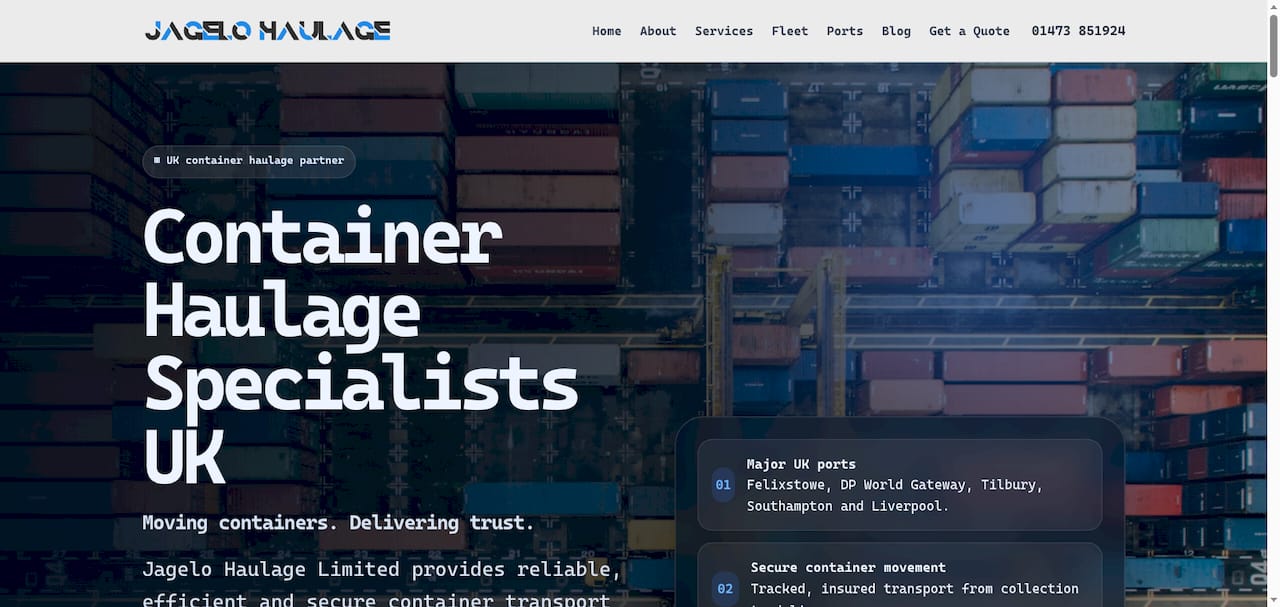
Where digital forwarders and integrated 3PLs add layers of sub-contracted capacity, Jhaulage removes them. Fixed per-move rates, same-day collection capability, and refrigerated or hazardous-goods handling are available without the volume thresholds that larger 3PLs typically require. Whether you need a single pilot move or a contracted lane, the process starts with a conversation. Request a quote or sample SLA from Jagelo Haulage today.
Authority sources and suggested next steps
Primary sources used in this article:
- Federal Shipping & Forwarding — About Us: confirms fedship.com’s Malaysian registration, Port Klang address, and regional service scope.
- Malaysia Services E-Directory — Federal Shipping & Forwarding: directory entry corroborating Malaysian business address and service sub-sectors.
- Shipping trends 2026 — mid-year state of the industry: industry data on the shift to performance-ranked, transparent partner ecosystems.
- RCS Freight Services — 2026 freight market outlook: commentary on D&D exposure and the role of proactive tracking alerts.
- ContainerHub — container tracking in logistics: practical guide to fleet and depot visibility standards.
- Jagelo Haulage — container haulage specialists UK: primary source for fleet size, port coverage, service types, and compliance credentials.
Suggested next steps for due diligence:
- Request a sample SLA from any shortlisted provider covering gate cut-off times, contingency procedures, and D&D alert protocols.
- Ask for API or EDI test access to confirm TMS integration before committing to a contracted lane.
- Verify the provider’s O-licence number via the DVSA public register and request ADR certification documentation.
- Schedule a port-site visit or phone interview with the provider’s port liaison contact.
- Commission a single pilot move before signing a volume contract; use it to test tracking visibility, communication, and delivery accuracy.