How to set up a regular container haulage contract

A regular container haulage contract is a formal, ongoing service agreement between a UK business and one or more hauliers to move shipping containers across defined lanes at agreed rates and service levels. To set up a regular container haulage contract correctly, you must work through four distinct phases: preparing a detailed tender pack, running a structured carrier selection process, completing a thorough operational onboarding, and establishing monthly performance reviews. Businesses that skip any of these phases typically face hidden cost inflation, service failures, and contract disputes within the first quarter. This guide covers each phase in full, drawing on current UK freight tendering standards.
What does a container haulage tender pack need to include?
The tender pack is the most powerful tool you have to control haulage costs. Incomplete tender packs force carriers to price in uncertainty, which inflates every quote you receive. A thorough pack removes that uncertainty and gives you genuinely competitive bids.
Your tender pack must contain the following core data elements:
- Lane files: Origin and destination postcodes for every collection and delivery point, including named ports such as Felixstowe, Tilbury, Southampton, and Liverpool.
- Shipment profiles: Container types (20ft, 40ft, high cube), full container load (FCL) versus less than container load (LCL) splits, and average gross weights.
- Historical volume data: 12–24 months of shipment volumes by lane, broken down by week where possible. This is the standard for capacity planning in UK freight tendering.
- Delivery windows: Confirmed time slots at each site, including any Vehicle Booking System (VBS) requirements at port terminals.
- Site access restrictions: Height barriers, weight limits, turning restrictions, and forklift availability at each delivery point.
- Waiting time rules: The threshold after which waiting time charges apply. Industry practice sets this at 60–120 minutes on site.
- Fuel surcharge method: Whether you will use a fixed surcharge, an indexed mechanism tied to the Department for Energy Security and Net Zero fuel price tables, or a negotiated rate review cycle.
- Invoicing and payment terms: Credit period, purchase order requirements, and electronic invoicing preferences.
| Data element | Why it matters |
|---|---|
| Lane files with postcodes | Allows carriers to calculate accurate mileage and route costs |
| 12–24 months volume history | Enables capacity planning and avoids surcharge surprises |
| Waiting time thresholds | Prevents disputes over demurrage and detention costs |
| Fuel surcharge method | Creates transparent, predictable price adjustments |
| Site access restrictions | Stops failed deliveries and penalty charges |
Pro Tip: Send your draft tender pack to one trusted carrier before the formal invite stage. Their questions will reveal gaps you have not noticed, and you can correct them before all bidders see the document.
Historical volume data carries particular weight. Carriers use it to plan driver rotas, trailer availability, and port slot bookings. Without it, they build a contingency buffer into their rates. That buffer is pure cost to you.
How does the container haulage tendering process work?
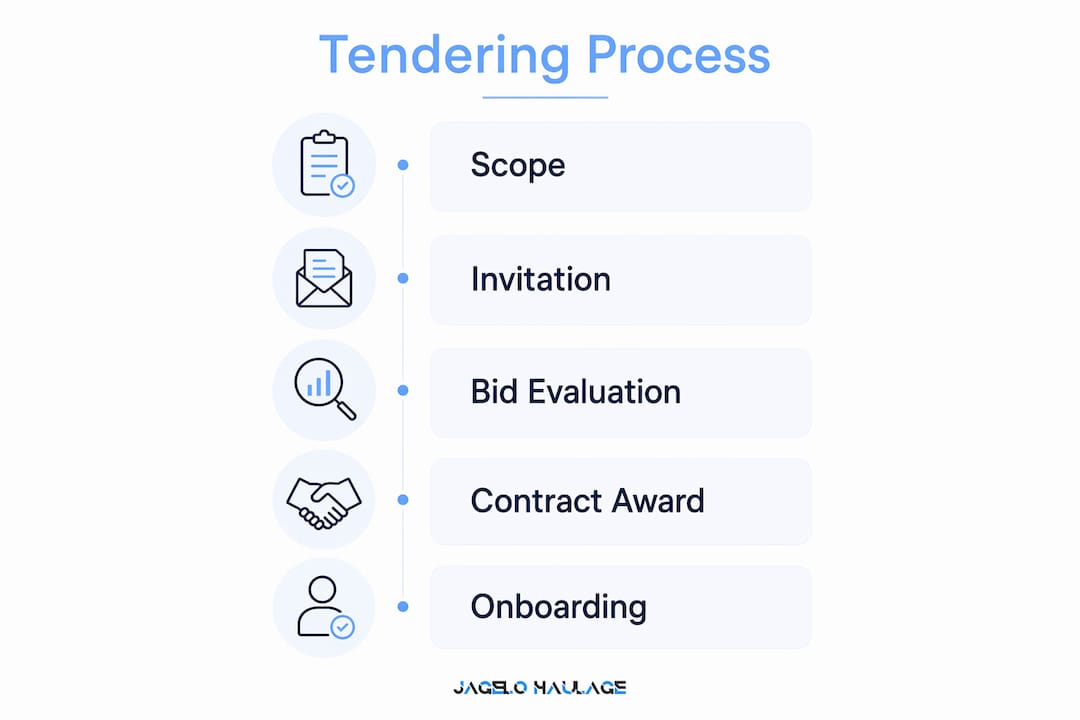
The freight tendering process follows seven formal stages: scoping, inviting, clarifying, evaluating, negotiating, awarding, and reviewing. Each stage has a defined output, and skipping one creates problems downstream.
- Scope: Define your lanes, volumes, service requirements, and contract duration. A typical regular container haulage contract runs 12–24 months with a break clause.
- Invite: Shortlist 5–15 carriers per transport mode. For UK container haulage, this means carriers with active operator licences, port access accreditation, and GPS-tracked fleets.
- Clarify: Open a formal Q&A window. Answer all carrier questions within 48 hours to maintain bid momentum. Delayed responses cause carriers to withdraw or submit inflated contingency rates.
- Evaluate: Score every bid using a weighted scorecard. A standard weighting for container haulage is 50% cost, 30% service capability, and 20% risk and compliance. Use the same scorecard for every carrier to keep the process defensible.
- Negotiate: Work with your top two or three carriers on rate adjustments and service level agreement (SLA) terms. Never negotiate with a single carrier at this stage. Competitive tension is your most effective cost control.
- Award: Issue formal award letters and contract documents. Confirm volume splits: primary carriers typically cover 70–80% of volume, with secondary carriers holding 20–30% as backup capacity.
- Review: Schedule monthly KPI reviews from day one. On-time delivery rate, cargo damage incidents, and invoice accuracy are the three metrics that matter most in container haulage.
| Stage | Key output | Common failure |
|---|---|---|
| Scope | Defined lane and volume requirements | Vague or incomplete lane data |
| Clarify | Answered Q&A log shared with all bidders | Slow responses causing carrier withdrawal |
| Evaluate | Scored comparison across all bids | Subjective decisions without a scorecard |
| Award | Signed contracts with volume splits confirmed | Single-carrier dependency with no backup |
| Review | Monthly KPI dashboard | No formal review until a problem occurs |
Pro Tip: When evaluating bids, ask each carrier to confirm their current port access status at Felixstowe and Tilbury specifically. Port access restrictions change, and a carrier without current accreditation cannot fulfil your contract from day one.
Backup capacity is not optional. Allocating 20–30% of volume to a secondary carrier protects your supply chain when your primary carrier faces driver shortages, vehicle breakdowns, or port congestion. Businesses that award 100% of volume to one carrier lose all negotiating leverage at the first renewal.
What does operational onboarding involve for a haulage contract?
Signing the contract is not the end of the process. The onboarding phase determines whether the contract performs as agreed from the first collection. Operational failures in the first four weeks are almost always caused by incomplete onboarding, not carrier incompetence.
Before go-live, confirm the following with every awarded carrier:
- Depot contacts: Named operations contacts at each depot, with direct telephone numbers and email addresses. Generic customer service queues are not sufficient for live container movements.
- Invoicing rules: Agreed purchase order format, invoice frequency, and the process for querying charges. Disputes over invoicing are the most common source of early contract breakdown.
- Escalation paths: A defined escalation route from driver level through to account manager and director level, with response time commitments at each tier.
- EDI and tracking setup: Electronic data interchange (EDI) connections, GPS tracking feeds, and proof-of-delivery (POD) flows must be tested before the first live movement. Allow 10 working days for system setup and testing.
- KPI definitions: Agree the precise definition of each KPI before go-live. “On-time delivery” must specify whether it means arrival within the booked window or completion of offload within that window.
Pro Tip: Run a pilot week with two or three live collections before committing full volume. A pilot surfaces site access issues, system errors, and communication gaps at low risk, before they affect your entire supply chain.
Carriers who understand your site-specific conditions from day one build more efficient routes and encounter fewer delays. Share your seasonal shipment patterns, peak volume weeks, and any planned changes to delivery points as early as possible. This institutional knowledge is what separates a functional contract from a genuinely productive long-term partnership.

What are the most common pitfalls in establishing a haulage service agreement?
Most container logistics contract failures trace back to decisions made before the contract was signed, not after. The following pitfalls are the most frequently encountered in UK container haulage.
- Vague waiting time definitions. Charges typically apply after 60–120 minutes on site, but contracts that do not define the start time precisely create disputes. Does the clock start at gate arrival, at dock presentation, or at the driver booking-in time? Specify it in writing.
- Incomplete tender packs. Risk premium inflation is a direct consequence of missing data. Carriers cannot price accurately without postcodes, pallet stackability data, and confirmed delivery windows.
- No backup carrier. A single-carrier arrangement for a key lane is a single point of failure. Port congestion at Felixstowe or Tilbury can ground a carrier’s entire fleet for 24–48 hours.
- Ignoring indexed pricing. Pricing linked to fuel indices and driver wage benchmarks reduces financial risk for both parties over a 12–24 month contract. Fully fixed rates look attractive at signing but create adversarial renegotiations when costs shift.
- Failing to share seasonal data. Carriers who do not know your peak volumes cannot pre-position trailers or book port slots in advance. The result is capacity shortfalls at exactly the moment you need reliability most.
“Carriers who ask detailed questions about your site access, volume seasonality, and delivery windows are demonstrating the operational capability to build efficient, reliable routes. A carrier who asks nothing is a carrier who is pricing in the unknown.”
The best haulage service agreements are built on shared information. You reduce your costs by reducing carrier uncertainty. That is the core principle behind every well-structured container delivery service arrangement.
Key takeaways
A successful regular container haulage contract requires a complete tender pack, a structured seven-stage tendering process, thorough operational onboarding, and indexed pricing to control costs over the contract term.
| Point | Details |
|---|---|
| Tender pack completeness | Include 12–24 months of volume data, lane files, and waiting time rules to remove carrier uncertainty. |
| Seven-stage tendering | Follow the formal stages from scoping to monthly review to select and retain the best carriers. |
| Backup carrier allocation | Award 20–30% of volume to a secondary carrier to protect supply chain continuity. |
| Onboarding before go-live | Allow 10 working days for system testing, EDI setup, and KPI definition before the first live movement. |
| Indexed pricing | Link rates to fuel and wage benchmarks to avoid adversarial renegotiations mid-contract. |
The detail that most businesses underestimate
Having worked through container haulage contract setups across UK ports from Felixstowe to Liverpool, the single most underestimated factor is always the same: the quality of information you give carriers before they price. Businesses spend weeks negotiating rate reductions of a few pence per mile, then lose far more through poorly defined waiting time clauses or a carrier who had no idea the delivery site has a 3.5-tonne weight restriction on the access road.
The contracts that perform well over 12–24 months are not necessarily the cheapest at signing. They are the ones where both parties understood the operational reality from the start. I have seen long-term haulage contracts collapse in month three because the shipper never shared seasonal volume data, and the carrier could not source enough trailers during the pre-Christmas peak. That is not a carrier failure. That is a communication failure at the tender stage.
My recommendation is to treat the tender pack as a living document. Update it with every new lane, every site change, and every volume shift. Carriers who receive current, accurate data will price more competitively at renewal. Those who are working from outdated information will protect themselves with contingency margins. You pay for the information gap either way. For a practical framework on evaluating haulage partners, the selection checklist approach is worth reviewing before your next tender round.
— Vytautas
Jhaulage: container haulage contracts for UK businesses
Jhaulage, operating as Jagelo Haulage Limited, works with UK businesses to establish reliable, cost-effective container haulage contracts across major ports including Felixstowe, Tilbury, Southampton, and Liverpool.
Jhaulage operates a fleet of over 40 GPS-tracked trucks and trailers, providing real-time cargo visibility from port to door. The team supports businesses through tender preparation, carrier onboarding, and ongoing contract performance management, with 24/7 operational support throughout. Whether you are setting up your first long-term haulage contract or renegotiating an existing arrangement, Jhaulage brings the port access, fleet capacity, and operational knowledge to deliver. Contact the team at Jhaulage’s container haulage specialists page to discuss your requirements.
FAQ
What is a regular container haulage contract?
A regular container haulage contract is a formal, ongoing agreement between a shipper and one or more hauliers to move shipping containers across defined lanes at agreed rates and service levels, typically for 12–24 months.
How long does it take to set up a haulage service agreement?
A full tender process from scoping to contract award typically takes 6–10 weeks. Allow an additional 10 working days for operational onboarding and system testing before the first live collection.
How many carriers should I include in a container logistics contract?
Award your primary volume (70–80%) to your lead carrier and allocate 20–30% to a secondary carrier. This protects supply chain continuity if your primary carrier faces capacity or port access issues.
What should waiting time clauses specify in a haulage contract?
Waiting time clauses must define the exact start point for the clock, whether gate arrival, dock presentation, or booking-in time, and the threshold after which charges apply, typically 60–120 minutes.
How does indexed pricing work in a long-term haulage contract?
Indexed pricing ties rate adjustments to published benchmarks such as fuel cost indices or driver wage data, creating transparent, predictable price changes rather than adversarial renegotiations at renewal.
Recommended
- Choosing a Reliable Container Haulage Subcontractor | Jagelo Haulage
- Heavy Container Haulage: A Strategic Reference Guide for UK Logistics 2026 | Jagelo Haulage
- Choosing a Reliable Container Haulage Contractor in the UK | Jagelo Haulage
- Road Haulage for Containers: A Professional Guide to UK Port Logistics | Jagelo Haulage