Part of our guide to container haulage from Felixstowe
Felixstowe truck appointment system explained

If you operate container haulage through the UK’s busiest port, understanding what the Felixstowe truck appointment system is has become considerably more pressing since January 2025. That is when Felixstowe replaced its long-standing Vehicle Booking System (VBS) with the Container Booking System (CBS), a real-time web-based platform for scheduling container deliveries and collections. The transition caught many hauliers off guard, particularly those accustomed to the flexibility of late amendments and container swaps. This article explains how the new system works, what the operational rules mean for your fleet, and how to adapt your scheduling to avoid costly penalties.
Table of Contents
- Key takeaways
- What is the Felixstowe truck appointment system?
- CBS operational rules and charges
- VBS vs CBS: what changed for hauliers?
- Best practices for Felixstowe truck scheduling
- My perspective on the CBS transition
- How Jhaulage supports CBS compliance at Felixstowe
- FAQ
Key takeaways
| Point | Details |
|---|---|
| VBS replaced by CBS | Felixstowe launched the Container Booking System on 1 January 2025, replacing the legacy Vehicle Booking System. |
| Strict amendment penalties | Any booking change made within 12 hours of the appointed slot incurs a £35.69 penalty fee. |
| No container swapping | Unlike the old VBS, CBS prohibits swapping container numbers without incurring a charge. |
| Early booking discipline | Finalising slots by Thursday for Monday appointments significantly reduces penalty risk. |
| Full enforcement active | The three-month grace period ended, and full charges have been enforced since February 2025. |
What is the Felixstowe truck appointment system?
The term “Felixstowe truck appointment system” refers broadly to the port’s formalised process for scheduling when haulage vehicles may enter the terminal to collect or deliver containers. The recognised industry term for the current iteration is the Container Booking System, or CBS. Understanding the distinction matters, because many operators still reference the old Vehicle Booking System when discussing Felixstowe transport booking, which creates genuine confusion about what rules actually apply today.
The CBS launched on 1 January 2025 as a direct replacement for the VBS. Its core purpose is to give the port granular control over vehicle flow through the terminal, reducing congestion, cutting dwell times, and supporting 24/7 operational efficiency. Under the previous system, hauliers had grown accustomed to a degree of scheduling latitude that the port determined was creating systemic inefficiencies, including wasted journeys, terminal bottlenecks, and unpredictable vehicle volumes during peak periods.
Key features of the original VBS that the CBS supersedes include:
- Late amendment flexibility: Hauliers could adjust bookings relatively close to the appointment time without financial consequence.
- Container number swapping: Operators could substitute one container for another within an existing booking, accommodating last-minute cargo changes.
- Reactive scheduling: Dispatchers frequently relied on same-day adjustments to manage driver availability and traffic delays.
CBS was designed specifically to eliminate these practices, not because they were inherently unreasonable, but because their cumulative effect on terminal operations was significant. When dozens of hauliers each make small last-minute changes, the aggregate disruption to yard planning and gate throughput becomes measurable.
Pro Tip: If you are updating internal documentation or briefing drivers, use the term “CBS” consistently rather than the older “VBS” to prevent scheduling errors arising from terminology confusion.
CBS operational rules and charges
Understanding the Felixstowe logistics management system requires a thorough grasp of CBS’s booking rules, because the penalties for non-compliance are both specific and enforceable. The system is web-based and requires operators to select precise time slots for container pick-up or delivery in advance.
The booking process under CBS follows a clear sequence:
- Account registration: Haulage operators must hold a verified CBS account. The verification process on each booking is designed to reduce wasted journeys and promote faster terminal turnaround.
- Slot selection: Users select a specific time window for their vehicle’s arrival at the terminal gate, tied to a named container reference.
- Booking confirmation: Once confirmed, the booking locks in the container number, time slot, and vehicle details.
- Amendment window management: Operators may amend bookings free of charge outside the 12-hour window preceding the appointment. Any change within 12 hours triggers a £35.69 penalty fee automatically.
- No-show management: Failure to attend without cancellation constitutes a no-show, which attracts its own charge category under the CBS fee structure.
The prohibition on container number swapping without charge is one of the most operationally disruptive aspects for hauliers managing multi-drop schedules. Under VBS, a dispatcher could substitute a container if a driver became unavailable or cargo priorities shifted. CBS removes that flexibility entirely unless the operator absorbs the penalty.
£35.69 is the penalty fee applied for any booking amendment made within 12 hours of the scheduled appointment under the current CBS framework.
The three-month grace period that ran from January 2025 allowed hauliers to adjust to the new regime before financial enforcement began. Full charges, including late notification fees, no-show penalties, and guaranteed booking charges, became active from 1 February 2025. The British International Freight Association (BIFA) reported ongoing discussions about CBS’s operational challenges, particularly the rigidity of timeframes, and some concerns remain active within the haulage community despite the transition being well established.
VBS vs CBS: what changed for hauliers?
The differences between the legacy Vehicle Booking System and the current CBS are not merely technical. They represent a fundamental shift in the working relationship between the port and its haulage partners. The table below captures the most operationally significant contrasts.
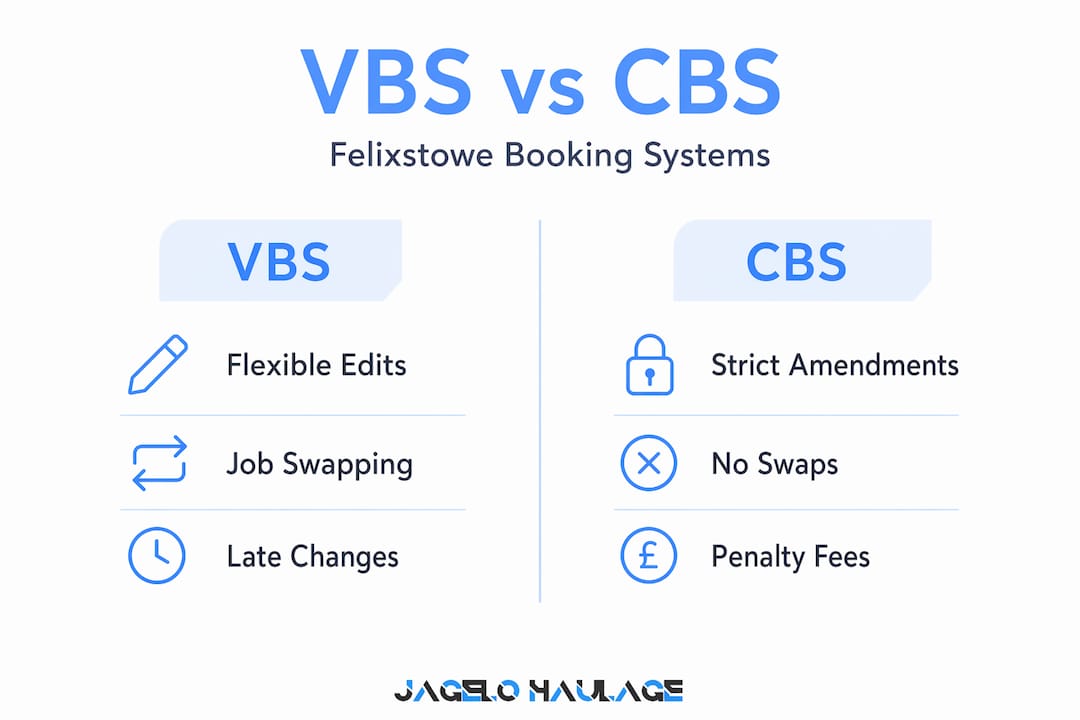
| Feature | Vehicle Booking System (VBS) | Container Booking System (CBS) |
|---|---|---|
| Amendment flexibility | Permitted close to appointment time | Restricted. Charges apply within 12 hours |
| Container swapping | Allowed without charge | Prohibited without penalty |
| Booking verification | Less rigorous | User details verified on every booking |
| No-show charges | Minimal enforcement | Active penalty charges |
| Scheduling approach | Reactive, adaptable | Pre-planned, precision-based |
| Enforcement regime | Lenient | Full charges from February 2025 |
The legacy VBS allowed job swapping and late amendments that CBS explicitly prohibits, and the practical consequence for hauliers is longer dwell times when scheduling is not adapted precisely. Those who have attempted to operate CBS with a VBS mindset have encountered avoidable penalty accumulation and, in some cases, missed collection windows that triggered demurrage charges on their clients’ containers.

The shift represents a move toward greater operational precision at the cost of haulier flexibility, with the stated aim of supporting 24/7 port efficiency. For fleet managers, this means scheduling decisions that once happened reactively on the morning of a job now need to be locked in days in advance.
Pro Tip: Build a weekly scheduling review into your dispatch workflow, specifically to audit pending CBS bookings and identify any slots approaching the 12-hour amendment threshold before penalties become unavoidable.
For hauliers operating across multiple UK ports, the contrast with ports operating less rigid booking systems can be jarring. Felixstowe demands a discipline that rewards pre-planning and penalises improvisation.
Best practices for Felixstowe truck scheduling
Adapting to the Felixstowe truck scheduling environment under CBS is not merely about understanding the rules. It requires embedding new behaviours into your dispatch and fleet management processes. The following practices reflect what experienced operators have found effective since the system went live.
- Finalise bookings by Thursday for Monday slots. Experts recommend locking in appointments early each week to avoid the compounding risk of weekend cargo changes colliding with the 12-hour penalty window on Monday morning.
- Plan driver schedules around CBS slots, not vice versa. The system does not accommodate driver availability changes without cost. Your driver rota must be built to service confirmed bookings, not the other way around.
- Monitor amendment deadlines with calendar alerts. Each confirmed booking should trigger an automated reminder set to fire 14 hours before the slot time, giving dispatchers a two-hour buffer to act before the penalty threshold is crossed.
- Reduce multi-container booking dependencies. Where possible, avoid structuring a single driver’s day around multiple CBS bookings that depend on sequential on-time performance. One delay cascades into the next slot and multiplies penalty exposure.
- Integrate CBS into your fleet management software. CBS requires integration into wider fleet planning tools to avoid the inefficiencies caused by rigid appointment adherence. Technology platforms that offer container yard software with port booking compatibility can significantly reduce manual administration errors.
- Maintain a contingency protocol for driver absence. Since container swapping without charge is no longer possible, a driver falling sick on the morning of a CBS slot requires an immediate replacement driver, not a booking amendment. Ensure your team understands this distinction.
- Account for peak booking demand periods. Slot availability at Felixstowe tightens considerably around bank holidays and during high-volume import seasons. Book further in advance during these periods, and do not assume slots will be available for late addition.
The Felixstowe Truck Stop provides secure overnight parking for drivers who need to position themselves near the port ahead of early-morning CBS slots, which is a practical solution for hauliers managing tight scheduling windows while supporting driver welfare. Planning container storage timing around appointments is equally worth considering for those managing complex multi-leg operations. The overnight container storage guide for Felixstowe outlines current options that align with CBS appointment timing.
My perspective on the CBS transition
I have worked with container haulage operations for long enough to recognise when a systemic change is genuinely necessary versus when it is primarily convenient for one side of the commercial relationship. The CBS transition at Felixstowe sits somewhere in the middle, and I think it is worth being honest about that.
The efficiency case for CBS is real. Wasted journeys cost everyone money, and a terminal that cannot predict vehicle volumes accurately cannot optimise its own resource allocation. I understand why the port moved in this direction. What concerns me more is the pace at which flexibility was withdrawn and the limited recognition of how fundamentally different CBS’s operating model is from what hauliers had built their workflows around.
In my experience, the hauliers who have adapted most successfully are those who treated CBS not as a booking system but as a scheduling discipline. They restructured their dispatch processes from the ground up rather than trying to retrofit CBS into existing VBS habits. That distinction matters enormously in practice.
The future likely involves tighter integration between port booking platforms like CBS and fleet management software, and the logistics sector will benefit when that happens. What I hope the port takes seriously is the driver welfare dimension. Rigid appointment adherence places pressure on drivers that does not always appear in penalty data but absolutely appears in fatigue, retention, and road safety. That conversation needs to stay on the table as port appointment systems evolve.
— Vytautas
How Jhaulage supports CBS compliance at Felixstowe
Managing CBS bookings accurately while maintaining fleet efficiency is not straightforward, particularly for operators handling high volumes at Felixstowe. Jhaulage, trading as Jagelo Haulage Limited, specialises in container haulage at Felixstowe and operates with CBS requirements fully embedded into its dispatch and fleet planning processes.
With a modern fleet of over 40 GPS-tracked trucks and trailers, Jhaulage provides port-to-door container transport with scheduling discipline that CBS demands. Whether you need reliable collection slots managed in advance or same-day contingency support for urgent cargo, the team operates with the precision that Felixstowe’s appointment system requires. For logistics professionals who need a trusted Felixstowe haulage partner aligned with the CBS framework, Jhaulage provides the operational expertise to keep your supply chain moving without penalty exposure.
FAQ
What replaced the Vehicle Booking System at Felixstowe?
The Vehicle Booking System (VBS) was replaced by the Container Booking System (CBS) on 1 January 2025. CBS is a real-time, web-based platform requiring precise advance booking of time slots for container pick-up and delivery.
How much is the penalty for a late CBS amendment?
Any booking amendment made within 12 hours of the scheduled appointment incurs a £35.69 penalty fee. Container number swaps and time changes made inside this window are also subject to the same charge.
When did full CBS enforcement begin at Felixstowe?
Full enforcement of CBS charges, including no-show fees and late notification penalties, became active from 1 February 2025, following a three-month grace period that ran from the system’s January 2025 launch.
How early should I book CBS slots to avoid penalties?
Experienced operators recommend finalising bookings by Thursday for the following Monday’s appointments. This early approach reduces penalty risk from weekend cargo changes or driver schedule disruptions colliding with the 12-hour amendment threshold.
Can I swap container numbers within an existing CBS booking?
No. Unlike the legacy VBS, the CBS does not permit container number swapping without incurring a penalty charge. Operators must treat each booking as fixed once it is within the 12-hour amendment window.
Recommended
- Felixstowe Container Haulage That Keeps Pace | Jagelo Haulage
- How Felixstowe connects to UK motorways: 2026 guide | Jagelo Haulage
- Container Haulage from Felixstowe: A Professional Guide to Port Logistics | Jagelo Haulage
- Reliable Container Haulage from Felixstowe Port: A Strategic Logistics Guide | Jagelo Haulage