Why same day delivery logistics differ for UK shippers

Failed same-day delivery attempts in UK last-mile operations cost £1.6 billion annually, a figure that reveals precisely why same day delivery logistics differ so sharply from conventional freight models. For logistics managers handling container transport across ports like Felixstowe, Tilbury, Southampton, and Liverpool, these differences are not abstract. They translate directly into vehicle availability, driver compliance, demurrage exposure, and urban access restrictions. This guide covers the core operational, cost, and compliance distinctions that separate same day shipping logistics from standard services, and explains what those differences demand from you in practice.
Table of Contents
- How same day delivery logistics differ from standard services
- Key operational challenges unique to same day delivery in the UK
- The impact of vehicle and route requirements on same day container haulage
- Cost implications and scalability limits of same day logistics
- Strategies to optimise same day delivery logistics for container transport
- Rethinking same day logistics: beyond conventional wisdom
- Container haulage solutions tailored for same day delivery
- Frequently asked questions
Key Takeaways
| Point | Details |
|---|---|
| Higher operational costs | Same day delivery costs 2-4 times more than standard due to dedicated vehicle use and no load consolidation. |
| Urban delivery challenges | Congestion, ULEZ fees, and failed deliveries significantly increase complexity and cost in urban same day logistics. |
| Vehicle compliance importance | Dedicated HGVs with GPS and tachograph compliance are essential to meet driver hour regulations in same day container haulage. |
| Limited scalability | Same day delivery scalability is limited to regional routes under 250 miles due to immediate dispatch and regulatory constraints. |
| Optimisation strategies | AI routing, micro-fulfilment hubs, and electric fleets can improve efficiency and reduce costs in same day delivery. |
How same day delivery logistics differ from standard services
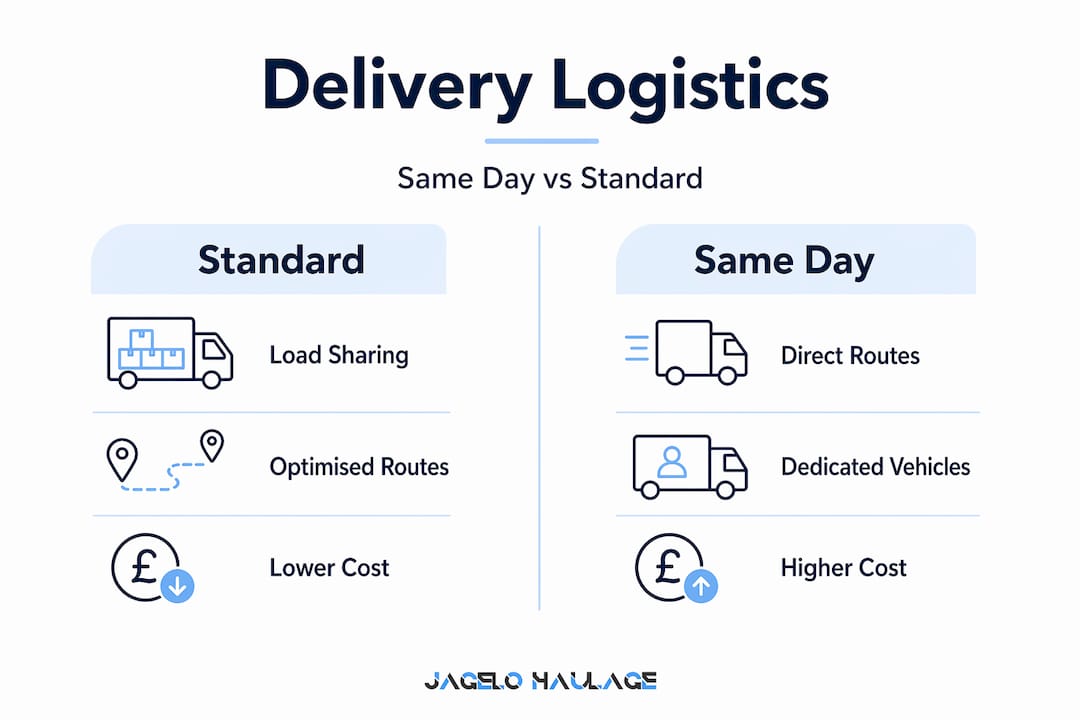
At the most fundamental level, the gap between same day and standard delivery logistics is not simply one of speed. It is a question of network design, vehicle allocation, and cost structure. Standard freight relies on load consolidation, where multiple consignments are batched into a single vehicle to reduce the per-unit cost. Same day delivery eliminates that entirely.
When a container departs a port on a same-day instruction, there is no consolidation depot in the chain. The vehicle is dedicated to that load, the route is direct, and dispatch is immediate. As dedicated vehicle costs run 2 to 4 times higher than standard logistics due to the absence of batching, the financial distinction becomes clear at once. This is not inefficiency. It is the structural cost of guaranteed delivery within a single working day.
Key operational differences at a glance:
- Standard logistics uses multi-stop route optimisation to reduce vehicle miles per unit
- Same day delivery operates on point-to-point routing with no intermediate handling
- Batching in standard services reduces driver time per consignment; same day does not permit this
- Vehicle turnaround time is tighter in same day operations, limiting fleet reuse within a single shift
- Urban congestion charges and Vehicle Booking System (VBS) slots at ports add compliance layers unique to same day
| Factor | Standard logistics | Same day logistics |
|---|---|---|
| Load consolidation | Yes, multi-consignment | No, dedicated per consignment |
| Routing model | Multi-stop optimisation | Direct, point-to-point |
| Cost per delivery | Lower due to batching | 2 to 4 times higher |
| Driver hours flexibility | Higher, due to staged runs | Restricted, immediate dispatch |
| Urban charge exposure | Mitigated by off-peak scheduling | High, due to time-critical windows |
| Depot handling | Multiple handovers | Eliminated |
Understanding these operational differences in urban logistics helps clarify why the two service types cannot simply be merged or treated as variations on the same model. For container freight specifically, the absence of depot handovers is both an advantage and a constraint, reducing damage risk whilst simultaneously demanding greater pre-planning. You can explore further container haulage insights on how these distinctions play out across UK port corridors.
Key operational challenges unique to same day delivery in the UK
With the foundational differences established, the specific hurdles facing logistics managers in UK cities come into sharper focus. The challenges of same day logistics go well beyond route planning. They include regulatory compliance, failed delivery penalties, and the physical limitations of dense urban environments.
London presents the clearest example. Delivery vehicles average 7.6 mph in central London, a figure that makes same-day delivery windows extraordinarily difficult to maintain without micro-fulfilment centres positioned within or adjacent to the congestion zone. The Ultra Low Emission Zone (ULEZ) compounds this by adding a daily charge of £12.50 for non-compliant vehicles, a cost that accumulates rapidly across a fleet operating multiple same-day runs.
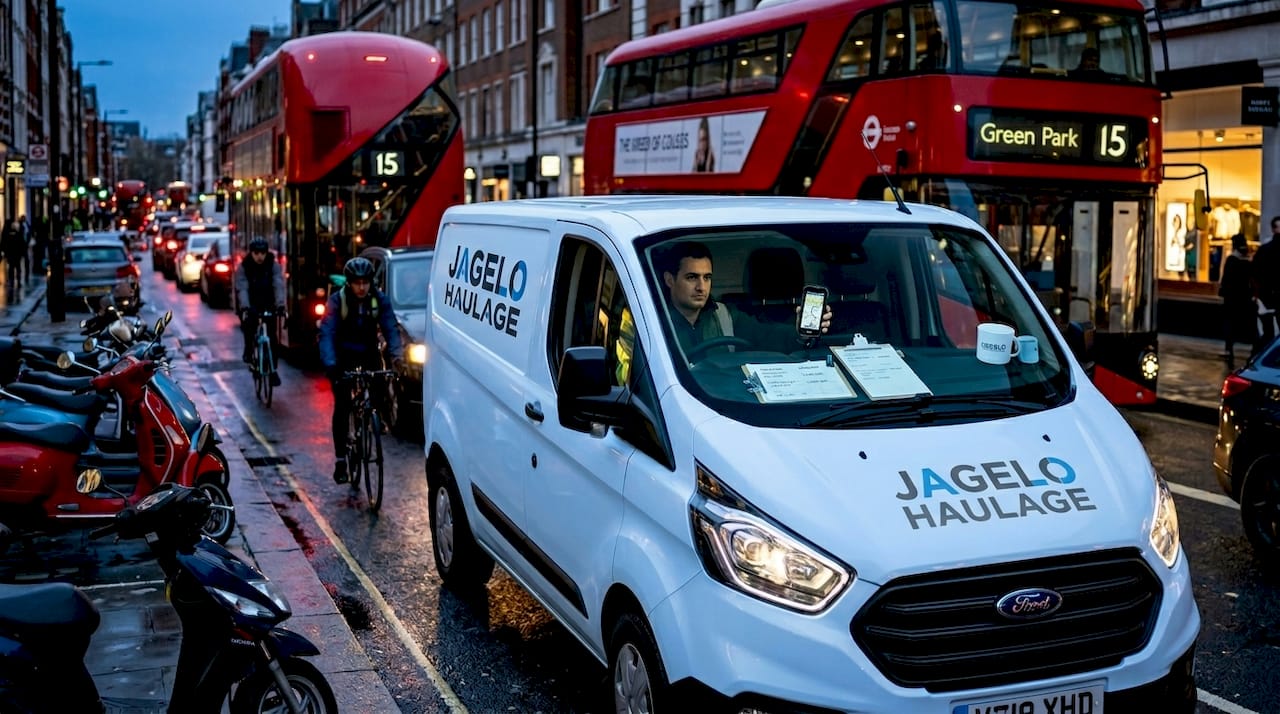
Failed delivery attempts are a particularly acute problem in same day operations. Failed attempts are 37% higher in same day services compared to standard delivery, precisely because compressed timelines leave no retry buffer. In standard freight, a rescheduled delivery the following morning is an operational inconvenience. In same day, it is a contractual failure with associated penalties.
Primary operational challenges in UK same day logistics:
- ULEZ and Congestion Charge zones in London and other cities raising daily operating costs
- Compressed delivery windows with no allowance for second-attempt rescheduling
- Driver Working Time Regulations (WTR) limiting hours, which constrains dispatch flexibility
- Vehicle Booking System (VBS) slots at major container ports that cannot always align with same-day cutoff times
- Emission compliance requirements for Heavy Goods Vehicles (HGVs) entering Clean Air Zones (CAZ)
- Limited availability of suitable micro-fulfilment centre locations near UK urban cores
Industry note: Cargo bikes and electric vans are gaining traction in central London for container content redistribution, but for full container load (FCL) movements, HGV access remains non-negotiable and compliance planning must begin well before dispatch.
Pro Tip: If your delivery zones include any of the UK’s 12 active Clean Air Zones, build a daily compliance cost model that includes ULEZ, CAZ, and Congestion Charge exposure for each vehicle in your same day fleet. Running this as a background calculation within your Transport Management System (TMS) prevents cost surprises at month-end. For a deeper breakdown of last-mile delivery challenges, the operational data across UK corridors is instructive.
The impact of vehicle and route requirements on same day container haulage
Building on those operational challenges, the vehicle and routing decisions that underpin same day container haulage deserve specific attention. The requirements here are markedly more prescriptive than in standard freight, and non-compliance carries direct financial and legal exposure.
Same-day container haulage requires pre-booked HGVs and 7.5 tonne trucks equipped with TMS and GPS for tachograph compliance. In standard haulage, driver hour management is often handled loosely across extended multi-day runs. In same day operations, a vehicle dispatched at 06:00 and expected to complete a delivery by 16:00 has an unforgiving tachograph timeline that must be mapped in full before the keys leave the depot.
The route planning process for same day container freight follows a distinct logic:
- Pre-clear customs documentation before the container is released at port to eliminate any hold that would breach the same-day window
- Pre-book the dedicated vehicle using a confirmed VBS slot, aligned with the port’s daily cutoff and the client’s delivery window
- Map the direct route avoiding consolidation depots entirely, and identify Clean Air Zone boundaries the vehicle must traverse
- Confirm driver eligibility under WTR before dispatch, ensuring available hours cover the full round trip including loading and unloading dwell time
- Activate GPS and TMS monitoring at point of departure to enable real-time tachograph tracking throughout the journey
- Schedule demurrage avoidance by confirming that the container is collected and delivered within the port’s free period, typically 3 to 5 days depending on the terminal
Pro Tip: Demurrage charges at ports such as Felixstowe can reach £150 to £300 per container per day beyond the free period. On a same-day operation, even a two-hour delay caused by an unchecked customs hold can push collection past the cutoff, triggering an overnight charge. Treat customs clearance as a pre-condition, not a concurrent task. Review container haulage operational factors relevant to UK port corridors for terminal-specific guidance.
Cost implications and scalability limits of same day logistics
After examining vehicle and route factors, the cost structure and scalability ceiling of same day delivery becomes the central concern for any logistics manager weighing service expansion. The economics are unambiguous and the constraints are geographic.
| Cost driver | Standard logistics | Same day logistics |
|---|---|---|
| Vehicle utilisation | High, multi-consignment | Low, single dedicated run |
| Urban surcharges | Minimised via off-peak scheduling | Unavoidable within time windows |
| Driver hour efficiency | High | Low, single direct run |
| Failed delivery penalty | Low, retry available | High, contractual breach |
| Demurrage risk | Managed across batches | Acute per individual container |
Same-day delivery costs 2 to 4 times more per consignment than standard logistics, and scalability is effectively bounded at regional routes under 250 miles due to immediate dispatch and driver hour restrictions. Beyond that radius, the driver runs out of legal working hours before the delivery window closes.
Urban cost inflation compounds the base premium. ULEZ non-compliance adds 15 to 20% to urban operating costs relative to standard logistics that can schedule off-peak movements. A same-day delivery into central London cannot simply be rescheduled to 03:00 to avoid the charge; the client’s window dictates the timing.
Practical approaches to manage same day cost exposure:
- Position micro-fulfilment hubs within or adjacent to high-frequency delivery zones to reduce zone entries per vehicle
- Schedule same-day runs to begin as early as operationally feasible, reducing peak congestion exposure
- Use Euro 6 compliant HGVs across the entire same-day fleet to eliminate ULEZ and CAZ charges at source
- Model per-route cost including all surcharges before quoting clients on same-day contracts
- Consider hybrid models where the HGV delivers to an urban transfer hub and e-cargo bikes complete the final mile for smaller container content distributions
Pro Tip: When comparing delivery service options for a new contract corridor, build a full cost-per-kilometre model that separates vehicle cost, driver time, fuel, and urban charges as individual line items. This reveals the true margin difference between same-day and standard services, and identifies where volume can genuinely justify the premium. Explore how container haulage services are structured to manage these cost drivers across UK port routes.
Strategies to optimise same day delivery logistics for container transport
Having examined cost challenges, the focus shifts to practical methods that logistics managers can apply to improve outcomes in same day container delivery across UK urban and regional corridors.
- Deploy AI-driven route planning that adjusts dynamically to real-time traffic, road closures, and Clean Air Zone boundary changes. AI routing reduces delivery time by 12 to 18% and cuts failed delivery rates through live optimisation rather than static pre-planned routes.
- Establish micro-fulfilment centres near major urban delivery zones, reducing the number of times an HGV must enter a congestion or ULEZ zone per consignment.
- Transition fleet to Euro 6 or zero-emission vehicles ahead of regulatory deadlines to avoid Clean Air Zone charges that disproportionately affect time-critical same-day operations.
- Integrate last-mile transfer hubs where full container load freight is broken down for e-cargo bike distribution in dense city centre zones, maintaining the same-day commitment without HGV urban access issues.
- Pre-book dedicated HGVs with GPS and TMS active from the moment the port releases the container, ensuring tachograph data is live and driver hour calculations begin accurately.
- Align customs clearance and VBS slot booking with the specific cutoff times of your target port, whether Felixstowe, Tilbury, Southampton, or Liverpool, to eliminate the single most common cause of same-day window failure.
Pro Tip: Run a monthly audit of your same-day delivery success rate by corridor, separating urban from regional routes. This quickly identifies which zones are consistently causing window failures and whether the root cause is vehicle compliance, route design, or port-side documentation. Reliable logistics optimisation techniques for container freight are built on that granular corridor-level data.
Rethinking same day logistics: beyond conventional wisdom
There is a persistent assumption in the UK logistics sector that same day delivery is simply standard freight done faster. It is worth challenging that directly, because the assumption leads to structural decisions that consistently underperform.
Same day logistics is not an accelerated version of an existing network. It is a fundamentally different network design, one that eliminates sorting facilities, removes depot handovers, and places the entire operational burden on a single vehicle and driver completing a direct run. That design choice is not just about speed. Dedicated same-day delivery reduces loss risk by eliminating the sorting errors that occur in standard multi-depot networks, a distinction that is particularly significant for container shipments carrying high-value or time-sensitive cargo.
The implication for container transport is that the cost premium of same day is not simply a fee for urgency. It is a payment for integrity of custody, reduced handling, and a direct chain of accountability between port gate and delivery point. Framed that way, the 2 to 4 times cost differential looks considerably more reasonable when weighed against the liability and reputational cost of damaged or misdirected containers.
Environmental and urban regulatory pressure is also reshaping what same day logistics can actually look like in practice. The combination of ULEZ, Clean Air Zones, and the innovations in same day delivery emerging from multimodal approaches means that the HGV-only model is being supplanted by hybrid chains that hand freight from articulated trucks to electric vans to cargo bikes across a single same-day window. For logistics managers, this is not optional experimentation. It is the direction that urban access regulations are forcing the industry toward.
Technology adoption in this context is not about efficiency gains alone. It is about compliance, risk control, and maintaining the legal right to operate within the urban zones where your clients actually need their containers delivered.
Container haulage solutions tailored for same day delivery
The operational and cost complexities covered in this article are precisely the challenges that Jagelo Haulage Limited is built to address.
We operate a fleet of over 40 GPS-tracked trucks and trailers across UK ports including Felixstowe, Tilbury, Southampton, and Liverpool, providing dedicated same-day container haulage that covers every compliance requirement from tachograph monitoring to customs pre-clearance. Our TMS-integrated operations ensure driver hours are mapped before dispatch, VBS slots are confirmed in advance, and clients receive real-time updates throughout the delivery window. If you manage container freight and need a container haulage specialist with proven same-day capabilities, contact us directly for a route-specific assessment. All engagements are governed by our terms of service and our commitment to data protection is outlined in our privacy policy.
Frequently asked questions
Why does same day delivery cost more than standard logistics?
Same day delivery requires dedicated vehicles, immediate dispatch, and direct routing with no load consolidation, which means costs run 2 to 4 times higher than standard logistics where batching reduces the per-unit vehicle expense.
How do congestion and ULEZ charges affect same day delivery in London?
Non-compliant vehicles face the daily £12.50 ULEZ charge and a £15 Congestion Charge, with ULEZ non-compliance adding 15 to 20% to urban operating costs compared to standard logistics that can use off-peak scheduling to avoid these fees.
What vehicle compliance is needed for same day container haulage?
Pre-booked dedicated HGVs or 7.5 tonne trucks with active GPS and TMS are required to maintain tachograph compliance and ensure driver Working Time Regulations are not breached during immediate dispatch operations.
How can logistics managers reduce failed delivery attempts in same day logistics?
AI routing reduces failed delivery rates through dynamic real-time optimisation, and combining this with micro-fulfilment centres and scheduled delivery windows significantly improves first-time delivery success in compressed same-day timelines.
What limits the scalability of same day delivery for container transport?
Scalability is bounded at routes under 250 miles due to driver hour restrictions under Working Time Regulations, immediate dispatch requirements, and the absence of load consolidation, all of which confine same-day container movements to regional corridors.